
Unbiased headlines. Facts, not spin.
Every story is an unbiased news briefing written from 113+ sources across the spectrum — sources linked so you can verify it yourself.
 defense
Major Story (7/10)
Event date: July 26, 2026
defense
Major Story (7/10)
Event date: July 26, 2026
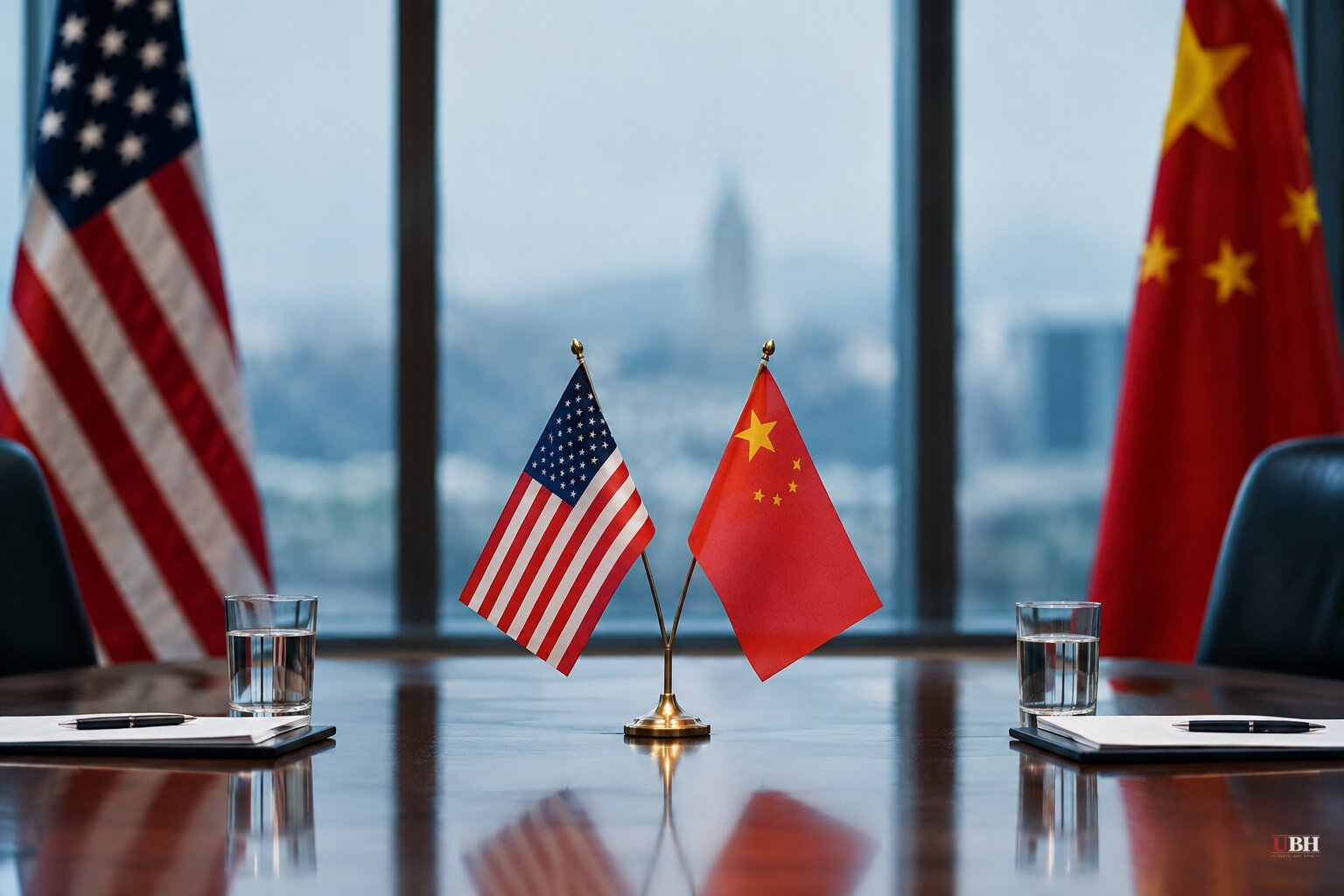
US and China Hold Quiet Nuclear Talks Over Alleged 2020 Secret Test as Senators Press Trump on Stalled Taiwan Arms
A quiet dispute that won't resolve
Since U.S. and Chinese officials began meeting on the margins of multilateral gatherings in Geneva, New York, and Casablanca earlier this year, the two governments have failed to bridge a basic disagreement: whether China secretly tested a nuclear weapon in 2020, according to people familiar with the matter cited by the Wall Street Journal and reported by Newsquawk and ROIC.ai. The talks are described as fragile, focused on reducing nuclear risk rather than setting formal limits, and expected to continue next month.
The dispute centers on a magnitude-2.75 seismic event recorded on June 22, 2020, by a Kazakhstan-based monitoring station near China's Lop Nur test site, according to U.S. officials cited by ROIC.ai. Washington assesses it was a single underground explosion, not an earthquake or mining activity, and suspects China used a technique called "decoupling," detonating explosives in a large underground cavity to muffle the seismic signature and dodge test-ban monitoring.
The international monitoring network run by the CTBTO recorded two very small events 12 seconds apart but says its data cannot confirm what caused them. Its system is built to reliably catch explosions of roughly 500 tons of TNT equivalent or higher; the alleged event was far smaller. That means the CTBTO's failure to confirm a test does not prove one didn't happen, but the publicly available data also does not independently settle the U.S. allegation.
Beijing rejects the accusation outright. Chinese Ambassador Shen Jian called it unfounded and said the United States "is the culprit for the aggravation of the arms race," arguing Washington is "hyping up the so-called China nuclear threat" to manufacture a rationale for resuming its own testing, according to Daily Wire. U.S. Under Secretary of State for Arms Control Thomas DiNanno countered earlier this year that China "sought to conceal testing by obfuscating the nuclear explosions because it recognized these tests violate test ban commitments."
Satellite images and a growing arsenal
Satellite analysis published by the Telegraph and reported by Daily Wire found active construction at seven Chinese nuclear-linked sites: Pingtong, Zitong, Lop Nur, Jiuquan, Mianyang, Jinta, and Guangyuan. Villages and farmland have reportedly been cleared for a facility where Chinese scientists use high-powered lasers to study how materials react to nuclear detonations.
Estimates of China's actual warhead count vary by source and date. Daily Wire puts China's current total around 600, behind Russia's roughly 5,500 and the U.S.'s roughly 5,300. SIPRI figures cited by ROIC.ai put China's stockpile at about 600 warheads in January 2025, rising to about 620 by January 2026. Both figures agree China trails the two larger nuclear powers by a wide margin, but U.S. officials say China is modernizing and expanding its arsenal faster than any other nuclear state, with government projections showing continued growth in the years ahead. China maintains a declared no-first-use policy, meaning it has pledged never to strike first with a nuclear weapon.
Washington is pushing for stronger verification measures, more transparency, and advance notice of ballistic-missile tests. Beijing has resisted, calling the proposals one-sided and politically motivated, according to ROIC.ai.
Taiwan arms sales caught in the middle
The nuclear friction is unfolding alongside a separate fight over Taiwan. In a Sept. 23 letter to Secretary of State Marco Rubio and War Secretary Pete Hegseth, Sens. Mitch McConnell, John Cornyn, Lisa Murkowski, and Thom Tillis pressed the administration on why three forms of Taiwan security support remain stalled: $300 million in already-appropriated foreign military financing, $1 billion for the Taiwan Security Cooperation Initiative, and a pending $14 billion arms package, according to the Epoch Times.
A day earlier, Tillis and Democratic Sen. Elissa Slotkin, co-chairs of the Senate Taiwan Caucus, sent Trump a separate letter urging him to formally notify Congress of the $14 billion package, which has been pending since Trump's May meeting with Xi in Beijing. The senators noted Taiwan would pay for the weapons itself and has approved a $25 billion defense supplemental to cover the purchase. "Taiwan is also not asking for a handout," they wrote. "They want to spend $14 billion to purchase U.S. arms to defend themselves."
The bipartisan group also raised a pointed concern: "We are concerned by President Trump's description of Taiwan as 'a very good negotiating chip' in engagements with Xi Jinping and the Chinese Communist Party," they wrote, arguing Taiwan arms sales should never be a bargaining chip with Beijing.
Rubio, speaking to reporters in New York on Sept. 23, said the administration applies the same review to every foreign military sale, weighing what the U.S. keeps in its own stockpiles against how fast weapons sold abroad can be replaced. "If we sell you something, we don't have it anymore," he said, adding the calculation depends on the specific weapons, existing inventories, and replenishment timelines. He did not address the senators' specific claim that the review has stretched on for months without resolution.
Unresolved questions
Neither the nuclear-test allegation nor the Taiwan arms delay has a firm resolution date. The next round of U.S.-China nuclear talks is expected next month, according to ROIC.ai, but with Washington and Beijing still disagreeing on the basic facts of the 2020 event, a breakthrough isn't imminent. On Taiwan, four Republican senators and two Taiwan Caucus co-chairs from both parties are now on record demanding answers Rubio and Hegseth have not yet given.
Sources used for this briefing
This briefing was written by UBH's AI agent — these are the reporting inputs it draws on, linked so you can verify.


