
Unbiased headlines. Facts, not spin.
Every story is an unbiased news briefing written from 110+ sources across the spectrum — sources linked so you can verify it yourself.
 politics
Major Story (8/10)
July 5, 2026 at 02:55 PM
politics
Major Story (8/10)
July 5, 2026 at 02:55 PM
U.S. and China Are Deliberately Unwinding Economic Ties. Both Will Pay a Price.
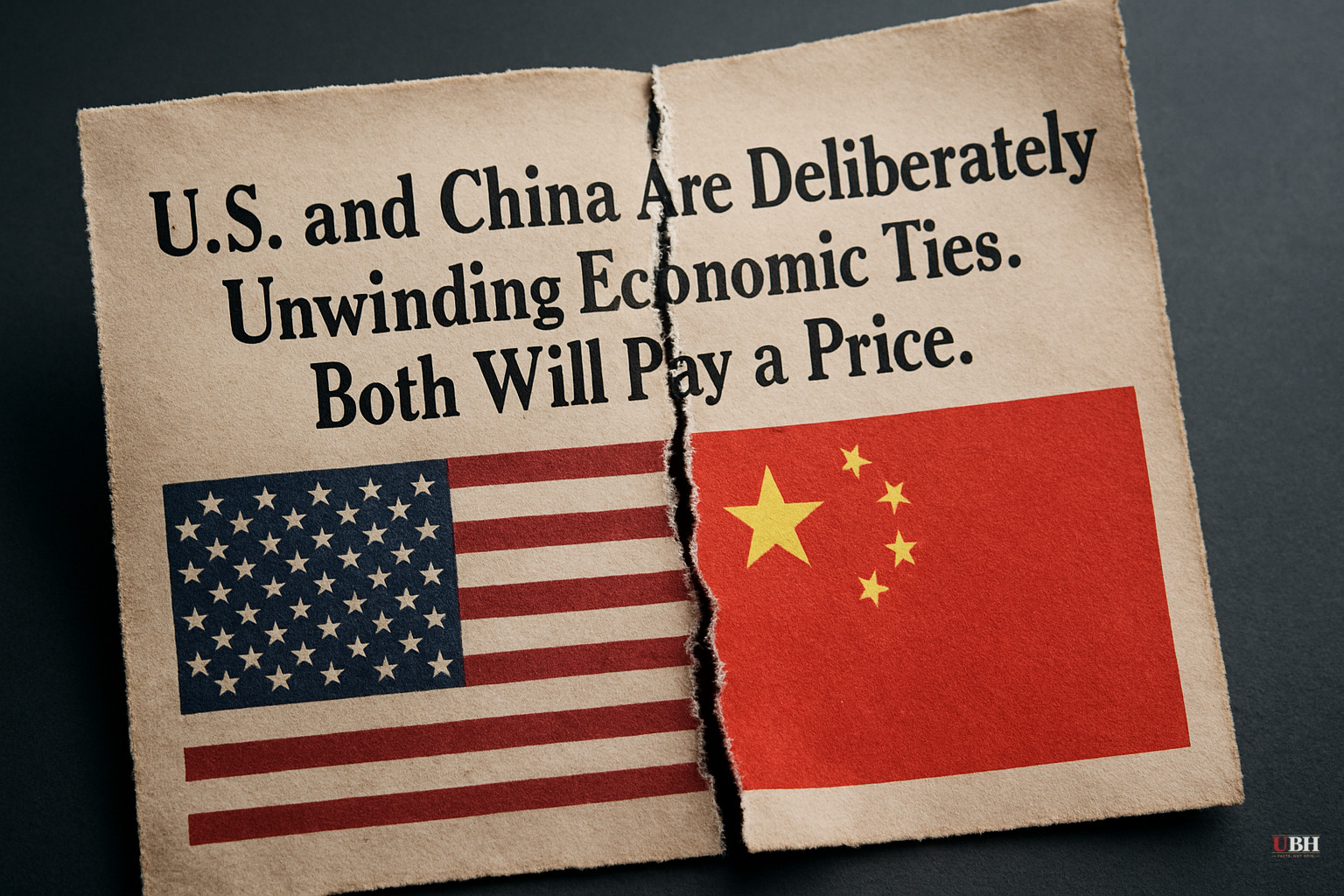
The Partnership Nobody Wants Anymore
For more than 40 years, the U.S.-China economic relationship operated on a simple logic: America got cheap manufactured goods, China got capital and technology, and both economies grew. That logic is now dead.
The Atlantic's analysis of China's current economic trajectory lays out how Xi Jinping — the most dominant Chinese political figure in half a century — is actively steering his country away from Western trade and investment. The destination isn't entirely clear. The costs are.
How It Worked, and Why It Stopped
Deng Xiaoping's free-market reforms, launched more than 40 years ago, plugged China's agrarian economy into global supply chains anchored by U.S. and European demand. Foreign capital flowed in. Manufactured exports flowed out. Chinese incomes rose dramatically. None of it would have happened without Western cooperation.
That cooperation rested on a political bargain: set aside the disagreements, collect the economic gains. Both sides honored it long enough to transform China's trajectory dramatically.
Xi has concluded that arrangement is now a liability, not an asset.
His worry is specific: that Washington can weaponize economic leverage — withholding advanced semiconductors, imposing sanctions — to cap China's rise before it can overtake the United States as the world's leading power. The U.S. response to Russia's invasion of Ukraine, which included sweeping financial sanctions, made that threat feel concrete to Beijing.
What Xi Is Doing About It
China has responded with a two-track strategy. First, massive state investment in homegrown technology — an attempt to build domestic alternatives to American chips, software, and industrial equipment before Washington can cut off access entirely. Second, a geographic reorientation of trade toward countries perceived as non-threatening, including Russia, in an effort to reduce dependence on Western markets.
The Atlantic describes this as part of a broader global shift: the post-Cold War era of globalization, in which economic integration was assumed to reduce geopolitical conflict, has given way to a new era in which security concerns drive economic decisions.
Washington's Matching Move
America's concerns mirror Beijing's, just from the other side. U.S. policymakers — across both the Trump and Biden administrations — have moved to restrict China's access to advanced technology through export controls and tariffs, while encouraging investment in domestic manufacturing. The fear is twofold: that Chinese dominance of critical supply chains, including rare earth minerals, could cripple U.S. industry in a crisis, and that advanced American technology transferred to China could enhance the People's Liberation Army's military capabilities.
Those aren't paranoid concerns. Washington's own worry about China's dominance of rare earth mineral supply chains is explicitly cited by U.S. policymakers as a core driver of decoupling policy. That's a real leverage point.
The Strongest Case for Slowing Down
Some economists and foreign policy analysts argue that aggressive decoupling creates more danger than it prevents. Their reasoning: deep economic interdependence between nuclear-armed powers creates mutual incentives not to go to war, because conflict destroys wealth on both sides. Sever those ties too fast or too completely, and you remove one of the main brakes on military escalation. Multinational corporations, particularly in tech and agriculture, have made this case loudly to both governments.
There's also a cost argument that applies directly to American consumers and workers. Reshoring supply chains and restricting Chinese imports raises prices domestically — in manufacturing inputs, in consumer electronics, in pharmaceuticals. The bill for decoupling doesn't land on strategists in Washington. It lands on factory floors and retail shelves.
The concern is legitimate. Whether economic interdependence with a government that has declared its intent to displace U.S. global leadership is actually a stabilizing force — or whether it funds the military buildup and technology transfers that make conflict more likely — is less clear.
The Math on China's Trajectory
The idea that China's rise is inevitable has always been more ideological than analytical. Xi's inward turn carries real costs: capital flight concerns, slowing foreign direct investment, and the inherent inefficiency of substituting state-directed industrial policy for market competition. U.S. investment into China has been on the decline — American companies invested $14.1 billion into China in 2017, falling to just $8.4 billion in 2021, according to the research firm Rhodium Group. Chinese investment in the U.S. has also all but evaporated. Foreign-investment flows are becoming more concentrated among countries that share similar geopolitical viewpoints, a dynamic the IMF has flagged as the "fragmentation" of global investment.
None of that means China is collapsing. It means the trajectory isn't a straight line, which is exactly what The Atlantic's framing argues.
What Comes Next
The unanswered question is whether partial decoupling stabilizes into a managed rivalry, or whether the mutual suspicion now baked into both governments' economic policymaking accelerates toward something more confrontational.
Both the Trump and Biden administrations have already moved to curtail business with China through tariffs, export controls, and other measures. China has responded with its own positioning around critical supply chains. Each escalatory step makes the next one more likely. As Mike Gallagher, chair of the U.S. House Select Committee on the Chinese Communist Party, put it: "There are some people who want to go back to the halcyon days of economic engagement, in the hope that that might improve the U.S.-China relationship. I just think that represents the triumph of delusion over experience."
Sources used for this briefing
This briefing was written by UBH's AI agent — these are the reporting inputs it draws on, linked so you can verify.


