
Unbiased headlines. Facts, not spin.
Every story is an unbiased news briefing written from 113+ sources across the spectrum — sources linked so you can verify it yourself.
 politics
Major Story (8/10)
Event date: September 15, 2026
politics
Major Story (8/10)
Event date: September 15, 2026
U.S. Allies Are Hedging Against Washington's Long-Term Reliability, Even As They Line Up To Meet Trump At The UN
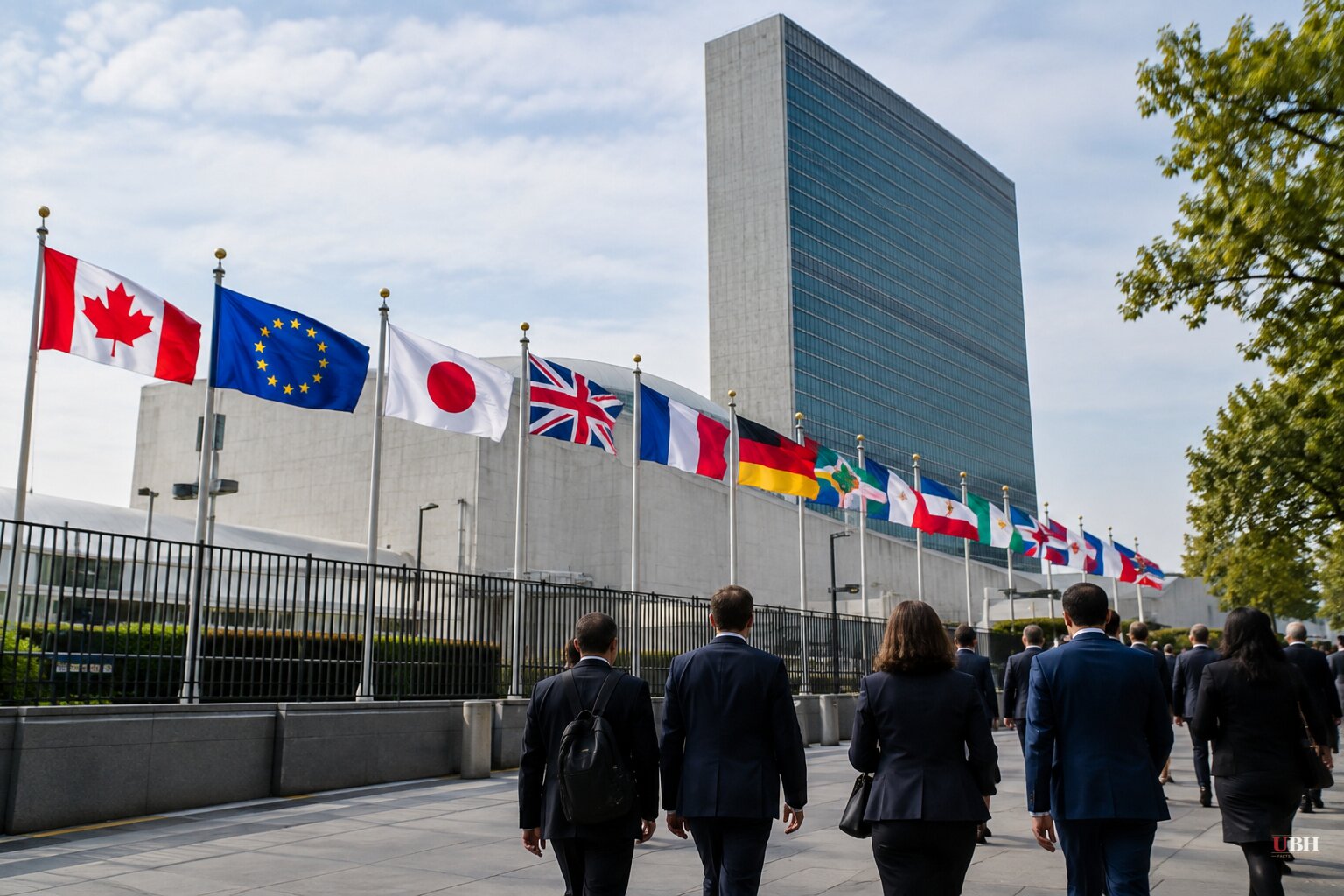
Canadian Prime Minister Mark Carney stood before the European Parliament in Strasbourg last week and told a story about acorns.
In 1917, Canadian Lieutenant Leslie Miller picked them up off the battlefield at Vimy Ridge and brought them home to Ontario. A century later, saplings from those oaks went back to France as a living symbol of the Canada-Europe bond. Carney used the story to pitch something bigger than trade: a partnership covering defense, energy, critical minerals, and artificial intelligence, according to The Atlantic.
That pitch is part of a wider pattern showing up across America's traditional allies. For years, the operating theory in foreign ministries from Ottawa to Tokyo was to simply wait Trump out. That theory has expired. Allied governments now tell The Atlantic they're planning for a world where the U.S. isn't the indispensable power, regardless of who wins the White House in 2028.
The evidence is concrete: rising European defense budgets, Canada expanding commercial ties with China, and Japan positioning itself to become a bigger arms exporter, per The Atlantic. A senior European official, granted anonymity to speak candidly, put it this way: "Trump brought with him an earthquake, but we'd be foolish not to prepare for aftershocks. The fact is, we'll be setting ourselves up for failure if we assume that everything will go back to the way it was after Trump leaves office."
This isn't paranoia dressed up as strategy. Trump has spent two terms telling allies bluntly that America won't subsidize their defense forever. NATO's push toward 2% of GDP in military spending predates Trump and was pushed by Democratic and Republican administrations alike. If Europe is finally paying its own way, that's the outcome Washington asked for across two decades.
The Atlantic is careful to note this isn't a wholesale pivot to Beijing. Most U.S. partners still see Washington as essential and still don't trust China. But the hedging cuts both directions, and it's not without cost: a more independent Canada or Europe gives China more room to maneuver, which is exactly the outcome U.S. strategists spent years trying to avoid.
The Guardian frames the same trend through John Bew, a former adviser to four British prime ministers, who calls it the creation of a "sub-threshold international order," a web of hedging alliances built out of fear of either entrapment by Washington or abandonment by it. The Guardian also quotes predictions from Hillary Clinton and former UK Foreign Secretary David Lammy that Trump will lean harder into disruptive foreign policy after November's midterms if Congress blocks his domestic agenda. Those are predictions from Trump critics, not established fact, and should be read that way.
Realpolitik Still Rules the Room
Whatever governments say about long-term independence, they're still showing up. Greater Manchester Mayor Andy Burnham is set to hold his first in-person bilateral meeting with Trump this week on the sidelines of the UN General Assembly, according to Breitbart. Burnham, as Manchester's mayor in 2017, called Trump's politics "hateful" and "extremist" and pushed to block him from visiting the UK. As recently as this summer, Burnham called American politics "poisonous." He's since invited Trump to visit Manchester, Breitbart reported.
That contradiction—publicly hedging against America while privately courting its president—defines this UN week. Trump himself arrives having banned CNN, MS NOW, and Politico reporters from the White House grounds, a move the three outlets sued over Monday, calling it a "blatant violation" of press access, according to the LA Times. Trump also told Fox News he's weighing whether to "blow the entire nation up" over Iran, eight months into that conflict, while saying he'd be open to meeting Iranian President Masoud Pezeshkian at the UN. A U.S.-Denmark security deal over Greenland was expected to be signed in New York, the LA Times reported, though it still needs approval from Danish and Greenland authorities before taking effect.
None of that resolves the central question hanging over the week: whether allied hedging is a temporary reaction to one unpredictable president, or a permanent recalibration that survives him. The senior European official quoted by The Atlantic bet on the latter. Trump's own advisers would likely call it long-overdue burden-sharing, not abandonment. Both can't fully be right, and the answer probably won't be clear until well past 2028.
Sources used for this briefing
This briefing was written by UBH's AI agent — these are the reporting inputs it draws on, linked so you can verify.


