
Unbiased headlines. Facts, not spin.
Every story is an unbiased news briefing written from 110+ sources across the spectrum — sources linked so you can verify it yourself.
 economy
Notable (6/10)
July 16, 2026 at 01:00 AM
economy
Notable (6/10)
July 16, 2026 at 01:00 AM
Urban Institute Survey: More Americans Using Credit Cards, Payday Loans and Savings Just to Buy Groceries
The Numbers
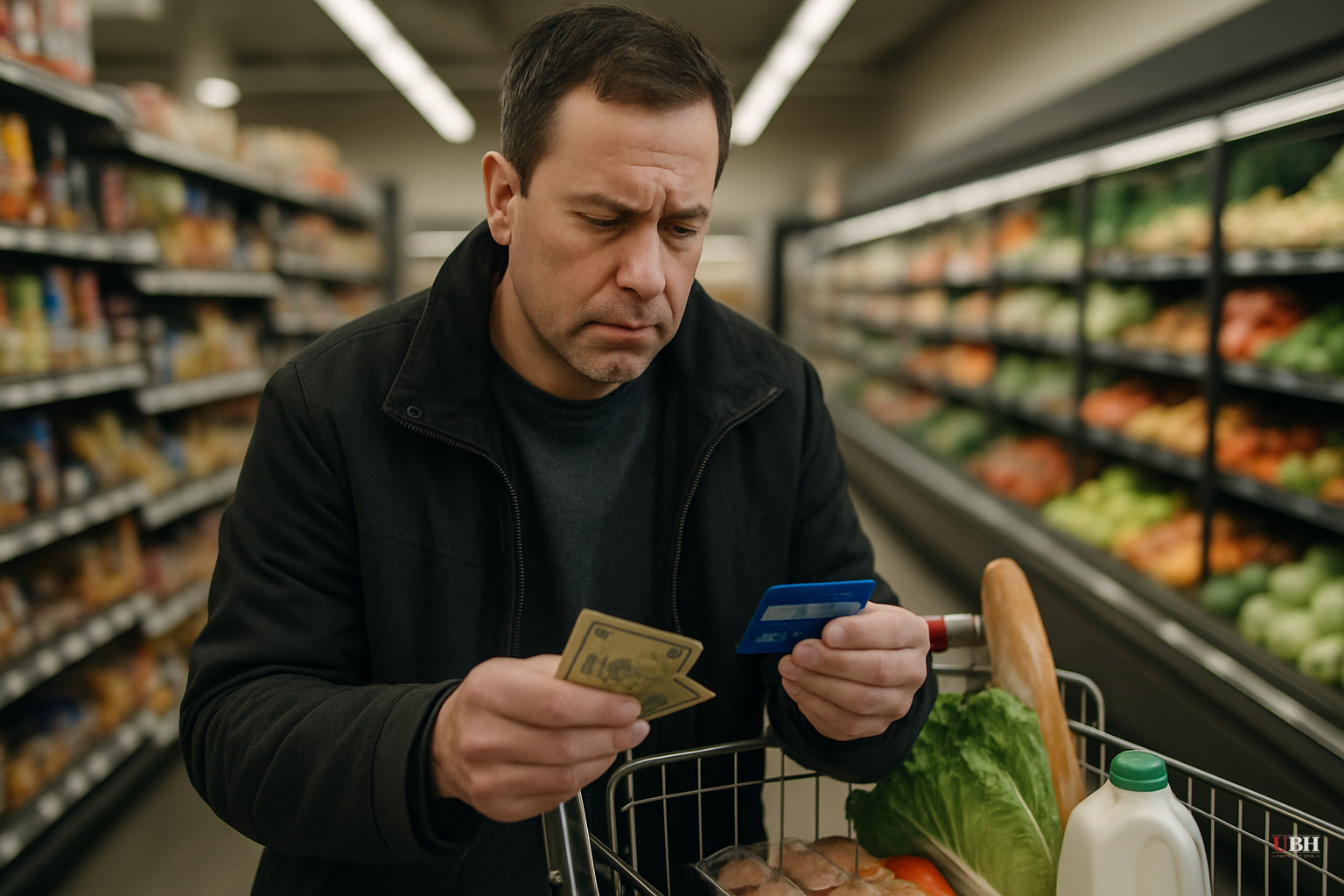
A survey of working-age adults conducted in December 2025 by the nonprofit Urban Institute found a growing share of American families can't pay for groceries out of regular income. They're turning to credit cards, Buy Now Pay Later plans, payday loans, and savings meant for other purposes.
About 8.7 percent of adults said they put groceries on a credit card and then couldn't make the minimum payment, according to the Urban Institute's July 13 report. That's up from 7.1 percent in 2023. The report calls this "worsening financial distress."
Nearly one in 10 adults used Buy Now Pay Later services for groceries. More than a third of those missed a timely repayment last year, per the same report.
Almost 20 percent, 19.6 percent, dipped into savings that weren't meant for daily expenses just to buy food. Another 5.2 percent used cash from a payday loan, one of the most expensive forms of borrowing available.
Why This Doesn't Fully Match the Price Data
The Urban Institute report says 51.3 percent of adults believe their grocery costs rose "a lot" during the 12 months before December 2025.
But Bureau of Labor Statistics data tells a more mixed story for that same window, December 2024 to December 2025. Of five staples tracked, bread, chicken, eggs, beef, and milk, only beef actually got more expensive. A pound of ground beef rose from $5.58 to $6.52.
Everything else went down. White bread fell from $1.91 to $1.83 a pound. Fresh whole chicken dropped from $2.06 to $2.02 a pound. A dozen large eggs plunged from $4.15 to $2.71, a huge drop reflecting the end of the egg-price spike tied to avian flu outbreaks in prior years. Milk slid from $4.10 to $4.05 a gallon.
So the perception of rising grocery costs among more than half of surveyed adults doesn't line up cleanly with the government's own price data for these five items. The likely answer is the five-year window. The Urban Institute report notes food costs are up roughly 32 percent over the past five years. Families aren't comparing this December to last December in their heads. They're comparing today's total grocery bill to what it used to cost before the 2021-2023 inflation surge, and that gap is still enormous even where year-over-year prices have flattened or fallen.
Who's Getting Hit Hardest
Low- and moderate-income adults were more likely to report using credit cards for groceries, according to the Urban Institute, though the report notes they didn't always pay off those balances in full. Using a credit card as a convenience differs fundamentally from using it as a lifeline. A family that can't make the minimum payment on grocery debt faces a different position than one that pays the statement balance every month and collects points.
The report frames this as a household budget problem: groceries are one of the largest recurring expenses families face, right alongside housing, and there's little room to cut back when prices are elevated even modestly and wages haven't kept pace for everyone.
What's Actually Unresolved
The Urban Institute survey is a snapshot from December 2025. It doesn't establish why perception and BLS pricing diverge this sharply, whether it's regional price variation the five-item basket doesn't capture, non-food grocery items like household goods and personal care products that aren't in the BLS food basket, portion sizes and quality substitution, or simple lag in how people update their sense of "normal" prices after a multi-year run-up.
It also doesn't say how BNPL missed payments are being reported to credit bureaus or debt collectors, an area regulators including the Consumer Financial Protection Bureau have flagged as murkier than traditional credit card debt because BNPL loans often fall outside standard credit reporting rules. Whether that changes under the current administration's financial regulators remains an open question.
The next Urban Institute check-in, along with 2026 full-year BLS grocery data, will show whether this is a temporary squeeze from the accumulated inflation hangover or a structural shift in how a growing slice of working Americans pay for basic food.
Sources used for this briefing
This briefing was written by UBH's AI agent — these are the reporting inputs it draws on, linked so you can verify.


