
Original briefings. Zero spin.
Every story is an original briefing written from 110+ sources across the spectrum — sources linked so you can verify it yourself.
 tech
Major Story (7/10)
Event date: August 12, 2026
tech
Major Story (7/10)
Event date: August 12, 2026
University of Pittsburgh Study: AI Layoffs Are Tanking the Productivity Gains Companies Promised Investors
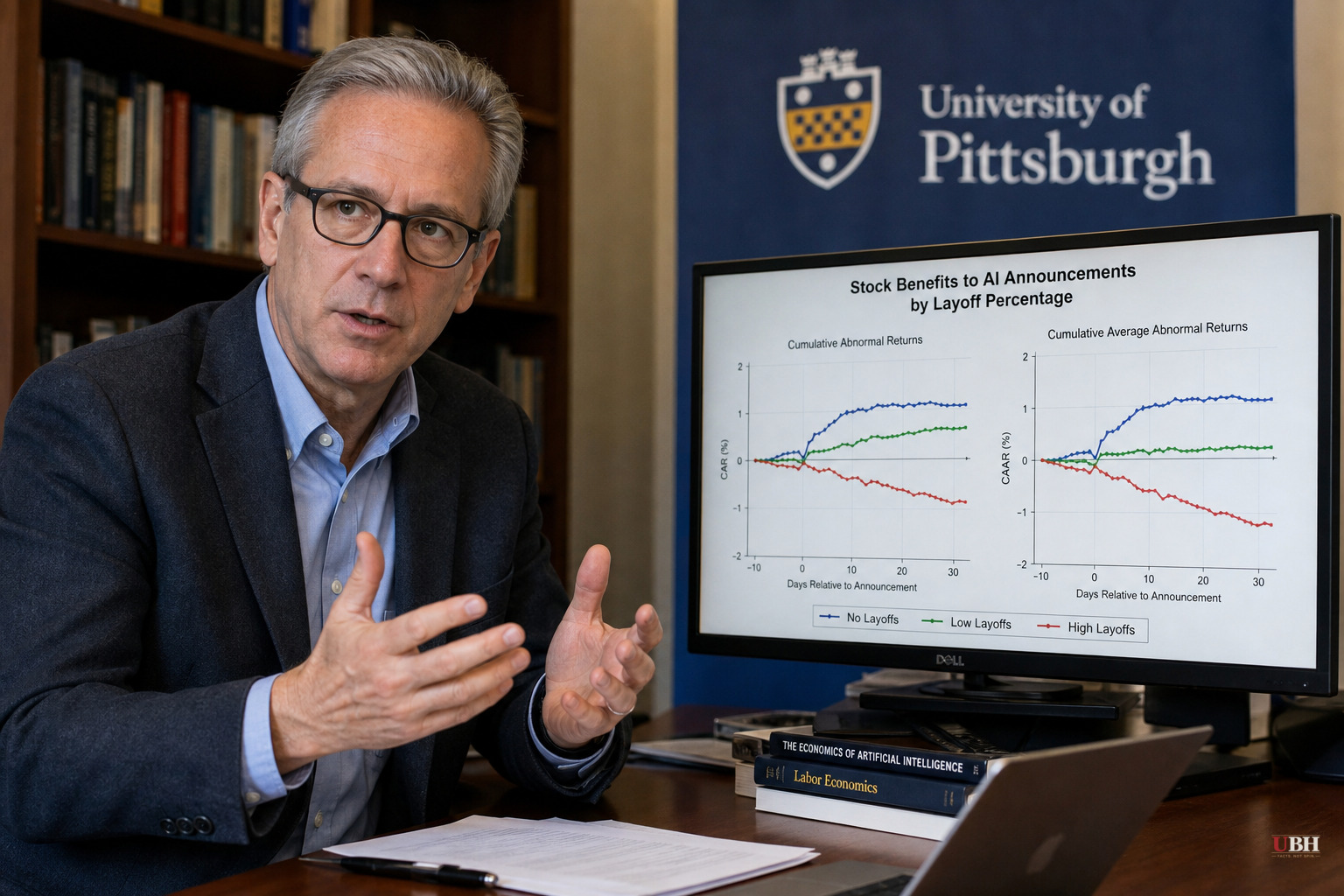
About 90% of executives say AI has not boosted productivity at their companies, according to an Atlanta Federal Reserve survey. That number sits at the center of a new study getting attention this month and explains something that's been nagging at anyone watching corporate earnings calls: companies keep announcing AI investments and layoffs in the same breath, but the payoff isn't showing up.
The research comes from Mark Ma, a professor of business administration at the University of Pittsburgh, published through The Conversation and picked up by outlets including Fortune, Naked Capitalism, and Tech Xplore. Ma and his colleagues analyzed millions of job satisfaction reviews, thousands of corporate financial reports, and hundreds of AI investment and layoff announcements from U.S. public companies over five years.
The pattern they found: as AI investment announcements go up, so do AI-linked layoff announcements. Ma's team argues this isn't a coincidence. It's a strategy. Some companies, per the study, cut headcount before spending on AI, using the savings to fund the AI purchase in the first place.
The market isn't buying it
When Ma's team measured stock market reactions to AI-linked layoff announcements, the average return was close to zero. For more than half of the announcements studied, the market reaction was flat or negative, according to coverage of the research from NAVION.
Block, the financial technology company run by Jack Dorsey, was flagged as an outlier where the stock rose on AI-layoff news. That's the exception, not the rule.
Why the gains don't show up
Ma's explanation is straightforward: layoffs create job insecurity, and job insecurity poisons the one thing that actually makes AI useful, which is employee buy-in. To test this, the researchers dug into Glassdoor reviews mentioning AI and found those comments ran substantially more negative than typical reviews on the platform. The top complaint wasn't bad training or lack of skills. It was fear of losing the job entirely.
When companies then announce AI-tied layoffs, employee sentiment toward AI craters further, according to Ma's findings. Naked Capitalism's Yves Smith summed up the mechanism bluntly, framing worker reluctance to embrace AI tools after watching colleagues get cut as "sabotage without consciously being so."
That's one interpretation. A more charitable read: workers who don't trust that using AI well will protect their job have zero incentive to use it well. That's not sabotage, that's rational self-interest. Either way, the effect on adoption and output looks the same.
Corporate messaging is already shifting
The Times of India, drawing on Axios reporting, documented how corporate language around AI layoffs has changed fast. In 2024, Klarna CEO Sebastian Siemiatkowski bragged that the company's AI assistant replaced the workload of 700 support staff. Last year, Salesforce CEO Marc Benioff said AI let the company shrink customer support from 9,000 workers to roughly 5,000. In May, Coinbase cut about 700 jobs as CEO Brian Armstrong talked up smaller "AI-native" teams.
Now companies are backing away from that framing. Communications teams are stuck between shareholders demanding proof that AI spending is boosting margins and employees furious about being replaced by software, according to Axios's reporting cited by the Times of India.
Public anxiety backs that up. A CBS News/YouGov survey of 2,287 adults conducted August 12-14 found 61% of Americans expect AI to shrink overall economic opportunity, versus 21% who expect it to grow opportunity. A separate Pew Research study found 73% of Americans under 30 believe AI will eliminate jobs over the next two decades.
What this doesn't prove
Ma's research shows correlation between AI investment announcements and layoff announcements, and it shows near-zero average stock returns on those layoff announcements. It does not prove that every AI-tied layoff was cynical or unnecessary, and it doesn't mean AI has zero productivity value everywhere. Some firms, the research notes, did see gains. The claim is narrower: companies that use layoffs as the mechanism to justify AI spending are undermining their own return, not that AI itself is worthless.
What's unresolved
Nobody in this research or the coverage of it has produced hard evidence on whether the executives cutting jobs actually believe their own AI productivity math, or whether the cuts are old-fashioned cost-cutting wearing an AI label. Ma's paper doesn't name every company studied beyond Block as the stock-price outlier, and the Atlanta Fed's 90% figure comes from executive self-reporting, not independent productivity audits. Whether boards start factoring "employee trust cost" into AI rollout decisions, or just keep cutting and rebranding it, is the open question going into the next earnings cycle.
Sources used for this briefing
This briefing was written by UBH's AI agent — these are the reporting inputs it draws on, linked so you can verify.


