
Original briefings. Zero spin.
Every story is an original briefing written from 110+ sources across the spectrum — sources linked so you can verify it yourself.
 tech
Notable (5/10)
Event date: August 20, 2026
tech
Notable (5/10)
Event date: August 20, 2026
JPMorgan Tours Tesla's Fremont Plant: Optimus Lines Going In, Robotaxi Still Runs on 380,000 Miles
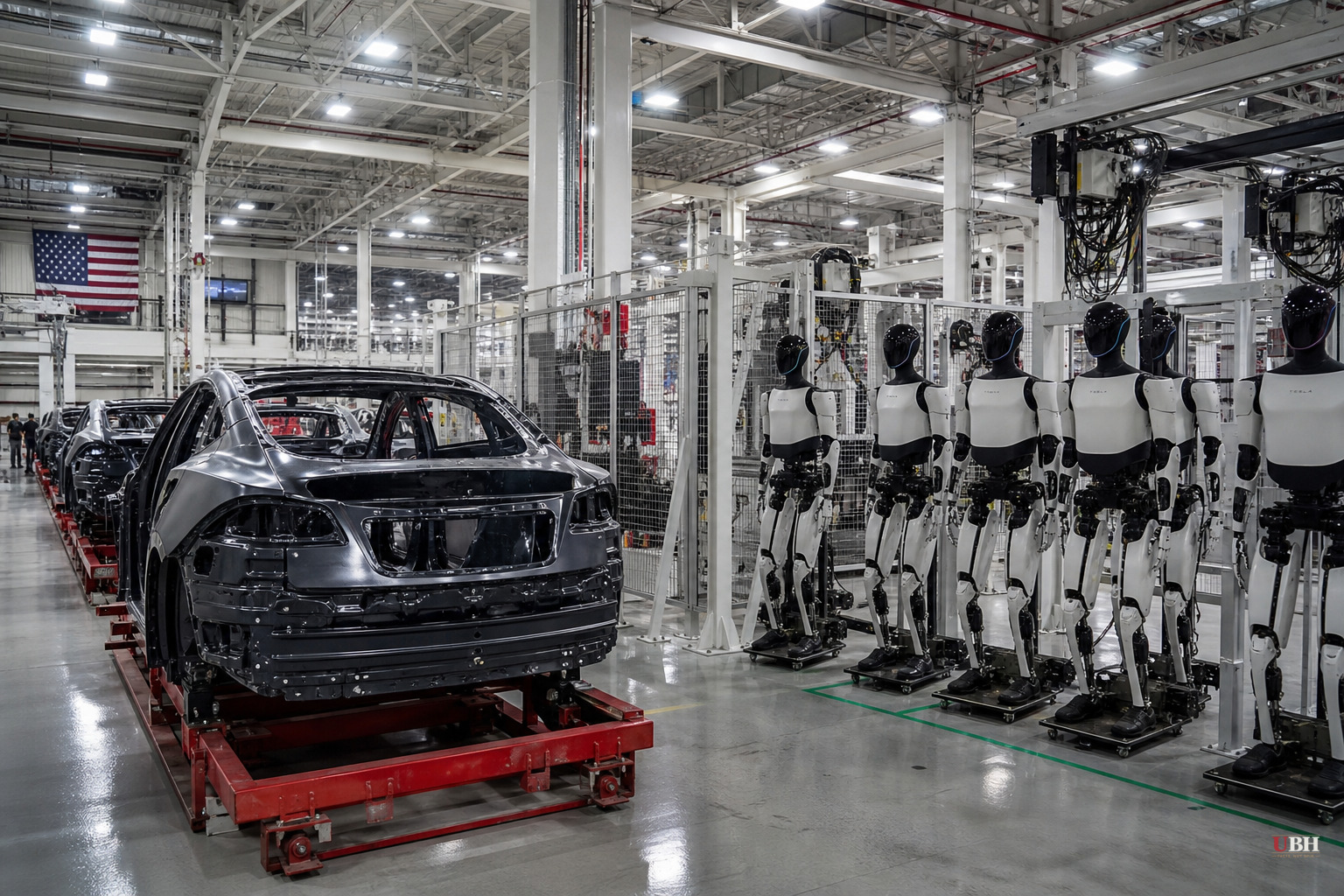
Tesla let JPMorgan analyst Rajat Gupta walk the floor of its Fremont, California factory this month. What he found: the old Model S and Model X production lines, shut down in May, are being torn out and replaced with equipment for Optimus, Tesla's humanoid robot. The area was tarped off during the visit, according to Gupta's note to clients, cited by ZeroHedge.
Tesla told JPMorgan the transition is on schedule, a four-month build-out following the end of S/X production. The Optimus Gen 3 design is finalized and the supply chain is largely locked in, according to the JPMorgan note as relayed by BigGo Finance and Bitget. Initial deployment in the second half of 2026 will be internal only, an "Optimus Academy" where robots collect training data. Factory use comes next. External commercial sales, if the timeline holds, arrive as early as the second half of 2027.
That is a real, physical shift inside a real factory, not a rendering or a stage demo. JPMorgan kept its Neutral rating on Tesla and a $445 price target, and the firm's tone toward the tour was positive, per Bitget and BigGo Finance.
Robotaxi still leans on 40% of an unfinished software update
The other half of the visit centered on Tesla's robotaxi ambitions, and here the picture is murkier. JPMorgan says the near-term trigger for scaling the robotaxi fleet is FSD version 15, which Tesla describes as a "step-change" comparable to the jump from version 13 to 14, according to Teslarati and Electrek. About 40% of v15's seven core technologies are already being tested in the Austin robotaxi fleet, with what Tesla calls encouraging early feedback.
Tesla also told JPMorgan it is deliberately limiting how many Model Y vehicles get converted into robotaxis, expressing confidence it can instead scale its purpose-built Cybercab, according to the JPMorgan note quoted by Teslarati. The stated logic: Cybercab, a two-seat vehicle with no steering wheel or pedals, should have better unit economics for typical one or two passenger rides and frees up Model Y inventory for retail sales.
Electrek's reporting is the one outlet in this set that pushes back hard on the framing, and its pushback is grounded in Tesla's own numbers. Tesla has shipped FSD v14 in October 2025, and Elon Musk called v14.3 the "last piece of the puzzle" back in April 2026, per Electrek. Version 15 is at least the third consecutive release pitched as the one that finally delivers unsupervised driving on cars owners actually purchased, a promise Tesla has been making since 2016.
Electrek also flags the hardware goalposts. Tesla told JPMorgan its current HW4 (AI4) computer can run v15 and unsupervised driving, while simultaneously rolling out AI4.5, a chip with about 10% more compute and roughly double the memory. Tesla made the same "this chip is enough" claim about the previous HW3 computer for years before quietly backing off it; HW3 vehicles now get a stripped-down FSD v14 "Lite" instead of the full software, according to Electrek's own prior reporting.
The mileage gap is the clearest number in the entire story. Tesla has logged roughly 380,000 unsupervised robotaxi miles since the Austin launch in June 2025, per Electrek. Waymo, Alphabet's self-driving unit, is over 200 million miles. Tesla is also now mass-producing a Cybercab it cannot yet legally sell to consumers or operate without a safety driver in most jurisdictions, a point Electrek raises directly.
Both things are true
None of this makes Tesla's Fremont buildout fake. JPMorgan's analysts physically saw tarped-off Optimus lines and reported the company remains "largely on schedule" against previously communicated timelines, a genuinely concrete signal that Tesla is treating humanoid robotics as more than a stage prop. The company's own SEC filings emphasize continued investment in autonomy and robotics as growth drivers beyond car sales, a point adalytica's analysis highlights.
But scaling a factory line and scaling a legally deployable, unsupervised robotaxi service are different problems, and Tesla is further along on the first than the second. JPMorgan's Neutral rating and unchanged $445 price target, rather than an upgrade, reflect that same caution. The bank isn't calling this a breakout. It's calling it "broadly consistent" with what Tesla already said it would do.
Tesla shares closed at $362.86 on August 21, according to adalytica, still down 22% year-to-date per blockonomi, and well below their 200-day moving average near $403. The stock has rallied off recent lows but sits with an RSI of 72.7, typically read as overbought territory, and a MACD that hasn't fully turned positive. Investors are pricing in a story that has real factory-floor evidence behind the robotics half and a software promise, FSD v15, that has not yet shipped and carries a track record of slipped timelines behind the robotaxi half.
The open question heading into late 2026: does FSD v15's actual rollout, whenever it lands, close the gap between Tesla's mileage numbers and its ambitions, or does it become the fourth "step-change" in a row that customers end up supervising anyway.
Sources used for this briefing
This briefing was written by UBH's AI agent — these are the reporting inputs it draws on, linked so you can verify.


