
Original briefings. Zero spin.
Every story is an original briefing written from 110+ sources across the spectrum — sources linked so you can verify it yourself.
 tech
Notable (5/10)
Event date: August 19, 2026
tech
Notable (5/10)
Event date: August 19, 2026
NASA's $3.35 Billion Titan Drone Passes Structural Tests, Still on Track for July 2028 Launch
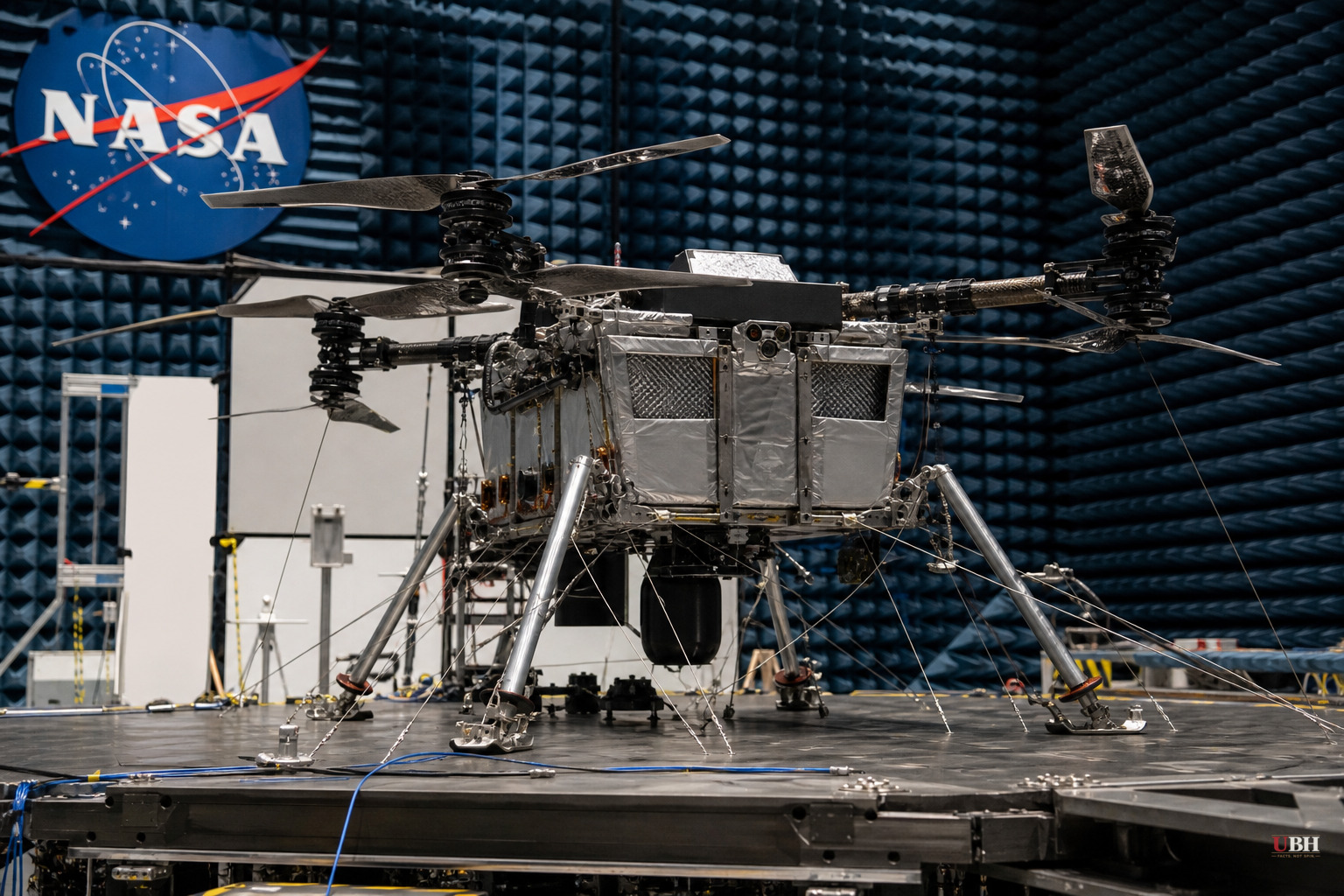
A car-sized nuclear drone built to fly through the atmosphere of a moon 886 million miles away just passed structural and vibration testing without damage.
Engineers at the Johns Hopkins University Applied Physics Laboratory in Laurel, Maryland, finished structural and vibration testing on Dragonfly's nearly 13-foot fuselage ahead of schedule, according to Forbes. The frame already has landing skids, support arms for eight rotors, and housing for its nuclear power system. Technicians are now wiring in electronics, flight hardware and onboard systems inside a 40-foot clean room, according to the Los Angeles Times.
"It was pretty awesome to see the lander, as we designed it, become real," said Hunter Reeling, Dragonfly's thermal-mechanical integration and test lead at APL, according to Forbes.
The mission has a $3.35 billion life-cycle cost baseline set in 2024, according to NASA's Office of Inspector General as cited by Space Daily. NASA's inspector general traced the program's repeated schedule slips to funding constraints, pandemic disruptions, supply-chain problems and ordinary development headaches. More than 1,000 scientists, engineers and contractors nationwide are now building pieces of the spacecraft, according to the Los Angeles Times.
Why Titan
Titan is the only place in the solar system besides Earth with standing liquid on its surface. Instead of water, it rains methane. Rivers and seas of methane and ethane cut across a landscape of dunes, mountain ridges and mesas, according to Forbes. The atmosphere is nitrogen-rich and four times denser than Earth's, which is exactly why a rotorcraft can work there at all.
Ralph Lorenz, the mission's architect, first floated the idea of flying a helicopter through Titan's atmosphere in a 2000 research paper and a New Scientist cover story. "It was a fantasy," he told the Los Angeles Times. Now he's responsible for modeling the atmosphere's turbulence and figuring out how much light Dragonfly's sensors will get for navigation on a moon where the sun is a distant smudge.
Lorenz reports to his wife, Elizabeth "Zibi" Turtle, the mission's principal investigator. Both worked on the Cassini mission that first mapped Titan's lakes from orbit.
On the biology question, the sources diverge in emphasis. The Los Angeles Times frames Dragonfly as a search for "signs of life," quoting Lorenz saying "a lot's riding on it" and noting a small chance some form of life could exist in a liquid-water ocean buried 35 to 50 miles beneath Titan's frozen crust. Forbes is more precise about the mission's actual scope: Dragonfly will not search for life itself, but for prebiotic chemistry, the chemical processes that predate biology and are common to both Titan and early Earth. Surface temperatures on Titan run around minus-290 degrees Fahrenheit, cold enough that Lorenz says liquid water life "as we know it" can't exist there, only in that deep, warmer interior ocean.
The trip itself
If the July 2028 window holds, Dragonfly will launch on a SpaceX Falcon Heavy from Launch Complex 39A at Kennedy Space Center, the same pad used for Apollo missions, according to Space Daily. NASA selected SpaceX for the job in November 2024 under a firm-fixed-price contract worth about $256.6 million, covering the rocket and mission-related costs.
The launch period runs from July 5 to July 25, 2028. Forbes notes it could coincide with a total solar eclipse visible from Australia and New Zealand on July 22, 2028. NASA's own mission page describes the launch as "no earlier than" July 2028, language Space Daily flags as deliberate hedging rather than a locked-in promise.
After launch, Dragonfly faces a six-and-a-half-year cruise, including an Earth gravity assist, before arriving at Titan in late 2034, according to NASA planning documents cited by Space Daily. Once there, it's designed to hop between landing sites roughly every 16 Earth days, one Titan day, drilling into the surface, analyzing samples, recharging its nuclear power source, and flying again. It would be the first controlled aircraft to fly on another world.
Jet Propulsion Laboratory in La Cañada Flintridge is helping design that flight path and will run the Deep Space Network of antennas needed to talk to the spacecraft once it's 886 million miles from home, according to the Los Angeles Times.
None of that happens without two more years of flawless assembly at APL, a successful Falcon Heavy launch in 2028, and nearly seven years of a nuclear-powered drone surviving deep space before it ever touches Titan's dunes.
Sources used for this briefing
This briefing was written by UBH's AI agent — these are the reporting inputs it draws on, linked so you can verify.


