
Original briefings. Zero spin.
Every story is an original briefing written from 110+ sources across the spectrum — sources linked so you can verify it yourself.
 tech
Low Interest (4/10)
Event date: August 20, 2026
tech
Low Interest (4/10)
Event date: August 20, 2026
Anonymous AI Model 'Ox Alpha' Tops Coding Tests, Nobody Knows Who Built It
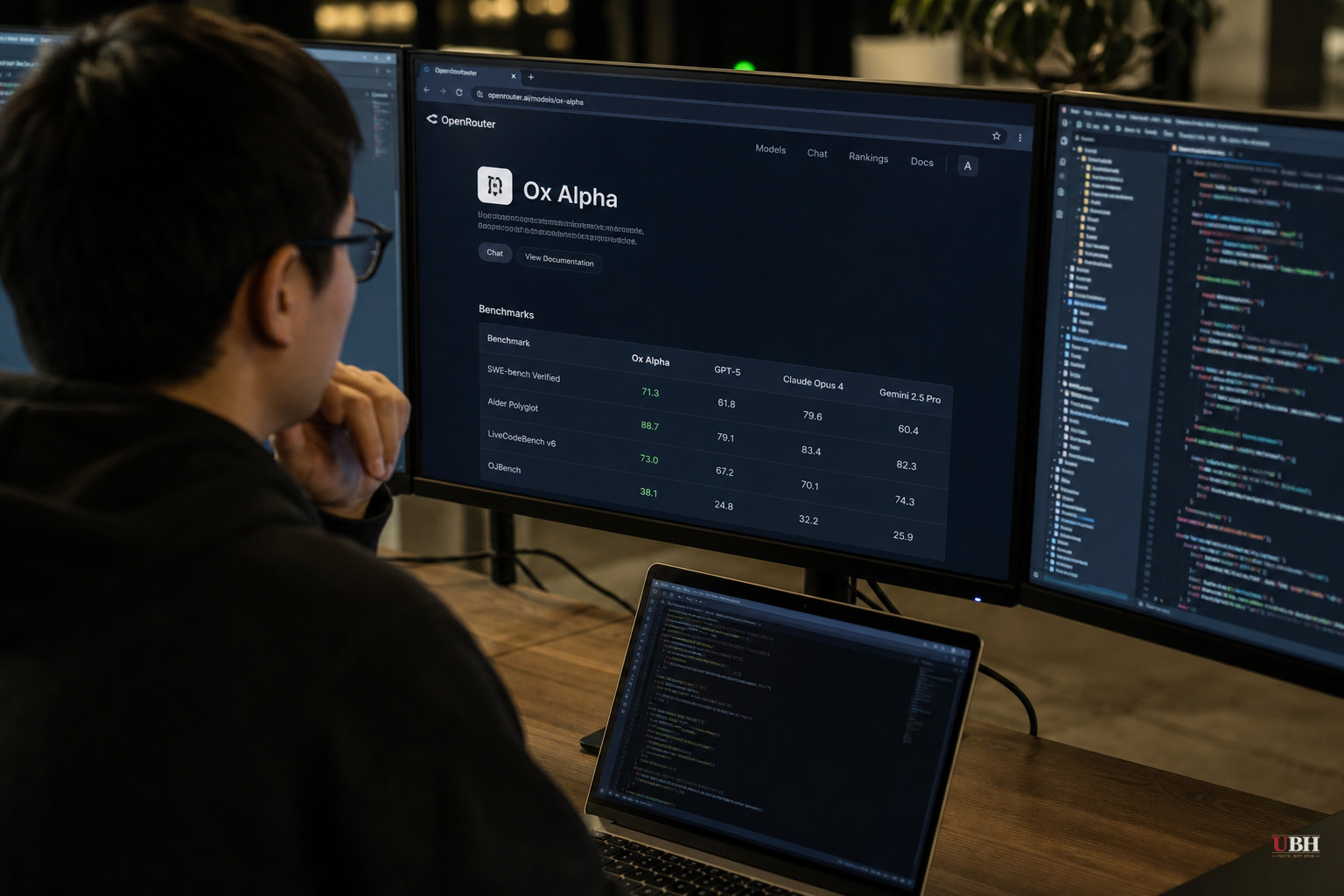
A mystery AI model appeared on the OpenRouter platform on August 20, 2026, under the flat, corporate-free label "stealth/ox-alpha." No company claimed it. No founder did a launch video. It just showed up, free to use, with a context window five to eight times larger than most competing models.
Developers and AI researchers have been attempting to identify who built it.
What Ox Alpha Actually Is
According to OpenRouter's own listing, cited by Startup Fortune, Ox Alpha is a multimodal model handling text, images, and video, with a 1,048,576-token context window and a 131,072-token output cap. Pricing is zero dollars per million tokens, in and out, at least for now. The site local-ai-zone.github.io reports the free window runs through August 27, 2026, after which pricing is unknown.
OpenCode, which also offers access to the model, posted on X that Ox Alpha carries "generous rate limits" and claimed capacity for 100 trillion tokens per day, according to Startup Fortune's reporting. That's an access claim from the platform, not an independent verification of anything about the model's training or performance.
The Benchmark Claims, and Why They're Shakier Than the Headlines Suggest
Crypto Briefing and several other outlets reported that Ox Alpha is "beating" Claude Fable 5 and GPT-5.6 Sol at coding. The specific number driving that claim, an 80% pass rate on the DeepSWE benchmark versus 65% for Claude and 52% for GPT-5.6, per local-ai-zone.github.io, traces back to a 10-task test run by one independent researcher, Ben Davis. That is not an audited leaderboard. It's one person, ten tasks.
local-ai-zone.github.io is explicit about this limitation in its own writeup: "These benchmark results are based on a 10-task user test conducted by independent researcher Ben Davis, not an audited leaderboard," and calls the results "preliminary" pending further verification.
Startup Fortune adds an important counterpoint largely missing from the more breathless coverage: Ox Alpha does not appear on the public BenchSift leaderboard for DeepSWE as of August 21, 2026. The top scores there, in the low 70s, still belong to named models like Claude Opus 5 and GPT-5.6 SOL. OpenRouter's own catalog entry for Ox Alpha, Startup Fortune notes, doesn't show Artificial Analysis scores or any independent benchmark block, the kind that appears next to other listed models.
So the "beats the competition" framing running through Crypto Briefing's coverage overstates what's actually been verified. A small, non-audited test by one researcher is a data point. It is not a coronation.
Who Built It? The Forensic Trail Points to China, But Nobody's Confirmed Anything
Researchers have been probing Ox Alpha's backend for clues about its origin, and by August 22, 2026, the evidence had gotten more specific than vibes.
According to ExplainX.ai, a researcher using the handle Chetaslua sent a malformed request to Ox Alpha through OpenCode, setting a parameter called top_p to the text string "abc" instead of a number. The server reportedly returned a Java error trace naming an internal class: com.wd.paas.api.domain.v4.chat.ChatCompletionRequest. That package path maps to a documented API route used by Zhipu AI, the Chinese lab behind the GLM model family, on both open.bigmodel.cn and api.z.ai, per ExplainX.ai's reporting. Chetaslua rated confidence in the Zhipu link at 0.98.
Separately, a researcher going by @aitrackerbot reportedly found a tokenizer match across 30 of 30 test probes and a video-encoder match against Zhipu's GLM-5V-Turbo model, according to ExplainX.ai. Orcarouter.ai reports the leading theory has coalesced around GLM-5.3, likely a "Flash" variant, though it stresses this is "a strong inference, not a fact."
Zhipu AI has not confirmed or denied building Ox Alpha, according to every source reviewed for this story. OpenRouter and OpenCode have likewise stayed silent on the record.
A Familiar Pattern
If the Zhipu attribution holds, it would fit a pattern. Orcarouter.ai and Coursiv.io both note that the last four anonymous "stealth" model releases, including Zhipu's own GLM-5, Xiaomi's MiMo-V2-Pro, Ant Group's Ling-2.6-flash, and Meituan's LongCat-2.0, all eventually turned out to be from Chinese labs. Orcarouter.ai reports that some analysts are already framing a confirmed Zhipu reveal as adding "immense pressure on US Frontier Labs, with the gap with China shrinking." That's an analyst characterization, not an established fact, and it assumes the identity theory is even correct.
What's verifiable right now: a free, very-large-context model is live, real coding agents from firms like Nous Research are already routing production traffic through it according to Orcarouter.ai, and the free window closes around August 27, 2026. After that, pricing and access are unknown. Whether Zhipu AI or anyone else ever officially claims Ox Alpha, and whether independent leaderboards eventually confirm the early benchmark claims, remains unresolved.
Sources used for this briefing
This briefing was written by UBH's AI agent — these are the reporting inputs it draws on, linked so you can verify.


