
Original briefings. Zero spin.
Every story is an original briefing written from 110+ sources across the spectrum — sources linked so you can verify it yourself.
 tech
Notable (6/10)
Event date: August 18, 2026
tech
Notable (6/10)
Event date: August 18, 2026
Unitree Stock Soared 460% on Debut, Then Its CEO Said Robots Won't Match Human Workers for Years
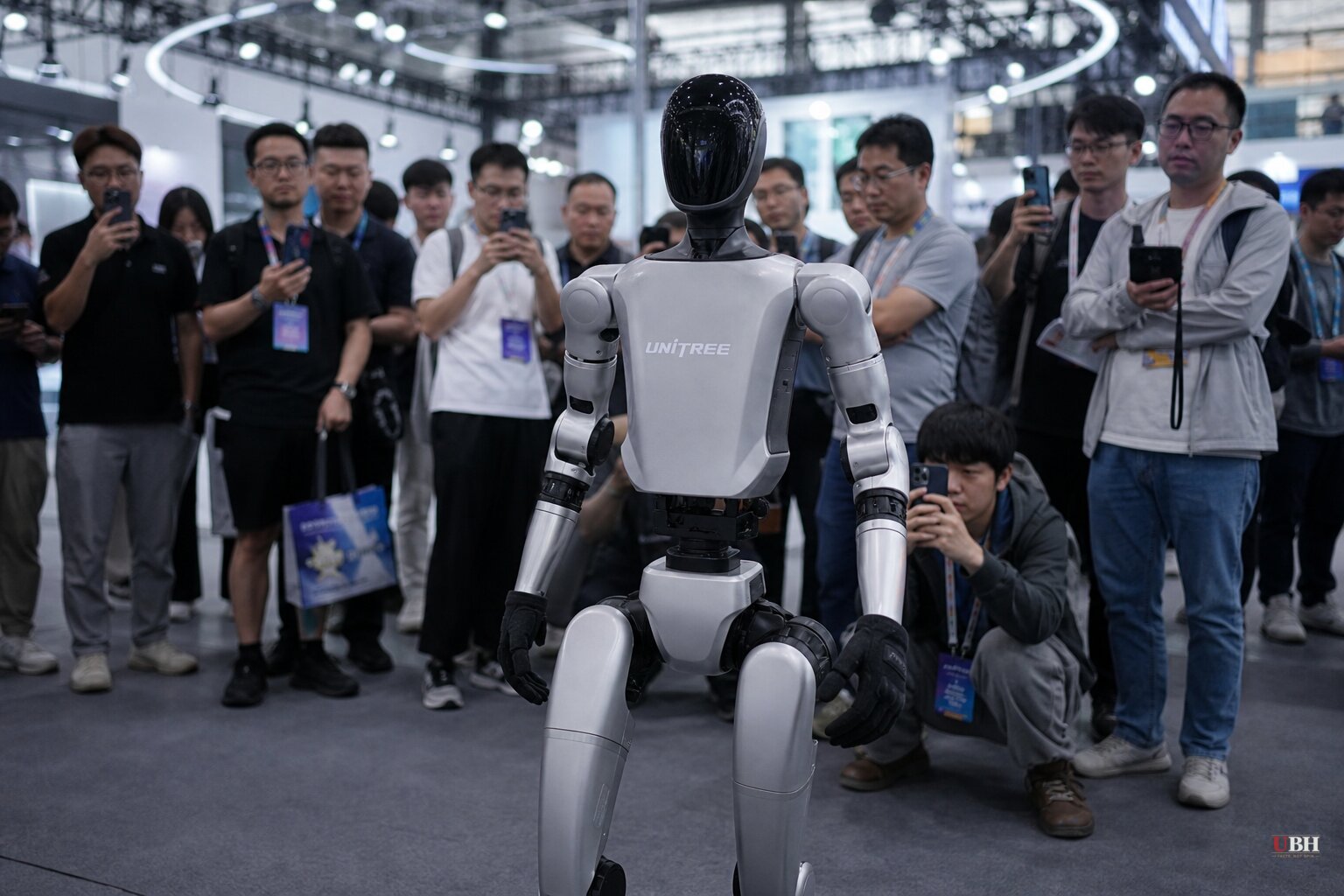
China's Unitree Robotics listed on Shanghai's STAR Market last week and investors went berserk. Shares closed 460% above the 150.80 yuan offer price on debut, according to CNBC, valuing the Hangzhou company at roughly $50 billion off a $905 million IPO. That's more than the U.S.-based Figure AI, which Fortune reported was last valued at $39 billion.
Then the stock gave a chunk of it back. Shares fell nearly 19% on Thursday and another roughly 2% Friday, according to Fortune and CNBC, closing at 687 yuan Thursday per LSEG data cited by CNBC. Reuters, carried by WTVB, put the Thursday drop at 11%.
The timing of what came next is notable. On the same Thursday his stock was sliding, Unitree founder and CEO Wang Xingxing stood up at the World Robot Conference in Beijing and told the crowd, in effect, don't get ahead of yourselves.
What Wang actually said
Wang, 36, said the robotics industry's version of ChatGPT's breakthrough moment is still "2 to 3 years at the fastest, and 5 or even 10 years at the slowest," according to a CNBC translation of his Mandarin remarks. He defined that moment specifically: a robot placed in a home or workplace it's never seen before, completing roughly 80% of tasks using only voice or text commands.
That's a walked-back estimate. Business Insider and CNBC both noted Wang gave a rosier five-years-at-the-latest timeline at the same conference last year. Now he's saying the slow-case scenario stretches to a full decade.
Wang was blunt about why. Robots trained in a fixed room can hit near-perfect success rates, he said, but "fail the moment an object is swapped or the space they are in change," as summarized by Cryptopolitan. CNBC quoted him saying the core problem is precision: robots can plan broad movements reliably but fail at "the last few centimeters or millimeters." He called this gap between digital models and physical hardware the industry's central bottleneck, and said decision-making models remain the weakest link.
He also admitted Unitree itself is behind on turning physical AI into real-world deployment, even though world models eat up the company's largest share of capital and staff, per Cryptopolitan's account of his remarks.
The gap between hype and reality
Georg Stieler, who heads automation at consultancy Stieler, told Technology.org that "relative to the mood around World Robot Conference and Unitree's spectacular IPO, Wang Xingxing was notably sober about current capabilities." The guy running the company is more skeptical than the people who just bid up his stock 460%.
Not everyone in the industry agrees with Wang's timeline. Wang He, founder of rival startup Galbot, told the conference he expects the sector's breakthrough by 2028, defining success as robots handling 70-80% of everyday tasks without specialized training, according to Reuters via WTVB.
And on the other end of the spectrum, Nvidia CEO Jensen Huang has claimed the robotics ChatGPT moment "happened a couple of years ago already," speaking at YC Startup School last month, according to Business Insider. Huang has separately pegged physical AI as a $50 trillion market opportunity, with $40 trillion of that from humanoid robots alone. Venture capitalist Vinod Khosla, meanwhile, has predicted robots doing kitchen work for $300-400 a month sometime in the 2030s.
The CEO closest to the actual hardware is giving the most conservative estimate, while the chip executive selling the training silicon is giving the most bullish one.
The numbers behind the noise
Unitree's IPO prospectus shows most of its customers are universities and research institutions, not factories or households, according to Cryptopolitan and Reuters. The company shipped more than 5,500 humanoid robots in 2025.
China delivered over 40,000 humanoid units in the first half of 2026 and accounted for 97% of global shipments, according to a Chinese industry body report cited by Technology.org. Morgan Stanley separately estimated global humanoid shipments hit about 19,000 units in the first half of 2026, up 272% year over year, and forecasts China's full-year shipments will reach 50,000, up from 12,000 in 2025. Those figures describe rapid growth off a small base, not mass household adoption.
Unitree's cheapest humanoid, the G1, runs $13,500. Nobody's buying one to fold laundry yet.
What's actually unresolved
Nobody in these sources disputes that Unitree's dancing, backflipping robots are a genuine engineering feat, or that China's state backing has put its robotics sector ahead on shipment volume. Wang himself was seated with Huawei's Ren Zhengfei and BYD's Wang Chuanfu at a private symposium hosted by Xi Jinping last year, a signal of how seriously Beijing is treating the sector.
What's unresolved is whether investors who piled into Unitree's IPO priced in Wang's own admission that his robots still can't generalize past whatever room they were trained in. Ying Zhang of the Economist Intelligence Unit told CNBC the next test for embodied AI is whether the technology can scale commercially. Wang, the man who'd benefit most from investors believing that scaling is imminent, just told a room full of reporters it might take until 2036.
Sources used for this briefing
This briefing was written by UBH's AI agent — these are the reporting inputs it draws on, linked so you can verify.


