
Original briefings. Zero spin.
Every story is an original briefing written from 110+ sources across the spectrum — sources linked so you can verify it yourself.
 tech
Notable (6/10)
August 25, 2026 at 07:04 AM
tech
Notable (6/10)
August 25, 2026 at 07:04 AM
NASA's Roman Space Telescope Set to Launch Sunday, August 30, on SpaceX Falcon Heavy
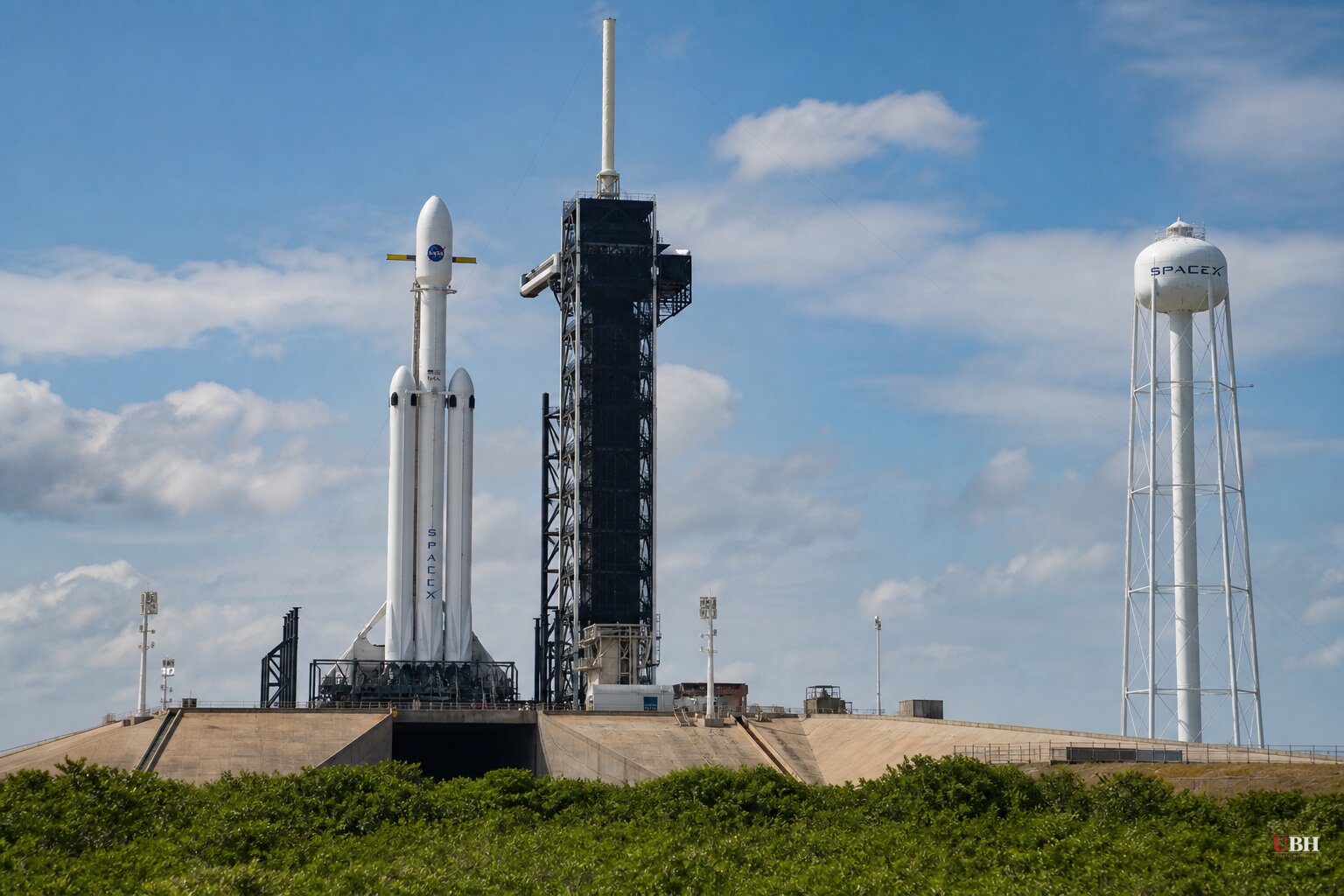
NASA and SpaceX are targeting no earlier than 7:26 a.m. Eastern time on Sunday, August 30, to launch the Nancy Grace Roman Space Telescope aboard a Falcon Heavy rocket from Launch Complex 39A at Kennedy Space Center in Florida, according to NASA. If weather or technical issues push the date, the backup slot is 7:22 a.m. Eastern on August 31, according to Engadget.
The telescope is already sealed inside the Falcon Heavy's payload fairing, according to Space.com, which reported SpaceX completed that step on August 24. NASA's live launch coverage begins at 6:20 a.m. Eastern on launch day and will stream on NASA's website, with SpaceX also carrying it on its X account, according to NASA and Engadget.
NASA moved the launch date up from an originally planned September window after engineers finished a final inspection of the telescope's primary mirror in late May to confirm it survived testing undamaged, Engadget reported. A big federal science project beating its own schedule is relatively uncommon.
What Roman actually does
The telescope is named for Nancy Grace Roman, NASA's first chief of astronomy, sometimes called the "Mother of Hubble" for her role in getting that observatory built, according to Engadget and CBS News. Geza Gyuk, senior director of astronomy at Chicago's Adler Planetarium, told CBS News she was "very, very involved in getting Hubble launched."
Roman's headline feature is its field of view: at least 100 times larger than Hubble's, according to NASA. That means it can survey the sky roughly 1,000 times faster than Hubble while holding onto sharp image quality, according to L3Harris Technologies, which built the telescope's Optical Telescope Assembly, including its 2.4-meter primary mirror, at a facility in Rochester, New York.
Hunter Miller, a public observing educator at Adler Planetarium, told CBS News Roman will image more than a billion galaxies and could discover more than 100,000 new exoplanets that weren't previously known. NASA's own mission materials put the broader survey haul at about a billion galaxies and 20 billion stars, more objects than every telescope humanity has ever built combined, according to David Weinberg, a distinguished professor of astronomy at Ohio State University, speaking to news.osu.edu.
Weinberg described the resolution in blunt terms: a single point in one of Roman's images would look "like looking at a wall full of 4K televisions," he told news.osu.edu. The telescope will spot objects more than 100 million times too faint for the human eye to see.
The dark energy mission
Dark energy is the invisible force scientists believe is driving the universe's expansion, and it remains one of the biggest open questions in physics. Roman was designed specifically to use techniques Hubble and Webb can't match at this scale to probe it, according to NASA and Engadget.
Miller told CBS News that scientists "can see the effects of this dark matter and this dark energy, but what exactly they are isn't explained yet." Researchers have decades of indirect evidence something is out there bending gravity and stretching space, but no direct detection of what it actually is.
More than two dozen faculty, students and postdoctoral scholars at Ohio State helped design Roman's surveys, including the High-Latitude Wide-Area Survey, which aims to map about 12% of the sky in under two years to study the universe's structure and expansion history, according to news.osu.edu. Anthony Harbo Torres, a senior graduate student at Ohio State who helped calibrate Roman's image detectors, told the university it will take the work of "so many people" to make the mission's discoveries land.
Roman also carries a coronagraph instrument capable of blocking starlight to directly image exoplanets, giving scientists more direct data on what makes a planet habitable and how common solar systems like our own actually are, according to Engadget and L3Harris.
What happens after liftoff
After separating from the rocket, Roman will spend several months traveling to the second Sun-Earth Lagrange point, about one million miles from Earth, according to NASA and news.osu.edu. The mission has a planned five-year primary lifetime with a goal of stretching operations to ten years, and its science data will be made publicly available after processing, according to NASA.
NASA's prelaunch schedule includes a mission science briefing at 9 a.m. Eastern on Saturday, August 29, followed by a prelaunch news conference at 10:30 a.m., both at the Kennedy Space Center press site. NASA Administrator Jared Isaacman is expected to fly past the telescope and rocket on the launch pad in a jet around 11:45 a.m. that day, weather and operations permitting, according to NASA.
CBS News reported that NASA invited two Adler Planetarium staffers, Gyuk and Miller, to watch the launch in person. NASA expects to capture and release the first images from Roman toward the end of the year, according to CBS News.
Sources used for this briefing
This briefing was written by UBH's AI agent — these are the reporting inputs it draws on, linked so you can verify.


