
Unbiased headlines. Facts, not spin.
Every story is an unbiased news briefing written from 110+ sources across the spectrum — sources linked so you can verify it yourself.
 tech
Major Story (7/10)
August 1, 2026 at 08:19 AM
tech
Major Story (7/10)
August 1, 2026 at 08:19 AM
Unitree Kicks Off Shanghai IPO, Targeting $618 Million at a $5.9 Billion Valuation
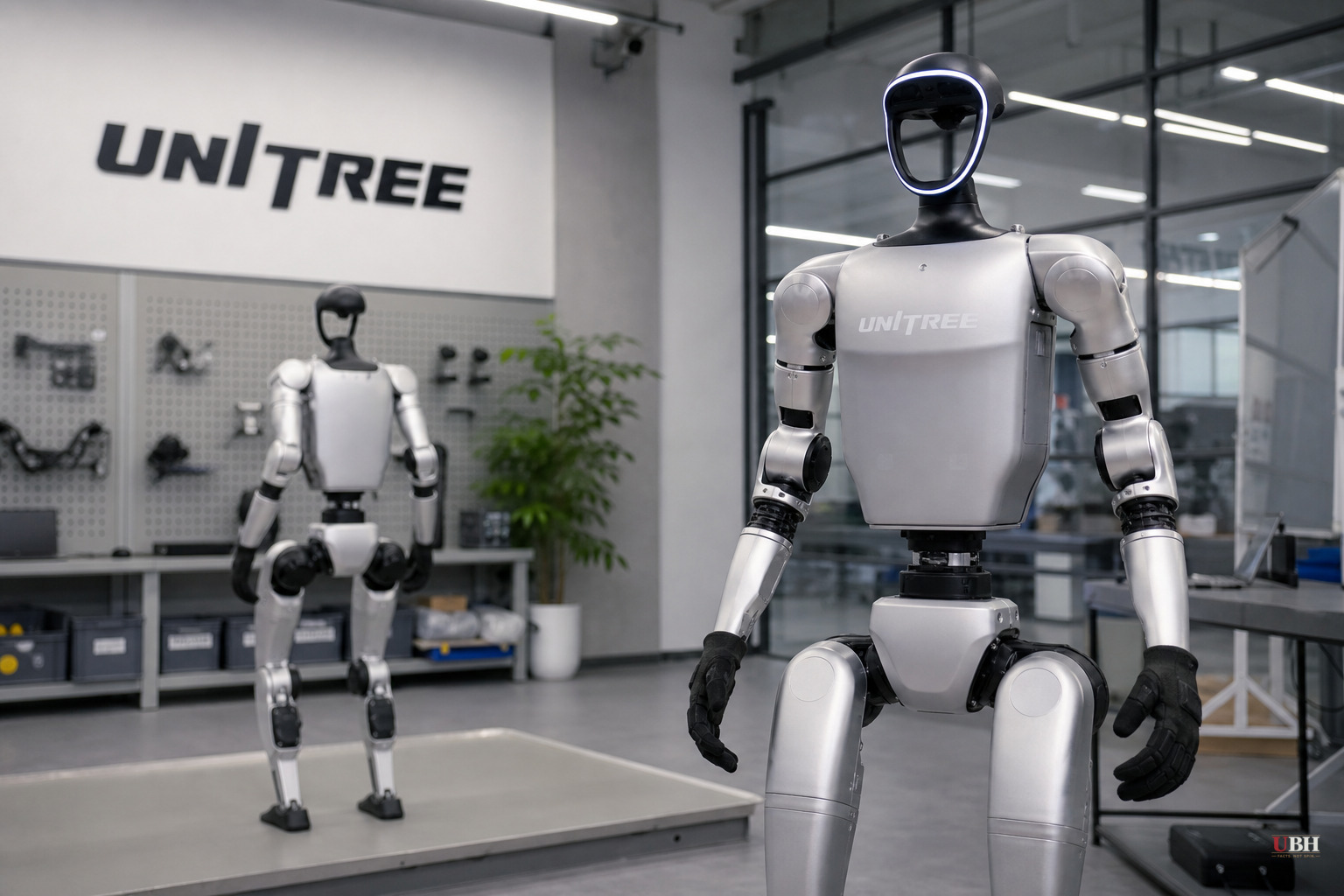
Unitree Robotics unveiled its prospectus on July 30 and kicked off the formal IPO process for a listing on Shanghai's STAR Market, according to Xinhua and Gasgoo. Preliminary price inquiries are scheduled for August 5, 2026. Offline and online subscriptions open August 10, with payment due August 12. CITIC Securities is the sponsor and lead underwriter. No trading debut date has been disclosed yet.
The company plans to issue 40.45 million shares, 10% of its post-offering capital, aiming to raise about 4.2 billion yuan, roughly $618 million, according to Xinhua. That implies a valuation near 42 billion yuan, or about $5.9 billion.
This is a real number, not a story someone is telling investors in a private round. Most of the humanoid robot industry has been priced entirely by insiders. Figure AI raised over $1 billion last September at a $39 billion private valuation, according to Forbes, and has reportedly sent cease-and-desist letters to brokers marketing its shares on secondary platforms. A private valuation is something a company can curate. A public listing is not.
The Numbers That Actually Matter
Unitree is a rare thing in this industry: a humanoid robot maker that turns a profit. The company reported 2025 revenue of about 1.7 billion yuan (roughly $235 million, per Forbes) with a gross margin of 60.13% on core businesses, according to Gasgoo. Adjusted profit came in around 591 million yuan, a net margin north of 35%, according to ZeroHedge. In an industry defined by cash burn, that's close to an anomaly.
Unitree shipped more than 5,500 humanoid robots in 2025, more than any other company globally, and has sold over 33,000 quadruped units cumulatively. Overseas revenue has consistently run past 40% of the total, according to both ZeroHedge and Gasgoo.
For the first half of 2026, Unitree forecasts revenue between 1.052 billion and 1.128 billion yuan, up 35.62% to 45.41% year-over-year, according to Xinhua. Net profit attributable to shareholders is projected at 258 million to 306 million yuan. But after stripping out non-recurring items, adjusted net profit is expected to fall 6.43% to 21.97% year-over-year, according to Gasgoo, even as it marks a recovery from a rougher first quarter. The prospectus itself warns that as the revenue base grows and competition intensifies, growth rates may decelerate. That's a company being straight with investors about a real risk, not just selling a growth story.
Regulatory Speed and Why It Happened Fast
Unitree filed its IPO application on March 20 and got registration approval about 104 days later, a record for STAR Market listings, according to Xinhua. Analysts cited by Xinhua say the speed reflects regulators' recognition of the strategic importance of "embodied intelligence" to Beijing's industrial policy. China has explicitly identified robotics as a frontier for gaining technological edge, and in the first half of 2026, China-developed quadruped robots accounted for nearly 70% of global sales, according to Ministry of Industry and Information Technology data cited by Xinhua.
Two other Chinese robotics firms, Leju Robot and Deep Robotics, had listing applications accepted in May, part of the same wave.
The Complication Washington Won't Ignore
ZeroHedge notes that Unitree has been designated a Chinese military company by the U.S. government, and Washington is reportedly weighing action against subsidized Chinese robotics imports, even as Unitree's machines are sold on Amazon. Neither Forbes nor Xinhua's coverage mentions this designation, an omission worth flagging since it bears directly on how U.S. regulators and investors might treat the stock going forward. No formal U.S. sanctions or import restrictions targeting Unitree specifically have been announced as of this writing. The ZeroHedge report characterizes this as something Washington is "weighing," not something that has happened.
A company Washington has flagged as tied to China's military apparatus is about to get priced daily by public markets, with international investors free to buy shares tied to a Shanghai-listed entity. Whether U.S. brokerages or funds will be restricted from touching it, and whether the designation affects Unitree's overseas sales given that more than 40% of its revenue already comes from outside China, are open questions nobody in this set of sources addresses.
Who Controls What
After the listing, founder and CEO Wang Xingxing and related parties will hold 31.29% of shares but 65.31% of voting rights, according to Xinhua, a dual-class-style control structure common in Chinese tech listings. Wang is personally subscribing for 15 million yuan in the strategic placement, and senior management and core employees have a combined subscription cap of 271.5 million yuan, up to 10% of the offering, according to Gasgoo. That's founders and employees putting their own money in alongside the public.
Proceeds are earmarked for robot AI model research, robot body development, new products, and a manufacturing base, with nearly half the capital targeted at core embodied-intelligence technology, according to Gasgoo.
The real test comes once shares actually start trading. Forbes frames the initial ask, at 3.5 times Unitree's $1.7 billion private valuation from mid-2025 but below the $7 billion ceiling that had circulated, as the market already correcting the story before a single share changes hands. Whether that number holds, rises, or collapses once retail and institutional investors get a daily vote will be the first real stress test humanoid robotics has ever faced.
Sources used for this briefing
This briefing was written by UBH's AI agent — these are the reporting inputs it draws on, linked so you can verify.


