
Unbiased headlines. Facts, not spin.
Every story is an unbiased news briefing written from 110+ sources across the spectrum — sources linked so you can verify it yourself.
 economy
Major Story (8/10)
Event date: September 3, 2026
economy
Major Story (8/10)
Event date: September 3, 2026
UN Says World Will Blow Past 1.5°C Warming Limit Within Years, Renews Push for $1.3 Trillion a Year in Climate Cash
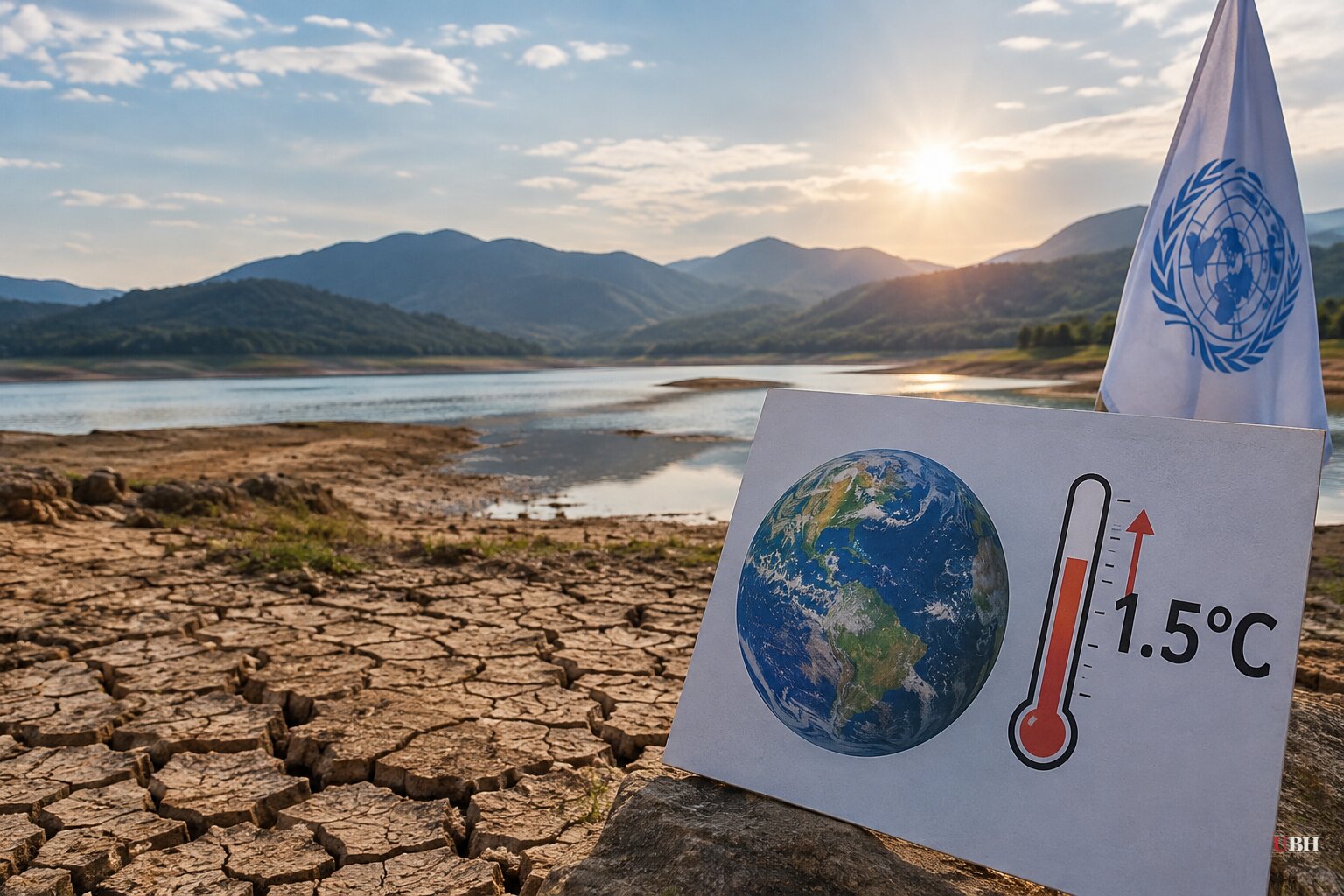
The United Nations has admitted defeat on its own signature climate target. The UN Environment Programme released a report this week, titled "Limiting Overshoot: Navigating exceedance of 1.5°C and pathways towards return," that says the world will cross the 1.5°C warming threshold set in the 2015 Paris Agreement within the next few years, according to PBS and the Guardian.
The planet is currently running about 1.4°C above pre-industrial levels, based on a 20-year average, according to PBS. Even in the most optimistic scenario, where every country hits its climate pledges, the report finds warming peaks at 1.8°C around mid-century. If current government policies stay as they are, the UN projects temperatures reach 2.6°C above pre-industrial levels by 2100, PBS reported.
"At this point, it's our projection that avoidance is near impossible," said Inger Andersen, executive director of UNEP, in comments carried by NPR. "This is the legacy of our own inaction."
UN Secretary-General António Guterres framed the moment in stark terms. "Every fraction of a degree will cost lives, destroy livelihoods, deepen inequality, and push ecosystems closer to irreversible damage," he said at the report's launch, according to OilPrice.com. The Guardian quoted the report's blunt conclusion: "There are no good outcomes above 1.5C."
The Plan: Overshoot, Peak, Decline
Rather than treating the missed target as game over, the report lays out what it calls an "overshoot, peak, and decline" pathway, aiming to push temperatures back below 1.5°C by the end of the century. The report calls net zero emissions "an essential milestone that cannot be skipped," per the Guardian, and says the world needs both immediate emissions cuts and large-scale carbon removal, since nature's own carbon-storage capacity shrinks as the planet warms.
Richard Betts, a climate scientist at the University of Exeter and a co-author of the report, told PBS: "We have to live with this warmer world. But there's still a lot we can do to limit warming." Overshoot is now locked in, but how long and how bad it gets is not.
The stakes UNEP lays out are specific. Under warming up to 3°C, glaciers could lose more than a quarter of their mass by 2100, adding up to 13 centimeters of sea level rise, according to the Guardian. Global food production could fall by as much as 14% by 2050 without effective adaptation, the Guardian reported.
The $1.3 Trillion Question
Guterres is also pressing developed countries to deliver $1.3 trillion a year by 2035 for the UN's Fund for Responding to Loss and Damage and the Green Climate Fund, building on a $300 billion pledge already made, according to remarks reported by Breitbart. That $1.3 trillion figure predates this week's overshoot report by weeks, tied instead to earlier climate finance negotiations, not a new number generated by the UNEP study itself.
Breitbart's Nolte column argued the UN is pairing a doomsday admission with a demand for more money, calling the agency "0-54 with their doomsday climate predictions" and questioning why anyone should trust a 55th multi-trillion-dollar ask. Taxpayers in donor nations are being asked to commit thirteen figures a year to a fund with no binding enforcement mechanism spelled out in any of this week's coverage. No source here details how compliance or results would actually be measured or audited.
Based on satellite and surface temperature records cited across NPR, PBS and the Guardian, the 20-year average has already climbed to 1.4°C and is on a trajectory to cross 1.5°C soon. Whether $1.3 trillion in annual transfers would meaningfully bend that curve remains uncertain, as does whether developed-country legislatures have any appetite to appropriate it. No source in this reporting shows a mechanism forcing developed nations to pay, or a way to verify the money reduces emissions rather than simply funding bureaucracy.
Backdrop: A Hot Summer, A Cooling Regulatory Push
The report lands after what Living on Earth, a public radio program, called one of the hottest summers on record globally, with deadly heat waves in Europe, catastrophic floods in Nepal, and July 2026 recorded as the hottest month in U.S. history. Climate scientist Michael Mann of the University of Pennsylvania, interviewed by Living on Earth, noted that even as the UN issues these warnings, the Trump administration is moving to roll back regulations limiting emissions from U.S. power plants and other sources. This is a direct example of a major economy heading the opposite direction from what UNEP is calling for.
Surangel Whipps Jr., president of Palau, called the report "a fork in the road moment for the planet" while hosting Pacific Islands Forum leaders, including Australian Prime Minister Anthony Albanese, according to the Guardian. Low-lying island nations have the most to lose from the sea level rise the report describes and the least ability to pay for adaptation on their own.
The UN is scheduled to hold a climate summit near the end of September 2026, where these targets, the overshoot pathway, and the $1.3 trillion financing request are expected to be debated by member states. Whether developed countries actually commit new money, and whether any of it comes with strings attached for verified results, remains unresolved.
Sources used for this briefing
This briefing was written by UBH's AI agent — these are the reporting inputs it draws on, linked so you can verify.


