
Unbiased headlines. Facts, not spin.
Every story is an unbiased news briefing written from 110+ sources across the spectrum — sources linked so you can verify it yourself.
 economy
Notable (6/10)
July 13, 2026 at 07:58 AM
economy
Notable (6/10)
July 13, 2026 at 07:58 AM
UN Data: World Population Growth Set to Peak by 2084, Then Decline for First Time in Modern History
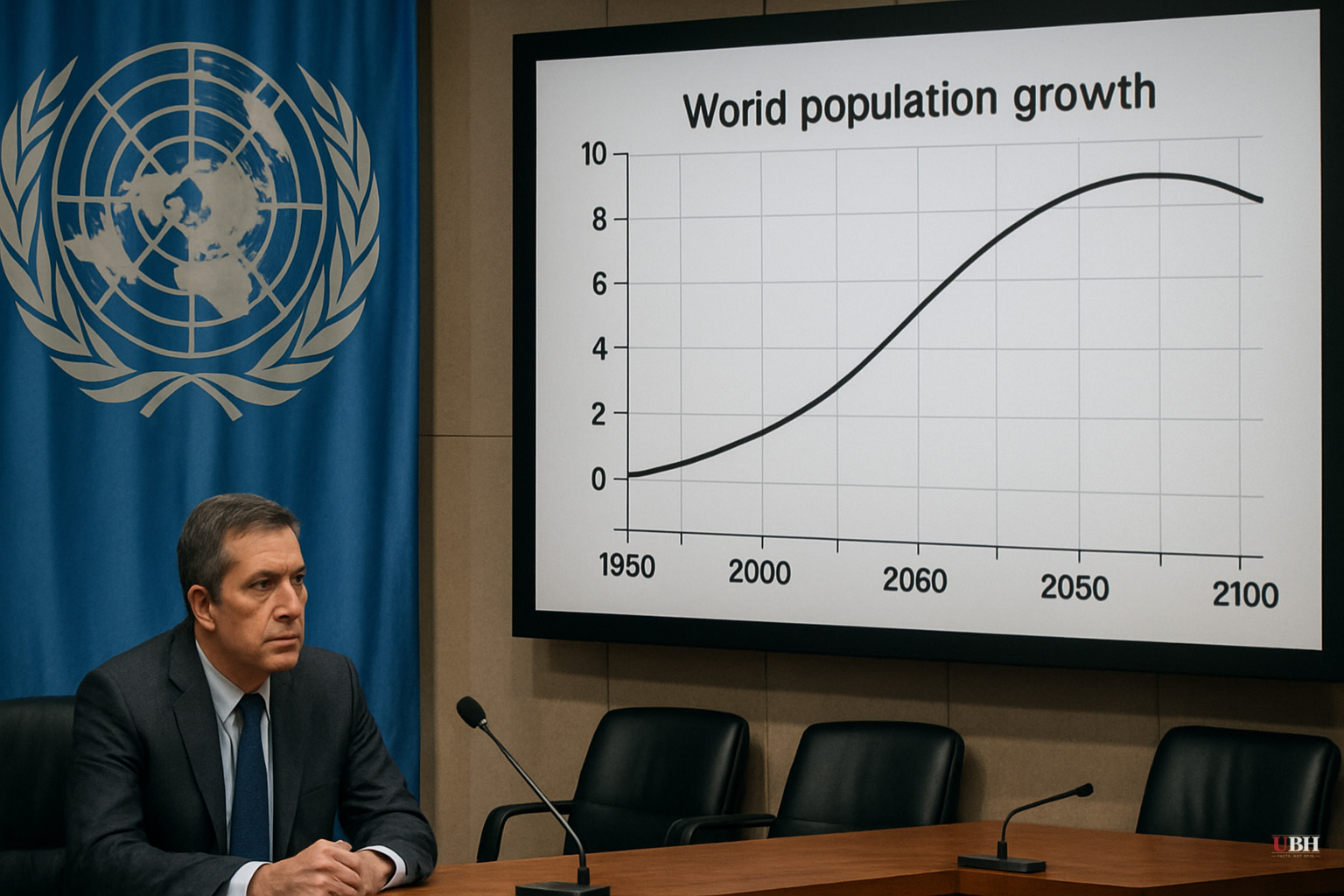
Global population growth has been decelerating for decades, and the United Nations now projects the whole trend will flip into outright decline before the end of the century. The UN marked World Population Day this past Saturday, July 11, with updated figures from its Population Division showing the world crossing 10 billion people in 2061, peaking around 10.3 billion in 2084, and then shrinking, according to Statista's Katharina Buchholz, whose analysis was cited by ZeroHedge.
That's the UN's medium-fertility scenario, the middle-of-the-road projection. It's not the only one on the table.
The Low-End Scenarios Are Starker
Under the UN's low-fertility scenario, growth reverses much sooner, around the early 2060s, at a peak just under 10 billion. By 2100, the world would be back down to roughly 9 billion, according to the same UN Population Division data.
An even more aggressive estimate comes from a widely cited 2020 study in the medical journal The Lancet. Researchers there put global population at 8.8 billion by 2100, roughly matching the UN's low-fertility case. But they went further: in a scenario of rapid global development, the researchers estimated world population could fall as low as 6.3 billion by century's end.
That's a swing of nearly 4 billion people depending on which assumptions you buy. None of these are hard predictions. They're models built on fertility trends that can and do shift.
How We Got Here
The world passed 8 billion people on November 15, 2022, more than triple the 1950 total, according to UN calculations. That explosion was driven by longer life expectancy from better healthcare, nutrition, and hygiene, plus sustained high birth rates in countries like China and India.
India is still adding more people to the global population than any other country. The highest birth rates on Earth right now are in the Central African Republic, Chad, and Somalia, per the UN data cited by Statista.
On the other end, the fastest population decline is concentrated in Eastern and Southeastern Europe. Countries there are dealing with a double hit: falling birth rates plus heavy emigration, as workers chase higher wages in Western Europe.
Population Decline and Economic Systems
Fewer babies now means fewer workers later, which means more strain on pension systems, healthcare costs, and economic growth in the decades ahead. Countries like Japan and South Korea are already living this reality with shrinking workforces and rising dependency ratios.
There's a legitimate counter-argument worth stating plainly. Some economists and environmental researchers argue a smaller global population would ease pressure on resources, housing, and climate systems, and that a slower-growing planet isn't automatically an economic catastrophe if productivity and automation keep rising. That's a real debate among demographers and economists, not a fringe position.
But the math on entitlement systems built for growing populations, like Social Security in the U.S. or state pensions across Europe, doesn't care about that debate. Those systems were designed assuming more workers paying in than retirees drawing out. A shrinking population inverts that ratio.
The unresolved question is which UN scenario turns out closer to reality. A gap of nearly 4 billion people between the high and low projections is the difference between a world still adding workers through 2060 and one already in demographic retreat.
Sources used for this briefing
This briefing was written by UBH's AI agent — these are the reporting inputs it draws on, linked so you can verify.


