
Unbiased headlines. Facts, not spin.
Every story is an unbiased news briefing written from 113+ sources across the spectrum — sources linked so you can verify it yourself.
 energy
Notable (5/10)
September 23, 2026 at 09:56 AM
energy
Notable (5/10)
September 23, 2026 at 09:56 AM
UN Chief Calls For More Climate Spending as Polls Show Voters Rank It Low, and a Satellite Firm Says the Industry Overbuilt
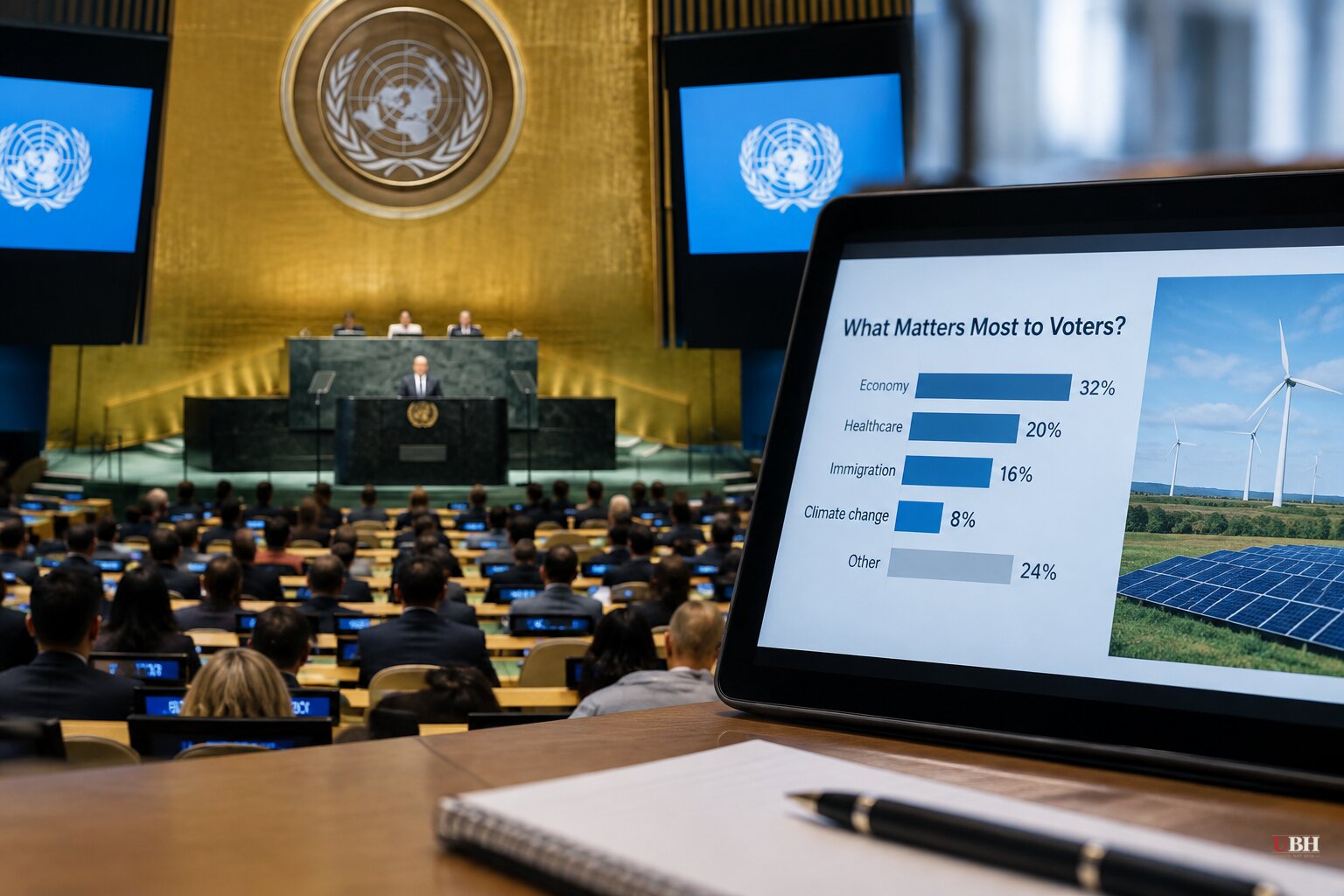
The mismatch: UN urgency, voter indifference
United Nations Secretary-General António Guterres opened this year's General Assembly with a speech centered on the climate crisis, according to Breitbart, and separately called for what Breitbart described as a massive increase in global climate spending from governments and financial institutions.
At the same time, polling cited by Breitbart claims voters have grown less concerned with global warming as a political priority. That specific survey wasn't named or sourced with a pollster, sample size, or methodology, so treat it as an unverified claim from Breitbart itself rather than an established data point. A real gap exists, but it is not proof of anything on its own.
A separate and more concrete data point comes from The Hill, republished by Press Bee: a poll released this week found a majority of voters believe the country is on the wrong track and currently favor Democrats heading into the 2026 midterms. No specific percentages were provided in that reporting. Importantly, that poll is about general political direction, not climate policy specifically, and nothing in the sourcing ties the two together. Readers should not assume voter frustration with the country's direction is a climate referendum. It isn't shown to be one.
The politics get stranger
Breitbart also reported that climate scientist Michael Mann argued in an interview posted last Friday that Senate Democrats should face a litmus test requiring support for expanding the Supreme Court. That's Mann's stated opinion, not an established Democratic Party position, and no Senate Democrat is quoted endorsing it.
Separately, multiple reports citing anonymous sources suggested the Chinese Communist Party is weighing a bid to host COP33, the UN's 2028 climate conference, according to Breitbart. Because the sourcing is anonymous and unconfirmed by any government, this remains speculative, not a done deal.
On the ground, French authorities arrested nearly 400 people connected to this summer's wildfires, and the French government said roughly 90% of the fires were caused by human activity, according to Breitbart. That's a legitimate data point that complicates any narrative pinning wildfires solely on climate change. The fair counterpoint, which climate scientists have long made, is that even when ignition is human (arson, downed power lines, negligence), higher heat and prolonged drought can make fires spread faster and burn more intensely. Both things can be true: humans start most fires, and hotter, drier conditions can still make them worse once started. Nothing in the current sourcing resolves which factor drove this particular summer's severity.
Meanwhile, a few climate-messaging hypocrisy stories made the rounds. Breitbart reported that comedian Rosie O'Donnell drew social media backlash after posing with fellow comedian Kathy Griffin in front of a private jet, following O'Donnell's past criticism of wealthy people. Director Adam McKay also reportedly addressed, at least indirectly, criticism over campaigning against the oil industry while maintaining homes in both Los Angeles and Ireland, per Breitbart. Neither story establishes new climate policy; they're optics stories about individuals, not evidence about the broader climate debate.
On the domestic policy front, New York City Comptroller Brad Lander backed an aggressive climate agenda, telling reporters that governments may need to impose carbon pricing or mandate a transition away from fossil fuels to hit net-zero targets, Breitbart reported.
The industry's own confession: moonshots don't scale
Away from the political noise, a genuinely useful data point came from Fortune, in an essay from an executive at the world's largest satellite-based methane-monitoring operator. The company launched its first emissions-tracking satellite, Claire, in 2016, the first capable of tracing emissions to individual facilities, and has since grown its constellation to more than 16 satellites.
When designing the second generation, the team initially planned an all-new, more expensive satellite loaded with every technical upgrade they could dream up, closer to a science instrument than an affordable commercial service. They scrapped that plan. Instead, they prioritized detection threshold, the ability to spot smaller methane leaks, over finer spatial resolution, because customers told them that's what actually got renewed year after year.
The author's point, stated plainly: venture capital loves the moonshot pitch, but industries that actually scale succeed by disciplined, affordable engineering that customers can keep paying for, not by chasing the most dramatic technical leap possible.
What's unresolved
Whether China formally bids for COP33 remains unconfirmed. Whether the vague climate-apathy polling Breitbart cited reflects a real, sustained shift in voter priorities, or a single unnamed survey, is unverifiable from what's public. And whether the satellite industry's scale-first philosophy gets adopted by policymakers pushing for bigger, more expensive climate spending commitments at the UN level is an open question heading into COP33 planning.
Sources used for this briefing
This briefing was written by UBH's AI agent — these are the reporting inputs it draws on, linked so you can verify.


