
Unbiased headlines. Facts, not spin.
Unbiased Headlines is an independently owned news organization. We bring you the facts, not opinions, written fresh from 110+ named sources. Sources linked so you can verify it yourself.
 defense
Major Story (7/10)
defense
Major Story (7/10)
Ukrainian Military Engineer's Teardown Finds 80 of 105 Parts in Russian Geran-4 Controller Came From US Firms
Since Washington moved this weekend to waive Russia-related fuel sanctions and Graham Act tariffs, the question of what Western sanctions actually restrict has been front and center. A new Ukrainian teardown of a Russian jet drone adds a concrete data point on the hardware side.
What the engineer found
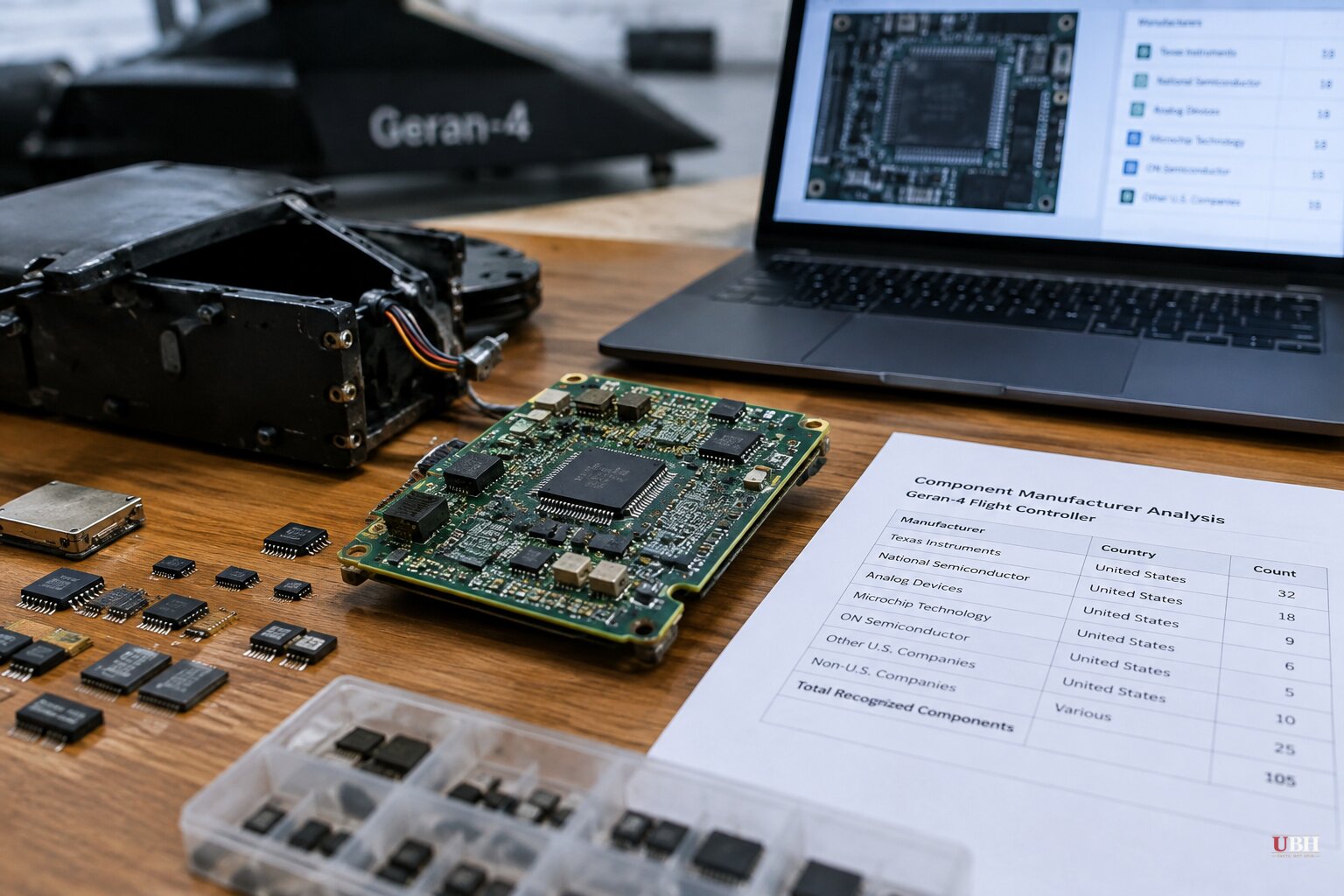
An engineer using the call sign Prop, who serves with the 1230th Athena Engineering and Technical Regiment of Ukraine's Support Forces, catalogued the electronics in a Geran-4 flight controller. The unit was recovered from debris in Poltava Oblast in 2026. Damage to the top of the casing left most internal boards intact, so he could read markings and serial numbers.
He identified 105 electronic components. At least 80, or 76.19%, are from US companies. The results were shared with the Ukrainian defense outlet Militarnyi, which published them.
Texas Instruments and National Semiconductor, which TI acquired in 2011, account for 61 components, or 58.1%. Seven boards carry 32-bit Texas Instruments processors running at 150 MHz. Named parts include TMS320F28335PGFA processors, VP230 CAN transceivers, MB3238I multichannel transmitters, PS767D301 voltage regulators and REF3020 voltage references.
Other US firms on the list include CTS, Onsemi, Monolithic Power Systems, Qorvo, Analog Devices and Microchip.
The rest of the parts list
China accounts for 11 components and Germany for two. Japan, Taiwan and the Netherlands each have one. Nine components could not be traced to a manufacturer.
The analysis found no Russian-made electronics in the controller.
Country attribution follows the parent company's place of registration. Intersil parts are counted as Japanese, under Renesas. Zetex parts are counted as American, under Diodes Incorporated.
Serial-number markings indicate the boards were made in Alabuga, according to the analysis. The electronics sit in an aluminium case measuring 175 mm by 104 mm by 145 mm, linked to other drone systems by two multipin Amphenol Aerospace connectors.
Production math
Militarnyi extrapolated from a production rate of 3,000 drones per month. At that pace, it wrote, the dependence creates a need for more than two million Texas Instruments and National Semiconductor components a year. That production figure and the resulting total are Militarnyi's estimate, not a verified count.
The outlet's conclusion: the figures point to "a lack of an effective mechanism for monitoring compliance with sanctions, both at the level of the companies themselves and at the government level."
How this fits earlier teardowns
Radio Free Europe/Radio Liberty took apart a Geran-4 earlier and found that the drone's brain used Texas Instruments chips, with manufacturer markings scraped off but logos still readable. A Ukrainian military intelligence (HUR) official told RFE/RL that the original markings on Western components are removed with lasers. He said that conceals batch numbers that could be used to trace which supply chain a part moved through and who handled it on the way to Russia.
The same HUR official said German-made Infineon parts have been used in the power distribution units of Russia's first Geran drones and continue to appear in later models.
RFE/RL's broader account says parts from the United States, Japan, Germany, Switzerland and other advanced economies make up the majority of the drone's components, with Chinese parts at roughly one-third. That differs from the 11 of 105 Chinese parts in the controller Prop examined. The two analyses cover different scopes: a whole airframe versus a single flight controller.
HUR has listed 45 foreign parts and eight unidentified ones in these drones. They include a Chinese Telefly LX-WP-160 turbojet, a Chinese mesh modem, Micron memory chips, STMicroelectronics microcontrollers from Switzerland, Taiwanese FOTEK relays and UK-made Raspberry Pi microcomputers.
Why the drone matters
The Geran-4 is a jet-powered descendant of the Iranian-designed Shahed. Propeller models cruise around 180 km/h. The Geran-4 travels around 500 km/h and has been observed at up to 960 km/h, at altitudes near 8 km and over distances around 700 km. That makes it much harder to intercept.
The drones stay connected through SIM cards and GSM modems. The modem has a 300 km range and doubles as a relay, so drones flying together extend each other's signal.
What the analysis does not show
The findings rest on one controller examined by one engineer. Nothing in the analysis establishes how these chips reached Alabuga. It does not say whether they came through authorized distributors, resellers, third-country intermediaries or stockpiles bought before sanctions. It also does not allege that Texas Instruments or any other manufacturer broke a law.
No charges or enforcement actions tied to these specific components have been announced. Texas Instruments has not commented in the material gathered here.
Militarnyi raised the central question: if a plant turning out roughly 3,000 drones a month is drawing on millions of American-made chips a year, who is tracking where they go after they leave the distributor?
Sources used for this briefing
6 links from 4 independent newsrooms (syndicated copies of the same report count once)
These are the sources it draws on, linked so you can verify.


