
Unbiased headlines. Facts, not spin.
Unbiased Headlines is an independently owned news organization. We bring you the facts, not opinions, written fresh from 110+ named sources. Sources linked so you can verify it yourself.
 defense
Major Story (8/10)
Event date: October 14, 2026 ·
Hegseth Vows 'Hell or High Water' Push for $350 Billion Defense Bill After Midterms
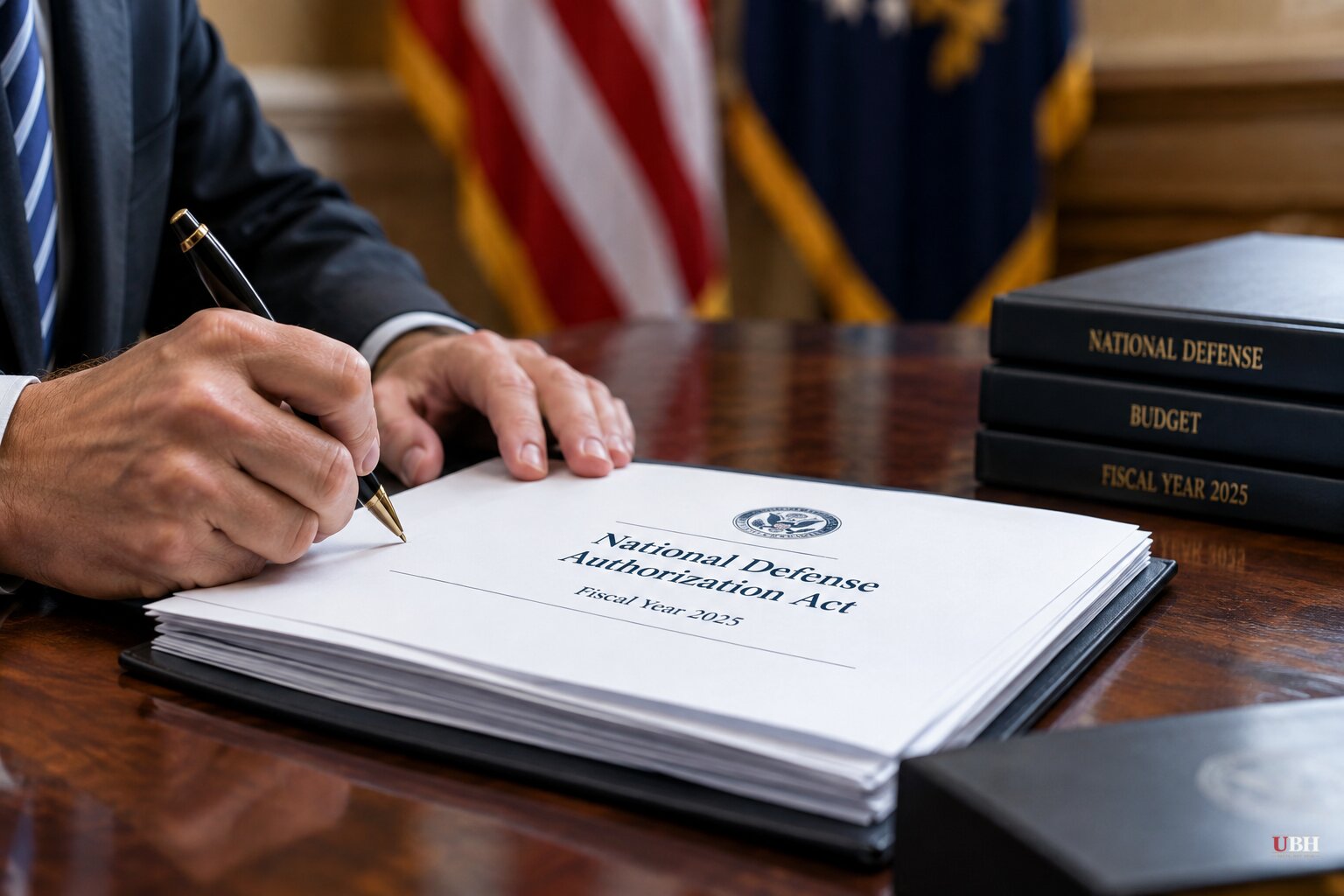
Defense Secretary Pete Hegseth told an Association of the United States Army panel on Wednesday, Oct. 14, that the Pentagon will push "immediately" for a reconciliation bill of "a minimum of $350 [billion], potentially more" once Congress returns after the midterm elections.
"Regardless of what happens in the midterms, we're running fast," Hegseth said. He described President Trump's $1.5 trillion defense request as the administration's goal "come hell or high water."
How the $1.5 trillion is built
The fiscal 2027 request is split in two. Roughly $1.15 trillion would come through regular appropriations. The other $350 billion would move through a reconciliation bill, which can clear the Senate with only Republican votes.
That second piece has not passed. Republicans are divided over how to pay for it. The package would fund Trump's Golden Dome missile defense shield, expanded munitions production and about $50 billion for drones, which Hegseth called the Pentagon's "No. 1 priority."
The administration has separately asked for another $67 billion to cover costs tied to the Iran war.
The drone money
The Pentagon's budget documents show a request of about $54.6 billion for the Defense Autonomous Warfare Group in fiscal 2027. The fiscal 2026 figure was $225.9 million.
Only $1 billion of the new amount would come through regular discretionary funding. Nearly $53.6 billion, about 98 percent, depends on additional mandatory funding legislation.
Hegseth said the Pentagon wants to go from thousands of drones to hundreds of thousands and eventually millions. He argued that mass-producing unmanned weapons changes the cost of war by forcing adversaries to spend more defending against them.
Hegseth has also announced plans for a four-star Autonomous Warfare Command by October 2027. That needs congressional approval. Separately, Acting Army Secretary Adam Telle directed the creation of an Army Futures and Autonomous Systems Command on Oct. 1, and the Army announced it the next day.
The China argument
Hegseth framed the money as a response to a Chinese military buildup. He called the request "absolutely critical" and a "one-time generational investment" to "fully rebuild" the military. He said whoever falls behind in autonomy, robotics, space and artificial intelligence will fall "even further behind."
On China's buildup he said: "That's not hyperbole; that's just an objective truth."
Air Force Secretary Troy Meink, on the same panel, said advances in satellite surveillance could increasingly expose American military assets to detection and targeting. He said autonomous systems would let commanders send unmanned aircraft into environments too risky for crewed platforms.
Hegseth also said the U.S. cannot simply copy Ukraine's drone playbook. "You can't use everything that's in Ukraine because of all the Chinese components involved in it," he said. The Pentagon, he said, must take the lessons while building systems that U.S. industry can produce.
The Iran war tab
The argument over cost is not limited to the base budget. Taxpayers for Common Sense, a budget watchdog, argues that Congress should use its power of the purse to rein in the seven-and-a-half-month Iran war.
The Pentagon's latest estimate puts the war's cost at $45.1 billion through Sept. 3. The Congressional Budget Office estimated $38.1 billion through Aug. 1 and projected future costs of $2 billion to $3 billion a month. The watchdog notes that the gap between the two estimates implies about $7 billion in a single month. Neither figure includes damage to military installations in the region.
The group also cites the CBO's estimate that the war has pushed inflation 0.5 percent above the pre-war projection. It points to one recent analysis that puts the cost at roughly $2,000 per household, including higher energy costs, higher interest rates and direct war spending. The Pentagon has put the U.S. servicemember death toll at 21.
What comes next
The timing is tight. If Democrats win the House in November, the lame-duck session may be the administration's best chance to pass a Republican-only reconciliation bill.
Hegseth has not said how the $350 billion would be paid for. Congress will decide whether more than $53 billion in drone funding, which does not exist in the regular budget, can pass at all.
It will also have to decide whether to approve a four-star command that Hegseth wants running by October 2027.
Sources used for this briefing
4 links from 4 independent newsrooms (syndicated copies of the same report count once)
These are the sources it draws on, linked so you can verify.


