
Unbiased headlines. Facts, not spin.
Every story is an unbiased news briefing written from 110+ sources across the spectrum — sources linked so you can verify it yourself.
 tech
Notable (5/10)
June 12, 2026 at 05:54 AM
tech
Notable (5/10)
June 12, 2026 at 05:54 AM
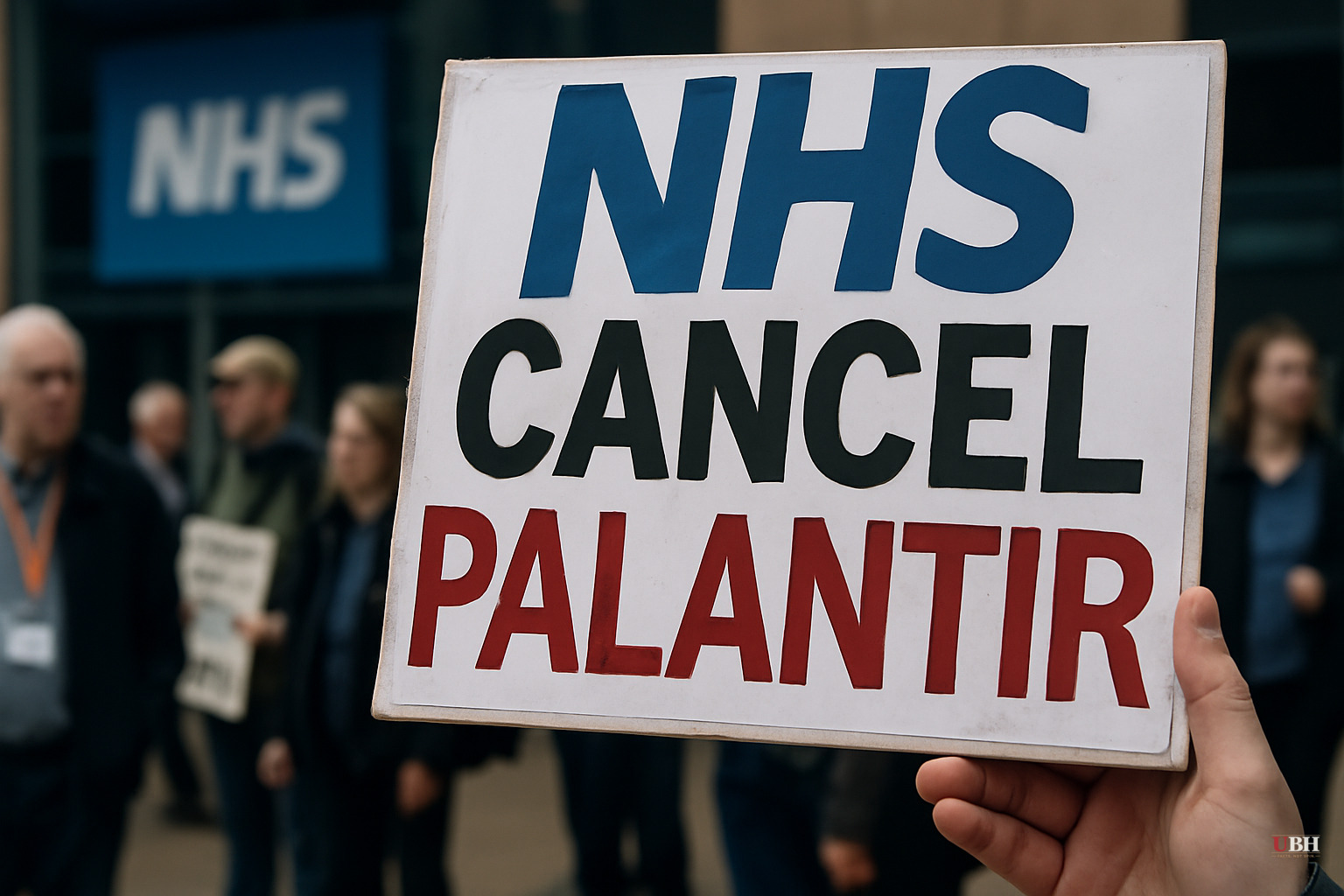
UK Protesters Demand NHS Cancel $440 Million Palantir Data Contract Over Privacy and Security Concerns
What Happened
On a rainy Thursday morning in Manchester, roughly 80 protesters in hospital gowns crowded the entrance of NHS ConfedExpo, the UK's major annual health care leadership conference. They were there to pressure NHS leadership to terminate a contract with Palantir, the American data analytics and AI company founded by Peter Thiel.
According to Wired, the contract is worth up to $440 million (approximately £330 million, per earlier BBC reporting on the award) and is structured to run until 2031. It tasks Palantir with building a "federated data platform" that aggregates and analyzes patient data across NHS England with the stated goal of reducing wait times and cutting waste.
The protest was organized by Pull the Plug, an activist group focused on AI's societal impact. It drew support from Amnesty International and Unison, the trade union representing health care workers.
What the Critics Are Saying
The objections fall into three categories.
First, data sovereignty. An NHS nurse who identified himself as John told Wired he is concerned about sensitive British health data sitting inside a foreign company's infrastructure. That concern is not fringe—it is the same concern governments raise when evaluating Chinese tech contracts. The question of who can access health records, under what legal framework, and what happens if US law compels disclosure is a legitimate one that the NHS has not fully answered in public.
Second, Palantir's other contracts. The company works with US Immigration and Customs Enforcement and, according to protesters, with the Israeli military. NHS nurse John explicitly cited both as reasons for terminating the deal. Frieda Lurken, co-founder of Pull the Plug and the protest's lead organizer, told Wired: "We want ordinary people to get a say in how AI is used in our lives." Some protesters waved Palestinian flags, making clear that opposition to Palantir's Israeli defense contracts was part of the motivation.
Third, consent and transparency. The NHS has not held a public referendum on whether patients agree to have their health records fed into a private American AI platform. That is not unusual—the NHS makes many procurement decisions without patient votes—but critics argue the scale of this particular contract warrants more democratic input than it has received.
The Case for the Contract
The strongest argument on the other side deserves stating plainly. The NHS is in genuine crisis. Wait times are among the worst in the health service's history. The system generates vast quantities of data that it currently cannot analyze at scale. Palantir's platform, if it works as advertised, could help clinicians identify bottlenecks, flag deteriorating patients earlier, and reduce duplication across trusts.
The UK government did not stumble into this relationship. It began working with Palantir in 2020 during the Covid-19 pandemic to track the virus, according to Wired. That deployment did not produce a scandal. Proponents argue that a federated data model, where data stays within NHS systems and Palantir's software queries it rather than copying it offshore, addresses the sovereignty concern, though critics dispute whether that distinction holds in practice.
The company and its supporters also point out that Palantir operates under UK data protection law, including GDPR-derived frameworks, and that the NHS contract includes compliance requirements. None of those assurances have satisfied the protesters, but they are real contractual constraints.
What Happens Next
The contract contains a break clause exercisable in February 2027. That is the concrete decision point. If the Labour government or NHS England leadership wants to exit the deal without penalty, February 2027 is the window. Protesters are explicitly targeting that clause—the Manchester demonstration was timed to the NHS ConfedExpo to maximize pressure on NHS executives before any internal review of whether to invoke it.
Whether NHS England initiates a formal review of the contract ahead of that date, and what criteria it would use to evaluate Palantir's performance, has not been announced as of June 12, 2026.
Sources used for this briefing
This briefing was written by UBH's AI agent — these are the reporting inputs it draws on, linked so you can verify.


