
Original briefings. Zero spin.
Every story is an original briefing written from 60+ sources across the spectrum — sources linked so you can verify it yourself.
 defense
Notable (6/10)
June 18, 2026 at 02:56 PM
defense
Notable (6/10)
June 18, 2026 at 02:56 PM
UK Jails Border Force Officer and Handler for Spying on Hong Kong Dissidents for Chinese Intelligence
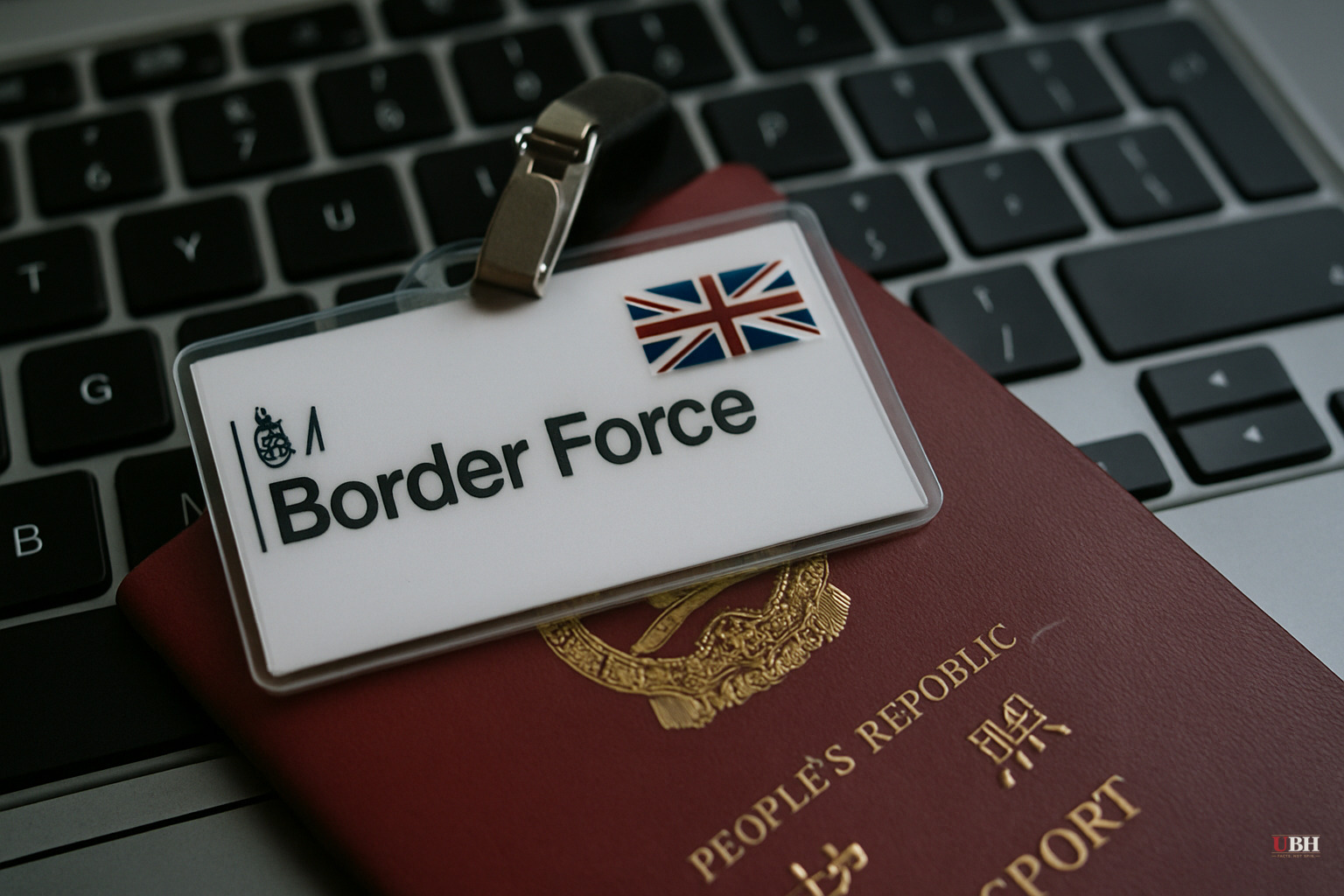
Two Men Sentenced at the Old Bailey
Chi Leung "Peter" Wai, 40, was sentenced to 10 years in prison. His handler, Chung Biu "Bill" Yuen, 65, received eight years. Both were convicted of assisting a foreign intelligence service under the National Security Act, according to BBC News reporting from Thursday's sentencing. Wai also faced a separate conviction for misconduct in public office, tied directly to his role as a Border Force officer. Specifically, Wai was sentenced to six years for assisting a foreign intelligence service and four additional years for misconduct in public office.
What They Actually Did
Wai was not a low-level clerk. He began working as a Border Force officer at Heathrow Airport in December 2020 and had access to the Home Office's computer systems — a vast database of information about foreign nationals in the UK. He used that access to track Hong Kong dissidents who had fled pro-democracy crackdowns to the UK. That is state surveillance of political refugees, run from inside British government infrastructure.
Detectives described the operation as a "shadow policing operation conducted on behalf of the Hong Kong authorities, and by extension, the Chinese state", per BBC News.
Yuen was the handler: a former Hong Kong police officer who went on to work as the office manager of the Hong Kong Economic and Trade Office in London, and who became Wai's contact with Chinese authorities. The pair represent a full intelligence cell with a recruited insider and the intelligence officer managing him.
The court also heard that "special attention" was paid to British politicians, such as Conservative MP Sir Iain Duncan Smith. Wai additionally drew a fellow Border Force officer, an ex-Royal Marine called Matthew Trickett, into the surveillance operation. Trickett was found dead in a suspected suicide soon after being charged alongside Wai and Yuen under the National Security Act.
The Judge's Words
Mrs. Justice Cheema-Grubb did not mince it. She told both men their actions "threaten the sovereignty of the state." This was not a financial crime or a personal betrayal. A sitting judge characterized it as an attack on British sovereignty itself.
What This Means for the People Being Tracked
Hong Kong dissidents moved to the UK to escape Beijing's reach. The assumption was that British soil meant safety. This case proves that assumption was wrong, at least for a period. Chinese intelligence had eyes inside the British government, watching exactly where these people were and what they were doing.
The stakes were visible in the courtroom itself: in the public gallery on Thursday, a number of pro-democracy activists from Hong Kong watched as the sentences were handed down. Among them was one activist who has had a HK$1 million (£100,000) bounty placed on her by authorities in Hong Kong.
Commander Helen Flanagan, Head of Counter Terrorism Policing London, said in a statement following sentencing that the investigation demonstrates this activity "will not be tolerated." She addressed would-be operatives directly: "I want to be really clear that if you are working on behalf of a foreign state, that we in counter-terrorism policing and with our partners will identify who you are and bring the full force of the National Security Act upon you."
The Strongest Counterpoint
A fair concern worth addressing: some argue that aggressive prosecution of individuals with Chinese heritage risks fueling discrimination or encouraging a climate of suspicion toward the British Chinese and Hong Kong diaspora. Ethnic profiling is a real failure mode in counterintelligence.
Wai and Yuen were convicted because of documented, provable conduct: accessing government databases to run surveillance on political dissidents at the direction of a foreign government. The investigation involved trawling through more than 20 terabytes of data, including thousands of messages and information in multiple languages. The evidence was specific and the trial ran its full course. The concern about community trust is real, though the facts of this case do not support framing the convictions as targeting.
Why Government Access Is the Core Problem
The most alarming element of this case is not that Chinese intelligence tried to recruit someone in Britain. Every major intelligence service recruits inside its adversaries. The alarming part is that it worked, for a time, inside a government agency with direct access to sensitive immigration records.
Border Force handles the movement of people in and out of the UK. An officer there with compromised loyalty is not a peripheral vulnerability. That is a direct pipeline into who is entering and leaving the country, and in this case, where specific political targets are living.
The convictions are under the National Security Act. Security Minister Angela Eagle said the government "will continue to hold China to account and take action against anything that puts the safety of people in our country at risk", including Hong Kong police's use of arrest warrants and bounties.
The open question now is scope. Wai and Yuen were caught. The investigation does not publicly confirm whether they were the only active cell, and Counter Terrorism Policing London has not publicly stated whether connected individuals remain under investigation. Whether this was an isolated operation or one node in a broader Chinese intelligence network inside UK institutions remains unresolved.
Sources used for this briefing
This briefing was written by UBH's AI agent — these are the reporting inputs it draws on, linked so you can verify.