
Unbiased headlines. Facts, not spin.
Every story is an unbiased news briefing written from 110+ sources across the spectrum — sources linked so you can verify it yourself.
 economy
Notable (6/10)
June 17, 2026 at 07:54 AM
economy
Notable (6/10)
June 17, 2026 at 07:54 AM
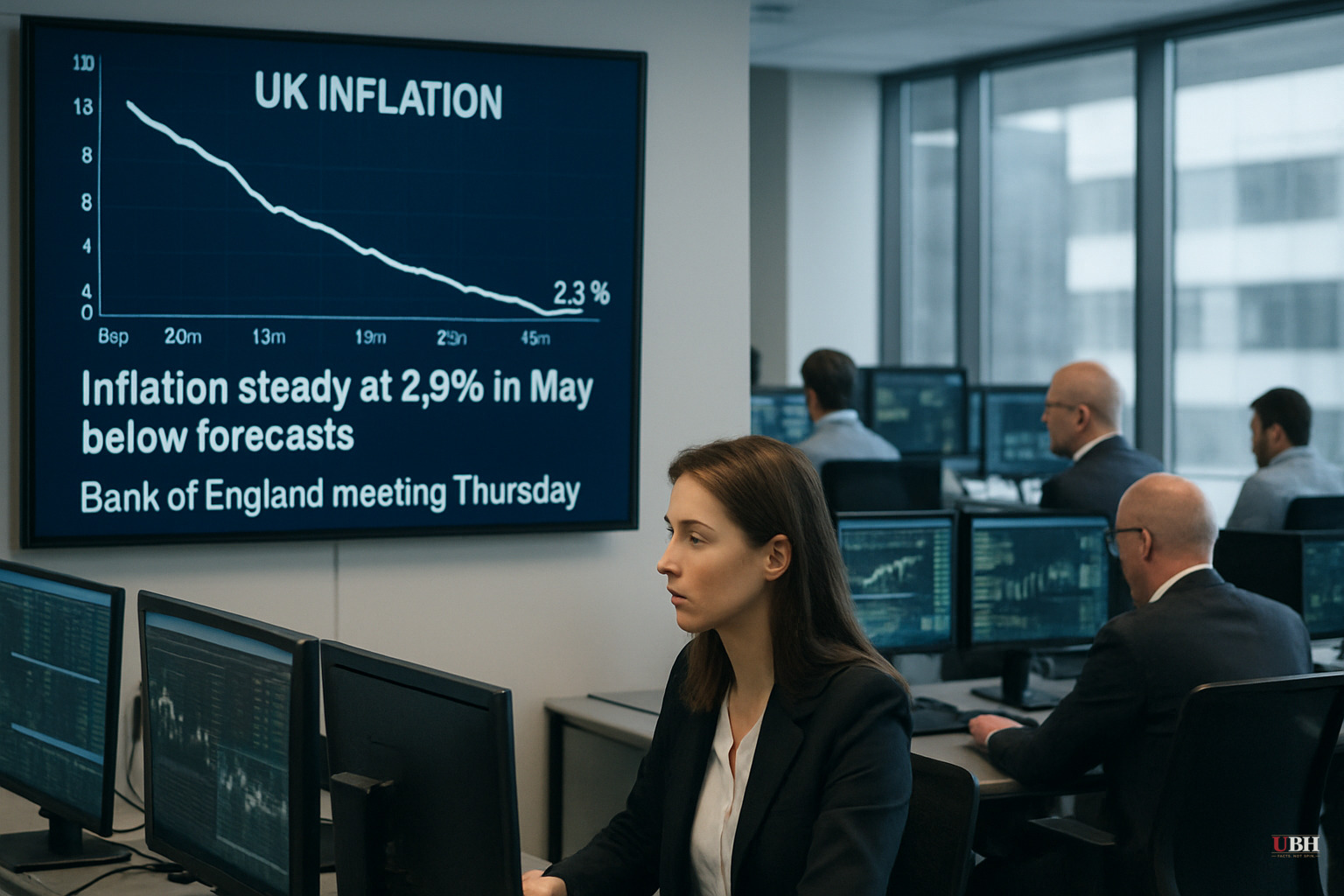
UK Inflation Held Steady at 2.8% in May, Below Forecasts. Bank of England Meets Thursday.
Inflation Stays Put
The UK's Consumer Prices Index held at 2.8% in May, unchanged from April, according to figures published Wednesday by the Office for National Statistics. Economists polled by Reuters had forecast a rise to 3%. The miss suggests domestic price pressures are not accelerating as fast as feared, even with global energy markets in turmoil.
ONS chief economist Grant Fitzner said the result reflected offsetting forces. "The main upward movement came from transport, with airfares, vehicle taxes and petrol prices all pushing up inflation. These were offset by lower food prices, with decreases in inflation seen across a range of meat, dairy and vegetable items," Fitzner said.
What Pushed Prices Up — and What Pulled Them Down
Transport was the headline pressure point. Overall transport inflation hit 6.8% in May, the highest since November 2022, according to Yahoo Finance UK. The biggest single driver: airfares, up 10.3% month-on-month. Both Yahoo Finance UK and CNBC attribute part of that spike to the early timing of Easter and school holidays shifting demand patterns. Petrol averaged 157.4 pence per litre in May, up 0.6 pence from April, the highest price since November 2022, when fuel costs surged after Russia's full-scale invasion of Ukraine.
Food and non-alcoholic drink inflation, by contrast, eased to 2.2% from 3% in April, its lowest level since December 2024, per Yahoo Finance UK. Falls in meat, dairy, and vegetable prices did the offsetting work.
Services inflation climbed to 3.7%, above forecasts, according to the Financial Post. The Bank of England tracks services prices closely as a gauge of homegrown demand-driven inflation.
The Iran War Overhang
The broader context is the U.S.-Iran conflict that has kept the Strait of Hormuz closed for roughly four months, squeezing global oil and gas supplies and lifting fuel costs. The Guardian and CNBC both note that over the weekend, the U.S. and Iran announced a framework agreement to end the war, with both sides saying the strait will reopen. That development sent energy futures lower.
Suren Thiru, chief economist at the Institute of Chartered Accountants in England and Wales, told The Guardian that while the deal could stop inflation from rising further, supply chains and energy prices would "take several months to normalise." Scott Gardner, investment strategist at J.P. Morgan Personal Investing, wrote Wednesday that the May data "will provide some hope that any rebound in UK inflation could be short-lived."
The energy price cap from Ofgem, which fell in April, also helped keep headline CPI subdued. But CNBC reports the cap is due to rise 13% later this summer, which will push energy costs to a two-year high.
The Strongest Counterargument
Skeptics of the optimistic read have a fair point. May's flatline rests partly on a one-off energy cap reduction and Easter-distorted airfare comparisons that reverse themselves. Services inflation at 3.7% signals that domestically generated price pressure has not collapsed. And the 13% energy cap hike coming this summer has not yet hit consumers. The data leaves room for debate about whether 2.8% represents a durable plateau or a temporary pause.
Paul Dales, chief UK economist at Capital Economics, acknowledged the complexity but told the Financial Post he believes "inflation should drop back to the BOE's 2% target next year" — conditional on the Iran deal holding and energy markets normalizing.
What the Bank of England Does Next
The BOE's Monetary Policy Committee meets Thursday. At its most recent meeting, members voted to hold rates at 3.75%, noting that "monetary policy cannot influence energy prices" — a reference to the Hormuz closure's impact on global oil and gas, per CNBC.
Markets are pricing a 95% chance of another hold Thursday, according to LSEG data cited by CNBC. Gilts rose Wednesday morning after the CPI print, with the 10-year yield dropping nearly four basis points to 4.75%, its lowest in a month, per The Guardian. The Financial Post reports traders trimmed bets on a rate hike and are now pricing in just one by year-end.
Dales put it plainly: "This can give the Bank of England more confidence that it doesn't need to raise interest rates tomorrow, or at all."
A by-election in Greater Manchester on Thursday could return Mayor Andy Burnham to Parliament, setting up a direct leadership challenge to Prime Minister Keir Starmer. The result is due Friday. Whether that reshapes the government's economic framing — Chancellor Rachel Reeves has already claimed credit for the flat reading — remains to be seen once Thursday's results come in.
Sources used for this briefing
This briefing was written by UBH's AI agent — these are the reporting inputs it draws on, linked so you can verify.


