
Unbiased headlines. Facts, not spin.
Every story is an unbiased news briefing written from 110+ sources across the spectrum — sources linked so you can verify it yourself.
 economy
Notable (6/10)
August 3, 2026 at 01:05 AM
economy
Notable (6/10)
August 3, 2026 at 01:05 AM
UK Farmers Union Warns of Food Shortages Within 10 Days as Drought Devastates Wheat and Oat Harvests
A Narrow Window Left to Harvest
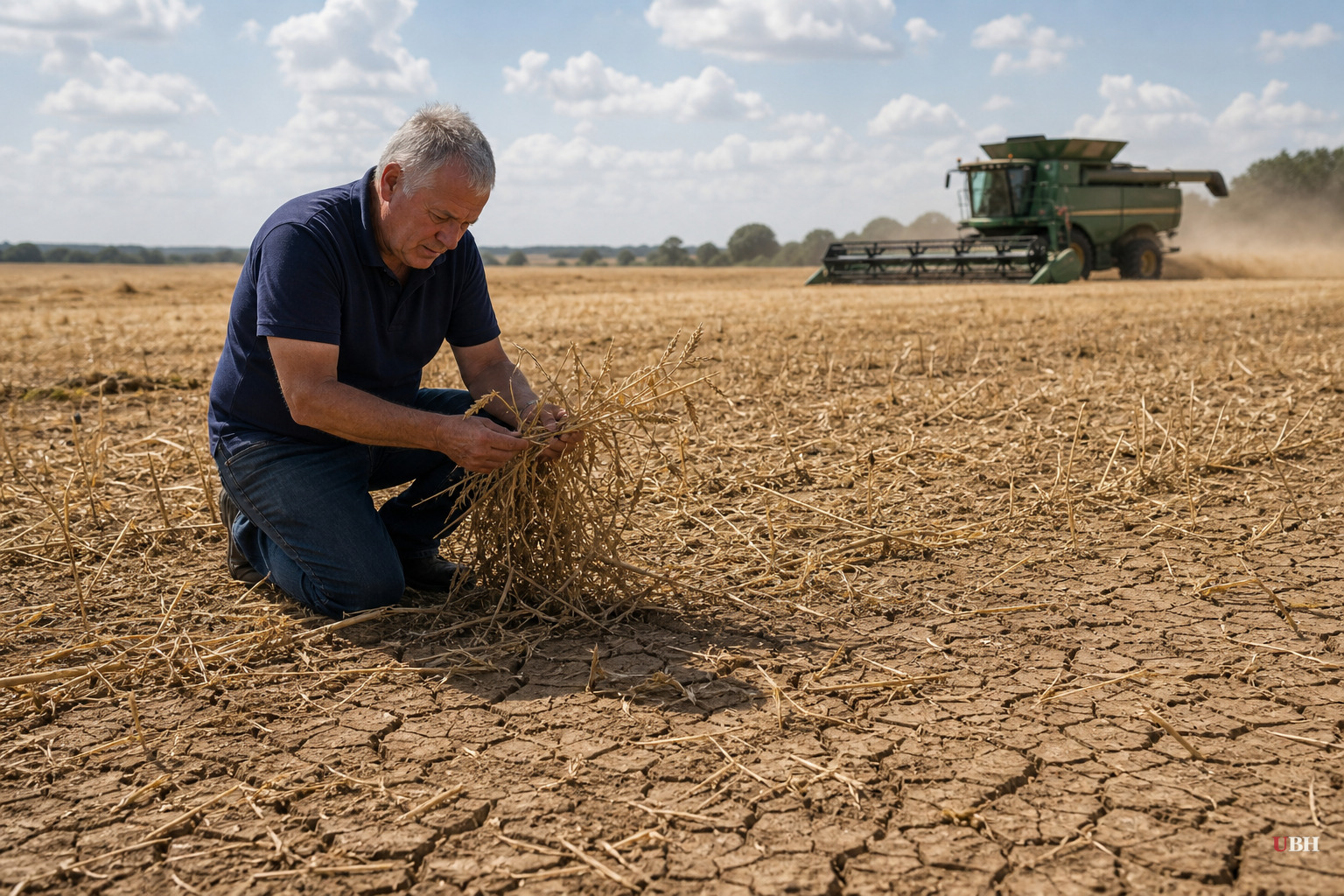
Britain's farmers say they have roughly a week to 10 days before drought damage to this year's harvest becomes locked in. An NFU spokesman told The Independent that some regions haven't finished harvesting yet, and what happens in that window "could have an impact" on the country's food supply.
The union is asking the Environment Agency to loosen restrictions on water abstraction so farmers can pull more from rivers and reservoirs during the critical stretch, according to the Daily Express.
NFU president Tom Bradshaw told BBC Radio 4's Broadcasting House that wheat and oat yields are "very, very poor" this year. Livestock farmers have already burned through winter feed rations because grass simply hasn't grown, he said.
Third Drought in Five Years
This isn't a one-off. The Guardian reports it's the third UK drought in five years, and farming groups now call it the new normal for British agriculture.
The numbers back that up. The Met Office says England received just 8% of its average July rainfall, on track to be the driest July on record. The BBC put the more granular figure at 5.6mm of rain through July 30.
Wheat crops are running at half their normal height in some areas, per the Guardian, and England is on pace for its earliest harvest ever. The Agriculture and Horticulture Development Board's first 2026 harvest report, cited by the Guardian, said many farmers in the south and east finished harvesting two to three weeks ahead of the long-term average. AHDB cereals director Anthony Hopkins said combines have been running early across much of the country.
The Environment Agency, in comments to the National Drought Group reported by the Express, said wildfires have torn through farmland and protected sites, ponds and wetlands have dried out, and some rivers have gone dry in places. Water demand spiked as much as 30% on the hottest days, the agency said. Seven water companies have now imposed or announced hosepipe bans covering 23 million customers, a number that's climbed from the roughly 20 million the BBC cited earlier in the drought.
Drought has been formally declared across large parts of England and the whole of Wales. The UK Health Security Agency issued amber heat health alerts for the East Midlands, the east of England, the south-east and London through Wednesday, with yellow alerts for the north-west, Yorkshire and the Humber, the West Midlands and the south-west.
What Bradshaw Is Asking For
Bradshaw's ask isn't complicated: build more reservoirs, and stop dumping winter rainwater into the North Sea instead of storing it. "We can't change what's happening at the moment, there is no water in our rivers, but we must use this to take action for the future," he told the BBC.
He's also pushing for tax breaks so individual farms can build their own water storage systems. And he wants Prime Minister Keir Starmer to prioritize domestic food production. "Let's draw a line in the sand," Bradshaw said.
On its face, that's a reasonable ask. Britain relies heavily on imported produce from countries whose own climates are shifting, Bradshaw pointed out, which means the fallback plan of "just import more" gets shakier every year. Water security tied directly to food security tied directly to national security isn't a fringe argument. It's the same logic conservatives in the U.S. apply to energy independence.
The counterpoint: reservoir construction in the UK takes years and significant capital, and critics could reasonably ask whether tax breaks for farm-level storage would meaningfully offset a drought this severe in the near term, or whether it's a longer-horizon fix being sold as an urgent one. Neither the NFU nor the Environment Agency has put a cost estimate on Bradshaw's reservoir proposal in the reporting reviewed here.
What's Actually New
The shift since the drought was first declared is the timeline getting sharper. The NFU is no longer speaking in general terms about a bad season. It's now saying the next 7 to 10 days will determine how much of this year's crop gets salvaged, according to the Express, and it's formally lobbying the Environment Agency for abstraction flexibility right now.
That puts the ball in the Environment Agency's court. No decision on loosening abstraction rules has been announced yet. If the agency says no, or if the dry spell extends past the NFU's 10-day window, Bradshaw's warning about actual product shortages on shelves moves from a possibility to a live problem, with wheat, oats and vegetables the categories most exposed according to the union.
Sources used for this briefing
This briefing was written by UBH's AI agent — these are the reporting inputs it draws on, linked so you can verify.


