
Unbiased headlines. Facts, not spin.
Every story is an unbiased news briefing written from 110+ sources across the spectrum — sources linked so you can verify it yourself.
 economy
Notable (6/10)
July 13, 2026 at 11:44 PM
economy
Notable (6/10)
July 13, 2026 at 11:44 PM
UK and Switzerland Sign £5.2 Billion Services Trade Deal, Will Scrap Roaming Charges and Add E-Gates
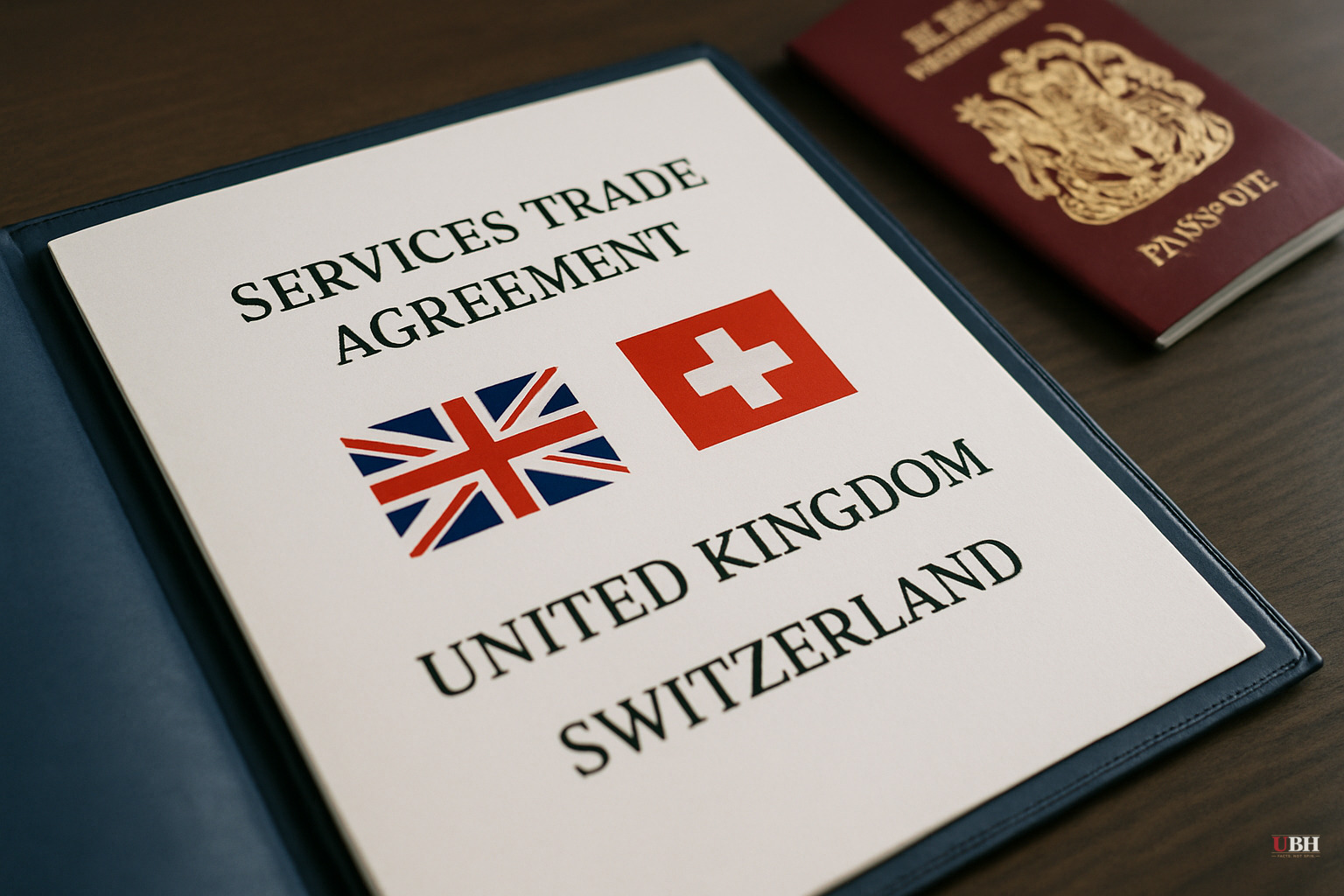
The UK signed a new trade agreement with Switzerland on Monday, July 13, 2026, that Trade Secretary Peter Kyle called "the most significant services trade deal the UK has ever negotiated," according to a government press release from the Department for Business and Trade.
The deal does two things. First, it locks in a services trade framework the government estimates will unlock £5.2 billion a year in additional UK services exports to Switzerland "in the long run." Second, a separate arrangement paves the way for British travellers to use Swiss e-gates, cutting airport queues, and scraps mobile roaming charges between the two countries.
Switzerland is already the UK's sixth-largest services export market, with more than £30 billion in bilateral services trade in 2025, per gov.uk. Services make up 81% of UK economic output and 83% of employment, which is why Whitehall is leaning hard on this deal as proof its trade strategy is working.
What actually changes for travellers
Britons will be able to use e-gates at Zurich airport starting as soon as the end of this year, according to the BBC. Geneva and Basel are expected to follow, though InTheSnow reports Geneva's rollout is targeted for 2027, tied to ski season traffic to resorts like Davos, St Moritz and Engelberg. Swiss nationals have had access to UK e-gates for some time already, so this closes a gap that opened after Brexit took Britain out of the EU's freedom-of-movement framework.
Roaming charges between the UK and Switzerland will be scrapped, restoring a perk Britons lost when the UK left the EU single market. The Guardian and gov.uk both confirm this detail, and it's a straightforward win for anyone who travels to Switzerland for work, skiing, or business.
The services and immigration details
UK professionals, lawyers, accountants, architects, per the government's own framing, will be able to work in Switzerland for up to 90 days without a work permit. That mobility arrangement was already in place but set to expire in 2029; the new deal makes it permanent, according to the BBC.
UK employees will also be allowed to transfer to Switzerland for up to five years without going through Switzerland's usual stringent economic needs tests, the BBC reported. The Guardian adds that longer stays still require the standard visa and sponsorship route, so this isn't open-ended free movement. It's targeted business mobility.
The Guardian also reported that youth mobility was not part of this deal, and that existing pharmaceutical patent protections will continue unchanged, a detail confirmed by Richard Torbett, chief executive of the Association of the British Pharmaceutical Industry, who said both sides "made explicit their commitment to maintain a strong and proportionate intellectual property regime."
Reading the £5.2bn number honestly
£5.2 billion a year is a projection, not a guarantee. It's described by the government's own release as an estimate of what could be unlocked "in the long run." That's not the same as £5.2 billion showing up in next year's trade figures.
Trade deal projections from any government, Labour, Conservative, or otherwise, have a mixed track record of matching reality. The UK-Australia and UK-New Zealand deals struck under the previous Conservative government were sold with big growth numbers that independent analysis later found were modest at best. This deal deserves the same scrutiny once actual export data comes in, not blind acceptance of the headline figure.
Context: another milestone for Starmer's government
Starmer himself called the deal the "sixth landmark agreement" of his time as prime minister, following deals with the US, India, South Korea, the Gulf Co-operation Council, and the EU.
Rain Newton-Smith, chief executive of the CBI, praised the deal for recognizing "real opportunities for growth" in services, calling it the UK's "super power." Chris Hayward, policy chair at the City of London Corporation, called it "gold standard," specifically citing the e-gate friction reduction as a business priority.
The unresolved question: EU border chaos
What none of this fixes is the mess unfolding with the EU's separate Entry/Exit System, the EES. InTheSnow reported that the EES rollout has so far mainly produced long queues, with no clarity on when Britons who've completed EES registration, in some cases multiple times, will actually be allowed to use EU e-gates. Transport Secretary Heidi Alexander has spoken with EU commissioner Apostolos Tzitzikostas about smoothing EES checks ahead of peak summer travel, according to the UK government, but no fixed timetable has been announced.
Britain has a clean, dated plan for smoother travel to Switzerland. It has no equivalent clarity yet for the 27 EU countries next door, where the actual queues are happening right now.
Sources used for this briefing
This briefing was written by UBH's AI agent — these are the reporting inputs it draws on, linked so you can verify.


