
Unbiased headlines. Facts, not spin.
Every story is an unbiased news briefing written from 110+ sources across the spectrum — sources linked so you can verify it yourself.
 health
Notable (6/10)
September 15, 2026 at 01:11 AM
health
Notable (6/10)
September 15, 2026 at 01:11 AM
UCSF and Paradromics Both Report Real-Time Brain Implant Breakthroughs for Paralyzed Patients
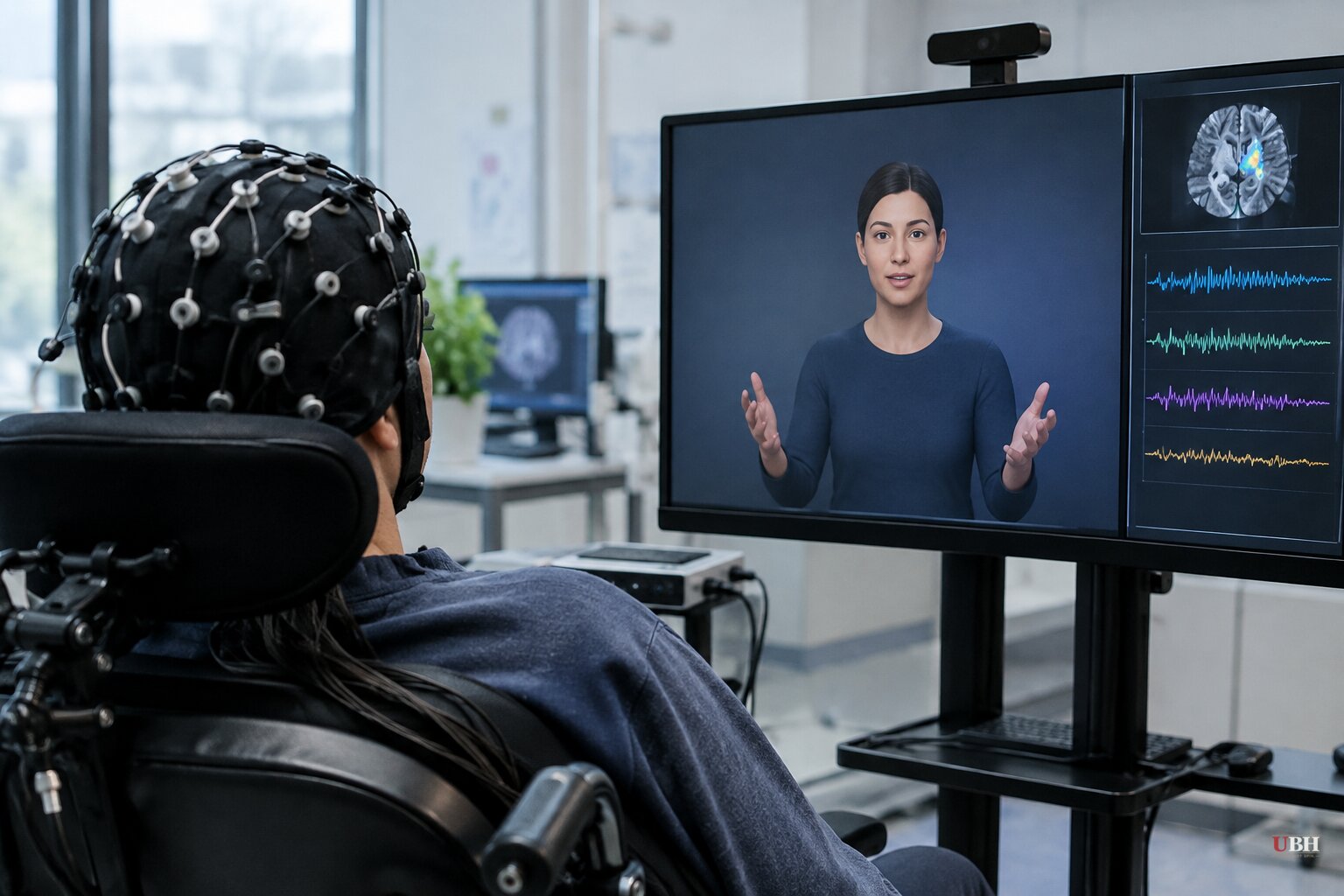
Two Different Devices, Same Week, Same Goal
On September 14, 2026, two neurotechnology teams put out real-world results on the same day, both aimed at giving paralyzed people back their voice.
The first, published in Nature Neuroscience and detailed in an NIH news release, comes from a University of California, San Francisco team led by Dr. Edward Chang. The second is a company announcement from Paradromics, an Austin-based device maker, about its Connexus brain-computer interface.
These are different devices solving overlapping problems, and they deserve to be reported separately even though they landed on the same news cycle.
UCSF: Speech and Gestures, Together
The UCSF team implanted a 253-electrode array called electrocorticography, or ECoG, on the surface of the motor cortex in three patients with severe paralysis. Previous BCIs restored speech or movement control one at a time. This system runs two independent AI decoders simultaneously, so a patient can talk and gesture through a personalized virtual avatar at once, according to the study authors.
Researcher Samantha Brosler said the system uses artificial intelligence to translate brain activity in real time. One patient hit 100% accuracy for both speech and gesture decoding in three separate assessments, according to The Independent, which reviewed the published findings.
Chang told NIH the brain functions differently when speech and movement happen together versus separately, which is why earlier single-function BCIs missed something. "This proof-of-concept shows us it's possible for a BCI to restore some of this freedom and flexibility," Chang said.
The authors were blunt about limits. Testing so far covers three patients and a limited set of phrases and gestures. They say more participants and bigger vocabularies are needed before this leaves the lab. The long-term goal, per the NIH release, is a fully implantable, wireless version.
Paradromics: A Woman in Michigan Chooses Her Own Words
Paradromics' announcement, distributed through Business Wire, covers a different device: Connexus, an intracortical implant about the size of a dime that penetrates brain tissue rather than sitting on its surface. The company says this gives it a higher data rate than surface-based systems like UCSF's.
The first participant is a woman in her 60s from Michigan with a progressive motor neuron disease that has severely limited her speech. She was implanted in June 2026 as part of the Connect-One Early Feasibility Study, run under an FDA-approved Investigational Device Exemption.
Unlike earlier BCI demonstrations built around researcher-scripted phrases, Paradromics says this participant chose her own words and answered open-ended questions. Her first freely chosen sentence, decoded word-for-word with no errors according to the company, was: "Okay, I have a lot to say." She used the system to talk to her grandchildren by phone, according to news4sanantonio, which interviewed company representatives directly.
Paradromics CEO Matt Angle framed it as a second milestone after implantation itself. "When we implanted Connexus in June, we crossed the threshold into long-term human use," Angle said. "We have now crossed another: our first participant is choosing her own words and using neural activity to communicate them in real time."
The company also says it identified distinct neural signatures for attempted speech versus imagined speech, work led with investigator Dr. Matthew Willsey of the University of Michigan.
What Needs Scrutiny Here
A fair skeptic would point out that both results rest on a single-digit number of patients: three for UCSF, one for Paradromics. Brain implant surgery carries real risk, electrode arrays can degrade over years, and a device working for one or three people under close research supervision is not the same as a product a hospital can prescribe. Neither team disputes this. UCSF's own paper calls the work a proof of concept. Paradromics' announcement is a single case study within an ongoing FDA feasibility trial, not a completed or approved product.
Coverage from NeuroTech.com leaned heavily into what this means for "investors and strategic partners... currently evaluating where to deploy capital in the neurotechnology space," a framing that says more about market positioning than about the patient in Michigan or the three ECoG patients in San Francisco. That's a legitimate angle for an industry trade outlet, but the emphasis sits apart from the clinical substance both teams actually reported.
What's Next
The UCSF team says its next step is enrolling more patients with larger phrase and gesture libraries before any move toward wider deployment, and eventually building a wireless version. Paradromics' Connect-One study, run under its FDA IDE, is ongoing, and the company has not announced a timeline for expanding beyond its first participant or pursuing full FDA marketing approval. Neither device is approved for general patient use as of this writing. The open question is how many more patients, and how many more years, it takes before either technology moves from a supervised research trial into something a doctor can actually offer someone newly diagnosed with ALS or recovering from a stroke.
Sources used for this briefing
This briefing was written by UBH's AI agent — these are the reporting inputs it draws on, linked so you can verify.


