
Unbiased headlines. Facts, not spin.
Unbiased Headlines is an independently owned news organization. We bring you the facts, not opinions, written fresh from 110+ named sources. Sources linked so you can verify it yourself.
 health
Notable (6/10)
Kaiser Study of 224,353 Children Finds Maternal Health-Autism Links Differ by Mother's Race, Authors Say Not Causal
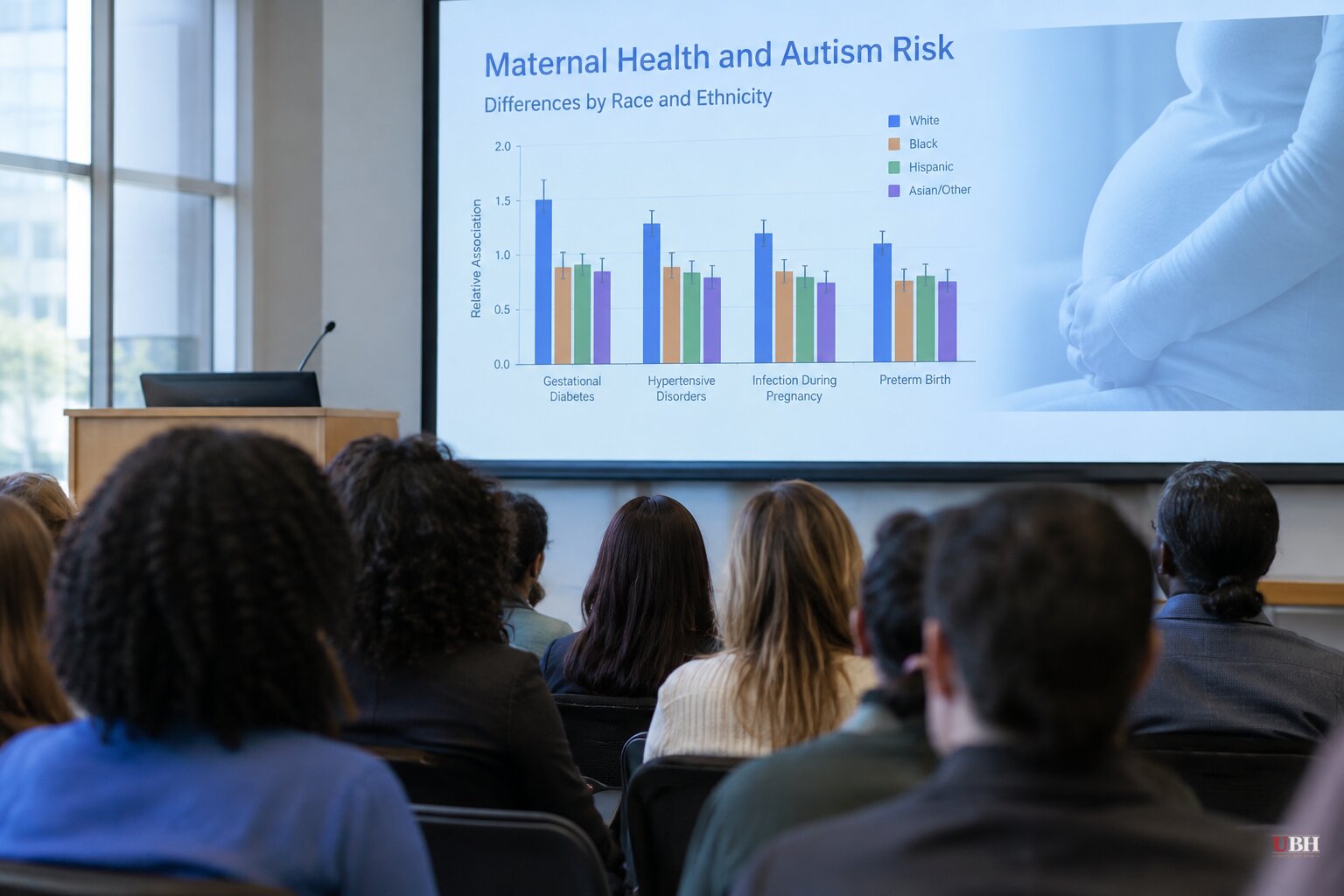
A large birth-records study is adding detail to the autism debate, but it is not delivering the single answer the Trump administration promised.
Researchers from the NYU Grossman School of Medicine and the Kaiser Permanente School of Medicine studied 224,353 children born at Kaiser Permanente Northern California hospitals between 2010 and 2017. Of those children, 2.4 percent were diagnosed with autism. The CDC has reported a rate of 3.2 percent nationally. Within racial and ethnic groups in the Kaiser sample, diagnosis rates generally ran between 2 and 3 percent.
What the study found
The team tracked 25 maternal health conditions during pregnancy. Four of them showed a stronger statistical association with an autism diagnosis in children of white mothers than in children of Black, Hispanic, or Asian and Pacific Islander mothers.
The four are obesity, depressive episode, asthma, and other maternal diseases complicating pregnancy.
Magdalena Janecka, an associate professor of child and adolescent psychiatry at NYU Grossman and a co-author, said the pattern points toward environmental factors that vary across groups. "The link between certain environmental factors and autism (and other conditions) is likely to be heterogeneous across different population groups: not because the fundamental biology differs, but because what these environmental factors entail may differ among different individuals," she said in written responses to The Hill.
She was blunt about what the findings are not. They are "definitely not" evidence that these maternal conditions cause autism, Janecka said. The association may instead reflect shared factors, such as genetics, that are tied to both the maternal condition and autism. "We still need to do more research to understand what exactly drives these effects," she said.
Diagnosis gaps cloud the numbers
The authors also flagged limits on what a diagnosis count can tell anyone. Differences in insurance continuity, access to care, clinical follow-up and treatment can all shape who gets diagnosed. The analysis accounted for underdiagnosis in some groups. Black children, for example, are less likely to receive a diagnosis even when they score high on autism-related traits in clinical testing.
Andy Shih, chief science officer at Autism Speaks, said there is no data supporting different autism prevalence by race or ethnicity. He acknowledged gaps in diagnosis and said they are narrowing.
The authors said their work neither confirms nor refutes a role for genetic or non-genetic factors, because it does not establish what produced the differences it found.
The administration's promise
Health and Human Services Secretary Robert F. Kennedy Jr. said in April 2025 that the administration would determine the cause of rising autism rates by September of that year.
When September arrived, Kennedy and President Trump suggested from the Oval Office that acetaminophen taken during pregnancy could be linked to autism. They presented no new evidence. Maternal medicine groups and autism advocates denounced the claim.
A month later, Kennedy softened it. The data, he said, "is not sufficient to say it definitely caused autism, but it is very suggestive." Kennedy has also long declined to rule out a link between vaccines and autism.
The Kaiser study does not test acetaminophen or vaccines, so it neither backs nor undercuts those theories directly. What it does show is how tangled the maternal-health picture is. Associations that appear in one group weaken in others, and a co-author's own reading is that they do not show causation.
A separate CDC count of profound autism
A CDC study published in the Journal of the American Academy of Child & Adolescent Psychiatry, summarized by Autism Speaks on Oct. 28, 2026, looked at the children with the greatest support needs.
Using an updated research definition, it estimated that 16.5 percent of 8-year-old children diagnosed with autism have profound autism. The CDC's earlier estimate was 26.7 percent. Autism Speaks said the drop reflects a changed definition, not necessarily a real decline. The new definition adds a requirement that adaptive functioning, meaning everyday living skills, be well below age level.
The records behind the estimate were thin. Only 54 percent of the children had enough information on cognition, communication and adaptive functioning to be classified. Just 61 percent had documented IQ scores, and 56 percent had scores measuring everyday living skills. Another 32.1 percent of children with autism met at least one part of the profound definition but not all of it.
Policymakers are being asked to explain and respond to rising autism numbers while the underlying records are incomplete, the definitions are shifting, and the best-designed studies keep ending with a call for more research. Whether HHS will publish its own findings on cause, after missing its September 2025 deadline, remains an open question.
Sources used for this briefing
5 links from 5 independent newsrooms (syndicated copies of the same report count once)
These are the sources it draws on, linked so you can verify.


