
Original briefings. Zero spin.
Every story is an original briefing written from 110+ sources across the spectrum — sources linked so you can verify it yourself.
 health
Notable (5/10)
Event date: August 21, 2026
health
Notable (5/10)
Event date: August 21, 2026
UCL Researchers Say Blood Transfusions Might Spread Alzheimer's-Linked Protein, Call for More Study
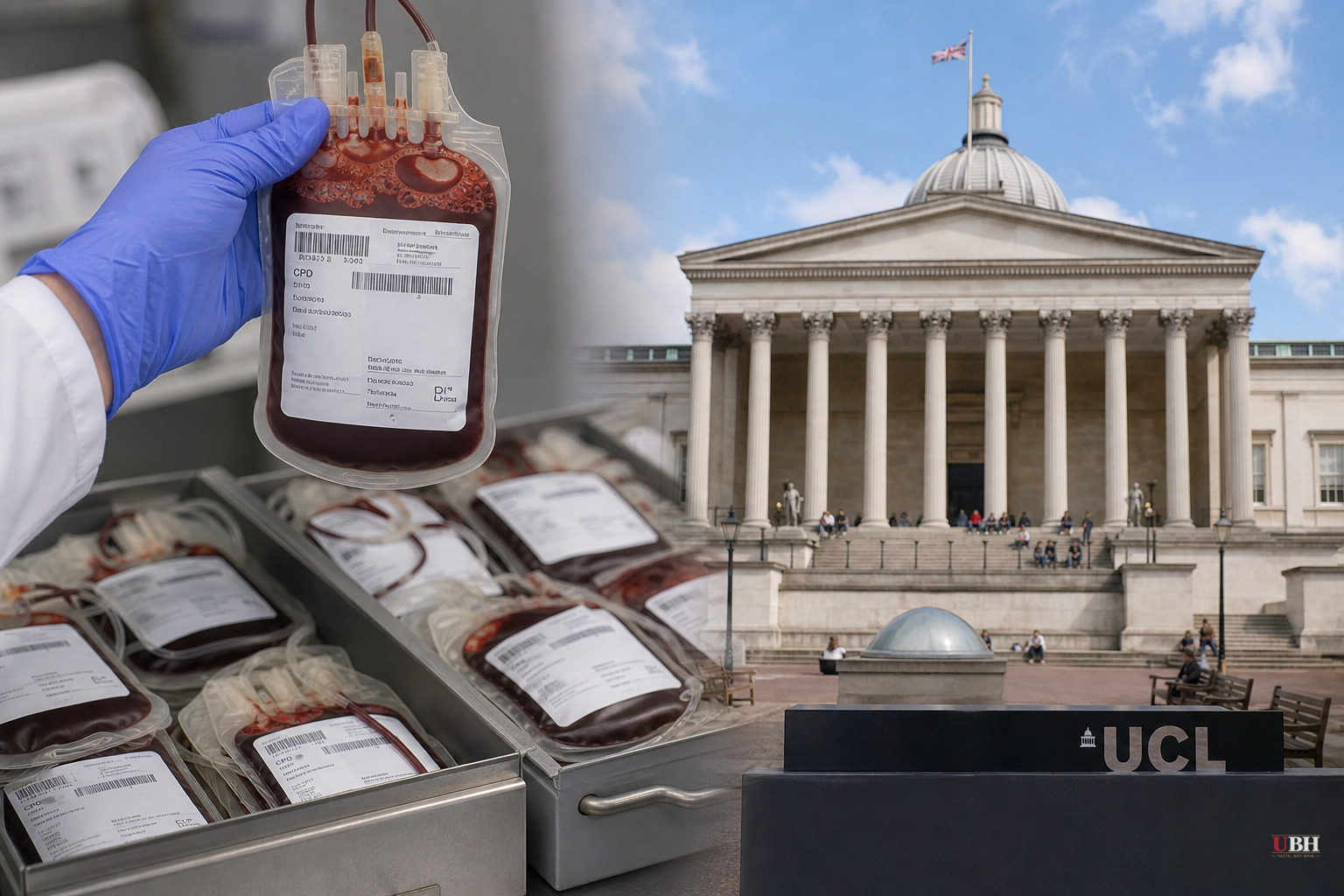
Blood transfusions save lives every day. A new review published in The Lancet asks a narrow but serious question: could they, in rare cases, also transmit the protein behind Alzheimer's disease and certain brain hemorrhages?
Professor John Collinge of University College London led the Viewpoint article, which grew out of an international workshop reviewing evidence on whether amyloid-beta pathology might spread through blood. Collinge told MedPage Today the workshop was convened "in the light of a large Scandinavian epidemiological study suggestive of such a risk and the existing literature on iatrogenic transmission of amyloid-beta pathology."
Amyloid-beta is a protein fragment tied to two conditions: Alzheimer's disease and cerebral amyloid angiopathy, or CAA, which weakens small blood vessels in the brain and can cause hemorrhagic strokes, according to BioEngineer.org. The protein can misfold and build up over years. Having some amyloid-beta doesn't guarantee dementia or stroke. Age, genetics and vascular health all factor in.
What the evidence actually shows
The centerpiece evidence is a 2023 epidemiological study out of the Karolinska Institute in Stockholm, covering more than 1 million patients across Swedish and Danish health records. Researchers found that people who received red blood cell transfusions from donors who later suffered multiple intracerebral hemorrhages had a significantly higher risk of suffering a brain hemorrhage themselves.
Multiple hemorrhages can be a marker of CAA, but they can also stem from other causes entirely. The study was observational. It found an association, not a proven cause. Collinge and his co-authors acknowledged this limitation directly, writing that detailed phenotyping to confirm CAA in donors or recipients wasn't possible in that dataset.
Still, the authors argue the pattern is "consistent with a factor associated with intracerebral hemorrhage risk being transferrable between donor and recipient," and say the most biologically plausible explanation is transmission of amyloid-beta seeds. That's their interpretation of an association, not a demonstrated mechanism.
Why this isn't coming out of nowhere
The reason UCL researchers are taking this seriously traces back to older, well-documented cases of amyloid-beta being transmitted through discontinued medical procedures. Collinge's team first reported human-to-human transmission of amyloid-beta pathology in 2015, in patients who died of Creutzfeldt-Jakob disease after childhood treatment with cadaver-derived human growth hormone.
Later research identified cases of early-onset CAA in patients who'd received cadaveric dura mater grafts, tissue transplants used decades ago in some neurosurgical procedures. In 2024, Collinge's group published a case series on five patients who developed iatrogenic, or medically acquired, Alzheimer's disease decades after childhood treatment with cadaveric growth hormone. A more recent case, described earlier this year, included autopsy-confirmed Alzheimer's in a similar patient.
Both of those source treatments are long gone. The UK stopped using cadaveric dura mater in 1992 and cadaveric growth hormone in 1985, according to UCL's own summary of the research. Nobody treated today receives either.
What this doesn't mean
None of the five sources reviewed here claim that current blood transfusions are causing Alzheimer's disease or strokes. BioEngineer.org states this plainly: the article "does not claim that modern blood transfusions cause dementia or brain haemorrhages." Collinge himself framed it as investigative caution, not alarm: "Blood transfusions are important and save many lives," he said in a statement carried by both UCL and Medical Xpress. "However, to ensure that they are as safe as they can possibly be, it's important that we thoroughly investigate any potential risks."
That's the honest state of play. An association from one large observational study, paired with a genuine biological mechanism seen in unrelated historical medical procedures, is enough to justify asking the question. It is not enough to justify changing transfusion policy today, and none of the researchers are asking for that.
What happens next
Collinge and colleagues say the immediate need is data and tools, not new rules. There is currently no validated, feasible screening test to detect amyloid-beta seeding activity in donated blood. Building one and running the epidemiological work needed to confirm or rule out a transmission risk will take time.
That leaves blood transfusion services and public health regulators in an uncomfortable spot: acting on a signal that isn't yet strong enough to act on, while the underlying science catches up. Collinge called it a situation requiring "rigorous science" alongside "urgent" access to better risk data and screening assays. Until that research lands, patients receiving transfusions face the same blood-safety framework used today, one built to catch infectious agents, not misfolded proteins.
Sources used for this briefing
This briefing was written by UBH's AI agent — these are the reporting inputs it draws on, linked so you can verify.


