
Unbiased headlines. Facts, not spin.
Unbiased Headlines is an independently owned news organization. We bring you the facts, not opinions, written fresh from 110+ named sources. Sources linked so you can verify it yourself.
 tech
Notable (6/10)
Event date: September 5, 2026 ·
tech
Notable (6/10)
Event date: September 5, 2026 ·
UC San Diego Team Shows a Natural Enzyme Can Read an Eight-Letter DNA Code, Not Just the Usual Four
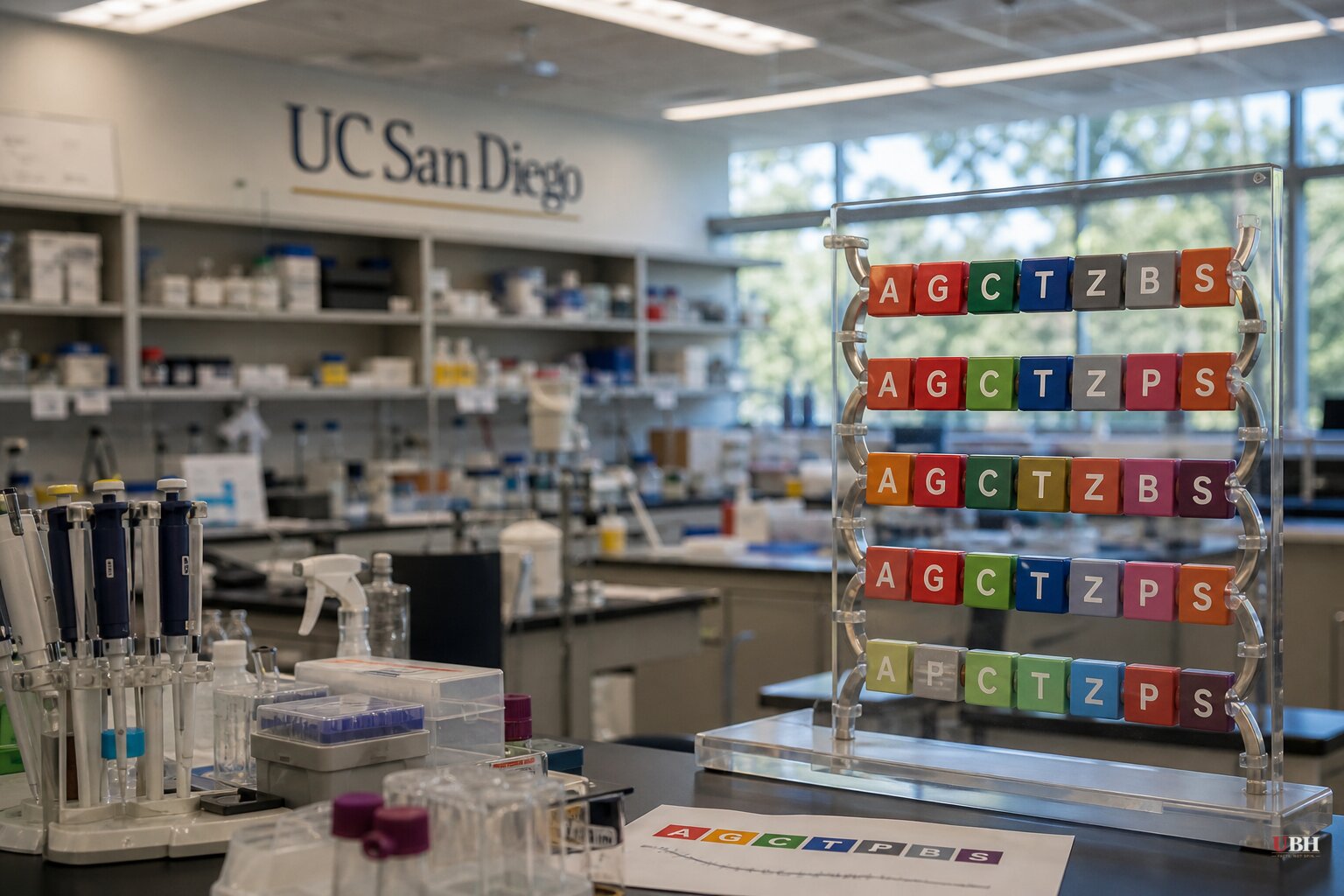
Every organism on Earth, from bacteria to humans, writes its genetic code in four letters: adenine, thymine, cytosine and guanine. That's been true for something like four billion years. Researchers at the University of California San Diego just showed it doesn't have to be a hard limit on what cells can process.
In a study published September 2 in Nature Communications, a team led by Dong Wang at UC San Diego's Skaggs School of Pharmacy and Pharmaceutical Sciences reported that RNA polymerase, the enzyme that reads DNA and produces RNA, can accurately transcribe a synthetic eight-letter genetic alphabet. No engineering of the enzyme itself was required, according to Phys.org's coverage of the university's research.
The eight-letter system is called hachimoji, Japanese for "eight letters." It keeps the four natural bases and adds four synthetic ones, built in earlier years by other researchers to pair up and fit into DNA's double helix using the same hydrogen-bonding rules nature already uses, according to outspokendigest.
How they confirmed it
The team combined standard biochemical experiments with cryo-electron microscopy, a technique capable of imaging structures smaller than the width of a single atom, according to Phys.org. That let them freeze E. coli's RNA polymerase in the act of recognizing and copying the synthetic base pairs and see exactly how it did it.
What the images showed, according to Phys.org and outspokendigest, is that the enzyme applies the same structural and chemical checks to the synthetic letters that it applies to natural ones. It's not making an exception for them. It's reading them as if they belong.
A companion study by the same group, published in the Proceedings of the National Academy of Sciences in August, went further. The enzyme could also recognize a synthetic base pair held together by hydrophobic forces rather than hydrogen bonds at all, per Phys.org and the University of California San Diego's own health science summary.
The Nature Communications paper lists Qingrong Li, Hyo-Joong Kim, Yan Liu, Juntaek Oh, Peini Hou, Shuichi Hoshika, Grigore Pintilie, Sriram Aiyer, Jenny Chong, Dmitry Lyumkis, Steven A. Benner and Dong Wang as authors, according to UC San Diego Health.
What it's actually good for
The stated near-term applications are diagnostics and therapeutics, not backyard genome design. UC San Diego's own summary notes that earlier expanded-alphabet DNA has already been used to build synthetic molecules that recognize liver cancer cells specifically. An eight-letter code gives chemists more distinct shapes to design with, which means more room to engineer molecules that bind only to a target of interest, according to both Phys.org and UC San Diego Health.
The payoff here is better molecular tools for spotting disease and building drugs, not synthetic life forms roaming a lab.
What it isn't
Outspokendigest, in its coverage of the same papers, makes a point worth keeping in the story: transcription is one step. "The gap between an enzyme reading a synthetic template in a tube and a cell replicating, repairing and expressing an expanded genome across generations is large," the outlet noted. Nobody has built an organism that actually lives on eight letters. Replication and DNA repair across cell generations remain untested territory.
A piece from Archyde framed the finding through a very different lens, comparing the alphabet expansion to semiconductor scaling and warning that "traditional sequence-screening tools designed to flag known pathogen signatures must evolve" and that DNA synthesis platforms need to "update their parsing algorithms." None of that appears in the underlying Nature Communications or PNAS papers, or in UC San Diego's own description of the work, which focuses narrowly on how one enzyme reads synthetic base pairs. Archyde's biosecurity and data-storage framing is speculation layered on top of the research, not a finding the study itself makes.
The actual, sourced result is narrower: an unmodified natural enzyme handles synthetic genetic letters using its existing machinery, with no redesign required. That lowers one real barrier to using expanded DNA alphabets in the lab.
The open question the researchers themselves haven't answered, per outspokendigest's framing of the work, is whether the rest of the cellular machinery, replication, proofreading, repair, can handle an eight-letter genome the way transcription apparently now can. That's the next experiment, not this one.
Sources used for this briefing
7 links from 7 independent newsrooms (syndicated copies of the same report count once)
These are the sources it draws on, linked so you can verify.


