
Original briefings. Zero spin.
Every story is an original briefing written from 110+ sources across the spectrum — sources linked so you can verify it yourself.
 tech
Low Interest (4/10)
September 8, 2026 at 01:34 AM
tech
Low Interest (4/10)
September 8, 2026 at 01:34 AM
Arm CEO Rene Haas Says Chip Shortage Is Holding Back AI Cancer Research
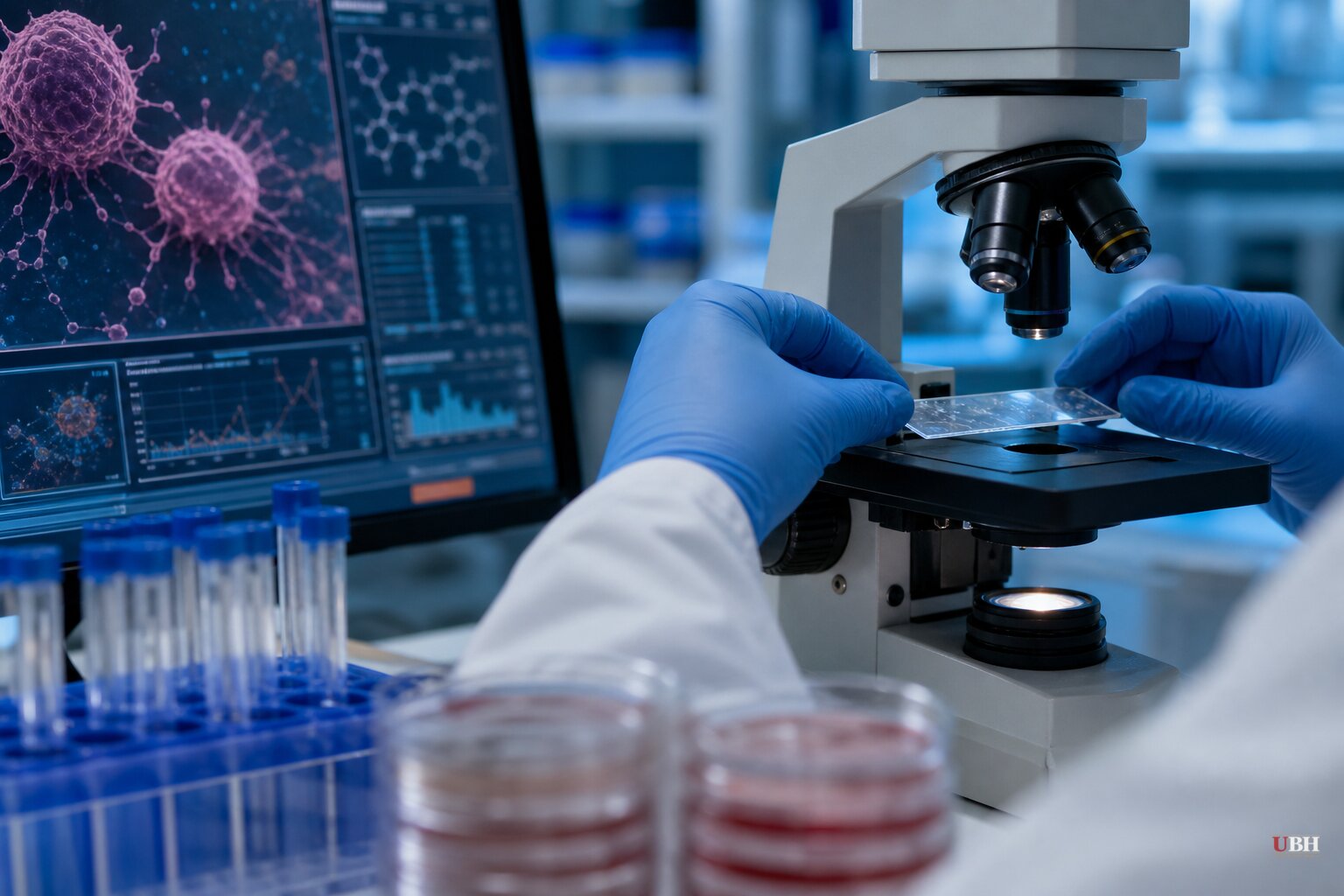
Rene Haas, chief executive of Arm Holdings, told the BBC's Big Boss Interview podcast that artificial intelligence will find a cure for cancer that humans on their own cannot, and he believes it'll happen in our lifetime. He also said the thing slowing it down is a shortage of the chips his own company designs.
Haas runs the Cambridge-based firm whose CPU designs sit inside hundreds of billions of phones, cars, smartwatches and gadgets worldwide, according to the BBC. Arm doesn't manufacture chips, it licenses the architecture, and its share price hit a peak this summer that made it, in cash terms, the most valuable UK-based company in history, per the BBC. Startup Fortune reported Arm's market cap crossed $300 billion in May 2026.
"Modelling a cell, modelling a human, modelling how a DNA marker is impacted by cancer, it's too complex a problem, not only for humans today, but the computers that run AI," Haas said, according to the BBC. "However, going forward, as we feed more and more of the models into these computers, and the computers get more sophisticated to run the models, they're going to solve it."
Haas also predicted humanoid robots will be widespread within five years and doing real manufacturing, cleaning, security and repair work within a decade, the BBC reported. He was skeptical the UK could build meaningful chip manufacturing capacity of its own, according to Startup Fortune's account of the same interview.
The shortage claim checks out, as far as it goes
Haas isn't inventing a supply problem. Startup Fortune reported that SK Hynix, Samsung and Micron have preallocated essentially all of their 2026 high-bandwidth memory capacity, with SK Hynix alone controlling 62% of the HBM market and sold out through the end of the year. TSMC's chief executive said on an April 2026 earnings call that supply won't catch up with demand until 2027, per the same report.
Startup Fortune also noted the geopolitical angle Haas raised: TSMC and ASML each control a vital link in the chip supply chain, Taiwan holds roughly 90% of advanced chip production and has used that leverage in trade talks with the US, Japan and the EU, Washington has floated 100% tariffs on Samsung and SK Hynix memory chips, and China's CXMT is rapidly gaining ground in DRAM. That's a real, physical bottleneck, not a marketing line.
Still, Haas is the head of a company whose entire business model depends on demand for computing power staying hot. He's also the one telling the BBC that more of his product is the thing standing between the world and a cancer cure. Nobody in these sources challenged him on that overlap directly, but readers should note it themselves.
A cancer researcher says it's not about the size of the computer
Prof Chris Bakal, from the Institute of Cancer Research in London and CEO of Sentinel4D, gave the BBC a different read entirely. He said the real question isn't whether to use AI, it's what data you feed it.
Bakal said his own labs train AI on data generated from patient samples themselves, not material scraped from the internet, and that the models don't need a giant data center to run. "The future of medical AI will not belong to whoever builds the biggest computer," he told the BBC. "It will belong to whoever has the right measurements. That kind of prediction could cut years from the time it takes to develop new treatments. This is where AI delivers real benefit to patients."
That's a direct rebuttal from someone who actually runs a cancer-AI lab to the idea that the field is waiting on more silicon. Both things can be partly true: large-scale genomic and molecular modeling may need more compute than exists today, while narrower, well-curated clinical AI tools may not need a chip shortage solved at all to help patients now.
Haas stepped down from AstraZeneca's board in April 2026, which the BBC noted gives him some standing on the pharma side, not just the chip side. He also holds a role tied to Arm's majority owner SoftBank, which has stakes across the AI industry including in OpenAI, per the BBC.
Arm launched a chip line called the AGI CPU in March 2026 aimed at AI workloads, according to Startup Fortune, and Haas expects data centers to become Arm's largest business segment. None of the sources in this reporting include an independent estimate of when, or whether, the specific DNA-modeling problem Haas described will actually be solved. His prediction is a forecast, not a finding, and no named oncologist or AI researcher in this reporting has put a date on it.
Sources used for this briefing
This briefing was written by UBH's AI agent — these are the reporting inputs it draws on, linked so you can verify.


