
Unbiased headlines. Facts, not spin.
Unbiased Headlines is an independently owned news organization. We bring you the facts, not opinions, written fresh from 110+ named sources. Sources linked so you can verify it yourself.
 tech
Major Story (8/10)
tech
Major Story (8/10)
Mistral Raises €3 Billion, Hits €21 Billion Valuation in Europe's Biggest Tech Funding Round
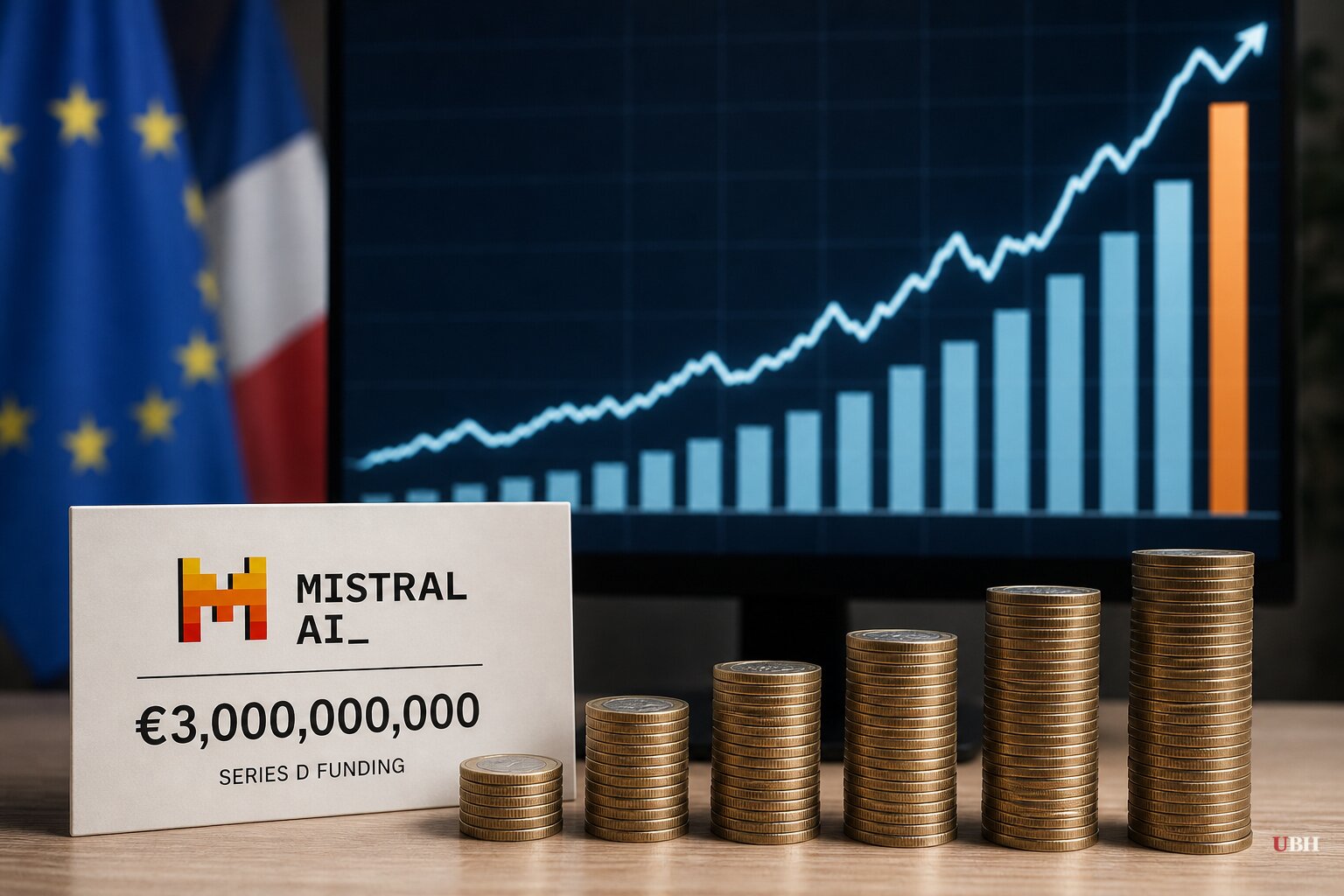
A company that didn't exist until 2023 just pulled off the largest equity fundraise in European tech history.
Mistral AI, the Paris-based artificial intelligence startup, closed a €3 billion Series D funding round on Tuesday, September 8, 2026, at a post-money valuation of more than €21 billion (about $24 billion), according to Reuters. Mistral itself called it the biggest equity round ever completed by a privately owned European technology firm.
That's a fast climb. Mistral's Series C, completed in September 2025, valued the company at €11.7 billion, according to Crypto Briefing. The valuation has nearly doubled in a year.
Who's Writing the Checks
Samsung Electronics led the round. Co-leads were PSG Equity, an existing investor, and the Scaleup Europe Fund, a new backer managed by EQT, according to Reuters and Unite.ai.
New money also came from Advent, funds managed by BlackRock, and the Grand Duchy of Luxembourg, per Unite.ai. Existing investors who came back for another round include Andreessen Horowitz, ASML, NVIDIA, BNP Paribas, Bpifrance, Salesforce Ventures, and roughly a dozen others.
One notable absence: Microsoft. The company agreed in July to spend billions of dollars on Mistral's European computing infrastructure, but it did not participate in this funding round, Mistral CFO Johan Bergqvist told Reuters.
The Scaleup Europe Fund is anchored by a €1 billion commitment from the European Commission, according to the European Innovation Council as cited by Unite.ai, alongside founding investors like Novo Holdings, Santander's Mouro Capital, and Allianz. That means European taxpayer-backed capital, through Brussels, is now a stakeholder in Mistral's cap table. EQT was selected to run the fund through a competitive public process, and the fund's first investments were set to begin this autumn. Whether a government-seeded fund picking a single AI champion is smart industrial policy or the EU putting its thumb on the scale is a fair question, and it's one taxpayers across the bloc should be watching closely as the fund deploys more capital.
The Sovereignty Pitch
Bergqvist framed the raise around what he called Europe's need for its own AI provider. "The fact that the EU or Europe have to have their own kind of AI provider in the game is important," he told Reuters. He pointed to a U.S. decision in June that limited foreign access to two advanced models built by Anthropic, without naming Anthropic directly in that context. "We have seen in the past that there is politics involved in the access of these solutions, and it's important that you make sure that you maintain access and do not compromise your kind of supply chain," he said.
That's a reasonable argument on its face. If Washington can restrict foreign access to American AI models with a policy decision, European governments and companies relying entirely on U.S. providers are exposed to a supply chain risk they don't control. Building a domestic alternative isn't unreasonable industrial strategy, even if it's being partly funded by an EU fund rather than pure private capital.
Still Small Next to the Americans
Mistral remains a minnow next to the U.S. giants it's positioning itself against. Anthropic is valued at $965 billion and OpenAI at $852 billion, according to Reuters, both nearly 40 times Mistral's size. Both American companies are also planning public listings this year.
Bergqvist said an IPO for Mistral is "always of course an optionality for us going forward," but timing is "still up in the air," adding there are "no ongoing discussions around that at the moment," per Reuters.
The Business Case
Mistral says it now serves more than 125 enterprise clients across 20 countries, including Airbus, ASML, and HSBC, according to Unite.ai and The Business Times. The company is targeting $1 billion in annualized recurring revenue by the end of 2026, Bergqvist told Reuters, with growth concentrated in Asia and North America. In Singapore specifically, where Mistral opened an office in January 2025, the company plans to triple its headcount, according to The Business Times.
The company also raised $830 million in debt in March 2026 earmarked for data center buildouts, according to Crypto Briefing, and is targeting 200 megawatts of computing capacity across Europe by the end of 2027.
CEO Arthur Mensch, who co-founded the company with Guillaume Lample and Timothée Lacroix after all three left Google DeepMind or Meta, said the round "means we can move faster on R&D, products, infrastructure and keep giving organisations the ability to run AI at scale, on their own terms," according to The Business Times.
The question now is whether Mistral's revenue growth can keep pace with a valuation that's nearly doubled in a year, and whether Brussels' bet on a single national champion pays off for the European taxpayers backing the Scaleup Europe Fund, or whether it just props up a company that still can't compete on scale with its American rivals.
Sources used for this briefing
7 links from 7 independent newsrooms (syndicated copies of the same report count once)
These are the sources it draws on, linked so you can verify.


