
Unbiased headlines. Facts, not spin.
Unbiased Headlines is an independently owned news organization. We bring you the facts, not opinions, written fresh from 110+ named sources. Sources linked so you can verify it yourself.
 tech
Notable (5/10)
tech
Notable (5/10)
AMD Unveils Threadripper Halo Station, a Six-Figure Desktop Built to Run Trillion-Parameter AI Models
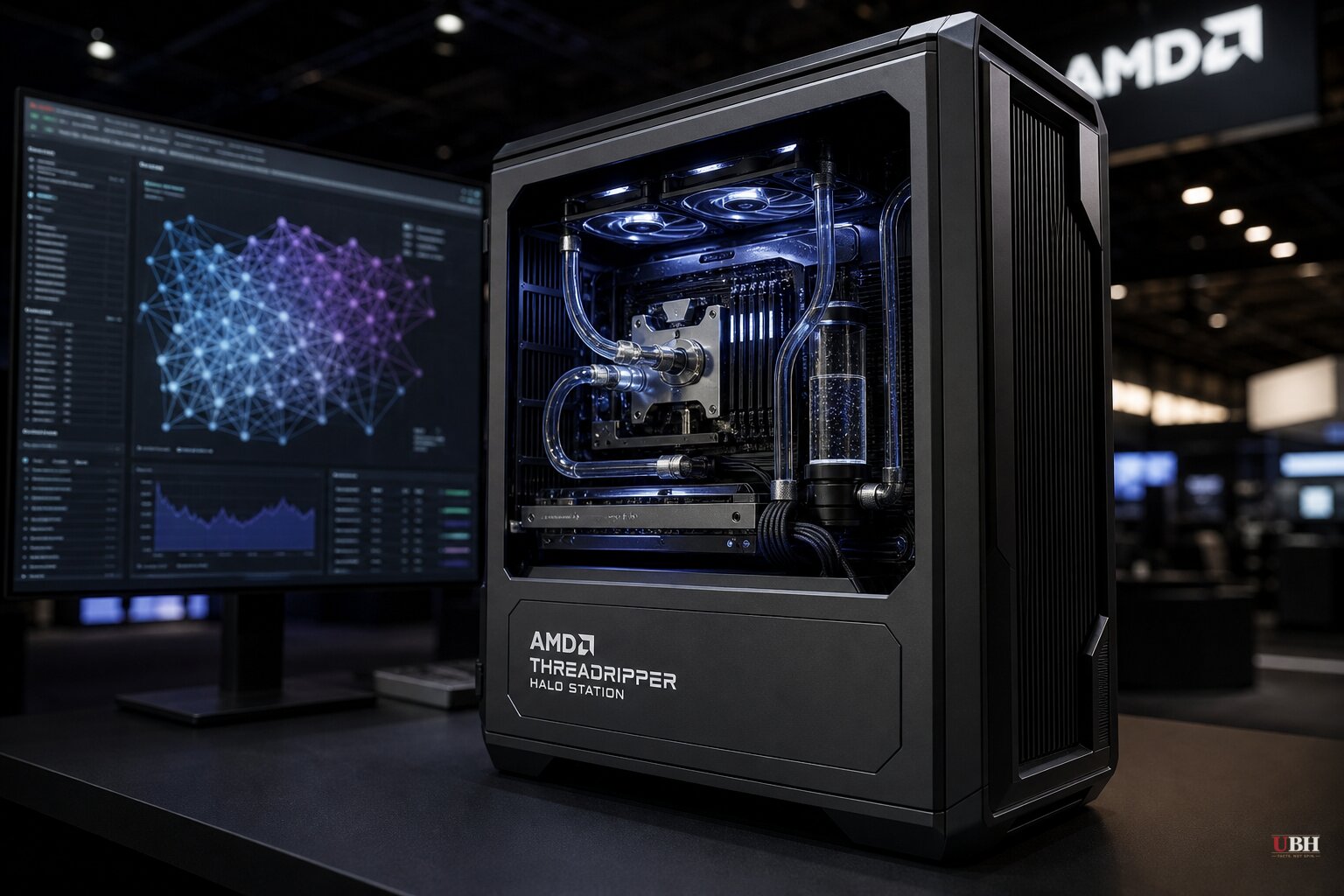
AMD's Jack Huynh, the company's SVP and general manager of its Computing and Graphics Group, walked onto a stage in Berlin on Friday, September 4, and declared the world was "entering the era of personal AI." The centerpiece of that pitch: the Threadripper Halo Station, a workstation AMD calls the most powerful in the world.
What's Actually Inside the Box
The specs are not subtle. A 96-core Threadripper Pro 9995WX CPU anchors the system. Two AMD Instinct MI350P data-center accelerators come standard, expandable to four, all under liquid cooling, according to AMD and reported by Euronews, IT Pro, and Mashable.
Memory is where AMD wants the conversation to happen. The machine tops out at 576 gigabytes of HBM3E memory across the GPUs and up to 2 terabytes of system DDR5, with IT Pro reporting combined memory reaching 2.6 terabytes and bandwidth up to 16.4 terabytes per second.
Huynh's claim: this configuration can run AI models with more than a trillion parameters, entirely on local hardware, no cloud connection required. He demonstrated the point on stage by generating a full 3D world and flight simulator from a single prompt, according to Euronews.
The Nvidia Fight
AMD built this thing to go after Nvidia's DGX Station, the current king of desktop-format AI workstations. AMD says the Halo Station carries 3.4 times the total system memory of Nvidia's box, a claim reported by IT Pro and echoed across AMD's own marketing.
Nvidia still has two advantages AMD can't spec-sheet its way around. First, the DGX Station is already shipping, retailing around €100,000, according to Euronews. AMD's machine won't launch until early next year, and the company has disclosed no price.
Second, Nvidia's CUDA software platform has a decade-plus head start with developers. AMD is pushing its open-source ROCm stack as the alternative, but Crypto Briefing and KuCoin both flag CUDA's ecosystem lock-in as the harder problem to solve than raw hardware specs.
The "Personal" Problem
Industry estimates peg the Halo Station's price well into six figures once fully configured, according to Crypto Briefing, and Euronews reports it will likely exceed €100,000, geared toward corporate and institutional budgets rather than individual buyers.
That's a fair criticism of the marketing, not the hardware. Calling a machine that costs more than most people's houses a "personal supercomputer" stretches the word past its normal meaning. AMD's actual audience is developers, small AI teams, and enterprises running compliance-sensitive workloads, not consumers browsing a laptop aisle.
AMD's broader argument is harder to dismiss. Huynh pointed to GPT-OSS, a 120-billion-parameter model released in August 2025 that scored 80.1 on the GPQA benchmark, and then to Qwen 3.5, released in March 2026, which hit 81.7 on the same benchmark with just 9 billion parameters, according to techfinitive. Smaller models are matching or beating bigger ones. That trend is what makes AMD's local-inference bet plausible instead of just expensive theater.
Why Skipping the Cloud Matters
For regulated industries, finance, healthcare, defense, on-premises AI offers latency, cost, and data control. Crypto Briefing and KuCoin both note that these sectors want AI workloads that never leave the building, eliminating a category of compliance risk entirely.
Huynh made a cost comparison on stage: ten million output tokens on Claude Sonnet 5 runs about €90, versus zero marginal cost running the same workload locally on AMD's Ryzen AI Max chips, per techfinitive. That number ignores the upfront hardware cost, obviously, but for high-volume users the math can flip fast.
AMD also announced a Microsoft partnership at the same event. Microsoft's Pavan Davuluri appeared on stage to unveil "Project Zenith," positioning Windows as an open platform for local, agentic AI experiences, according to Mashable's coverage of the keynote.
The unresolved question is whether developers actually port their workloads to ROCm when CUDA already works. AMD hasn't announced pricing, a firm launch date beyond "early next year," or which software partners will ship day-one support. Until AMD names a price, every comparison to Nvidia's already-shipping, already-priced DGX Station is a comparison of a real product against a promise.
Sources used for this briefing
8 links from 8 independent newsrooms (syndicated copies of the same report count once)
These are the sources it draws on, linked so you can verify.


