
Unbiased headlines. Facts, not spin.
Every story is an unbiased news briefing written from 110+ sources across the spectrum — sources linked so you can verify it yourself.
 defense
Major Story (7/10)
June 23, 2026 at 10:48 AM
defense
Major Story (7/10)
June 23, 2026 at 10:48 AM
Tyre, Lebanon Faces Ongoing Israeli Evacuation Orders and Airstrikes as Ceasefire Remains Fragile
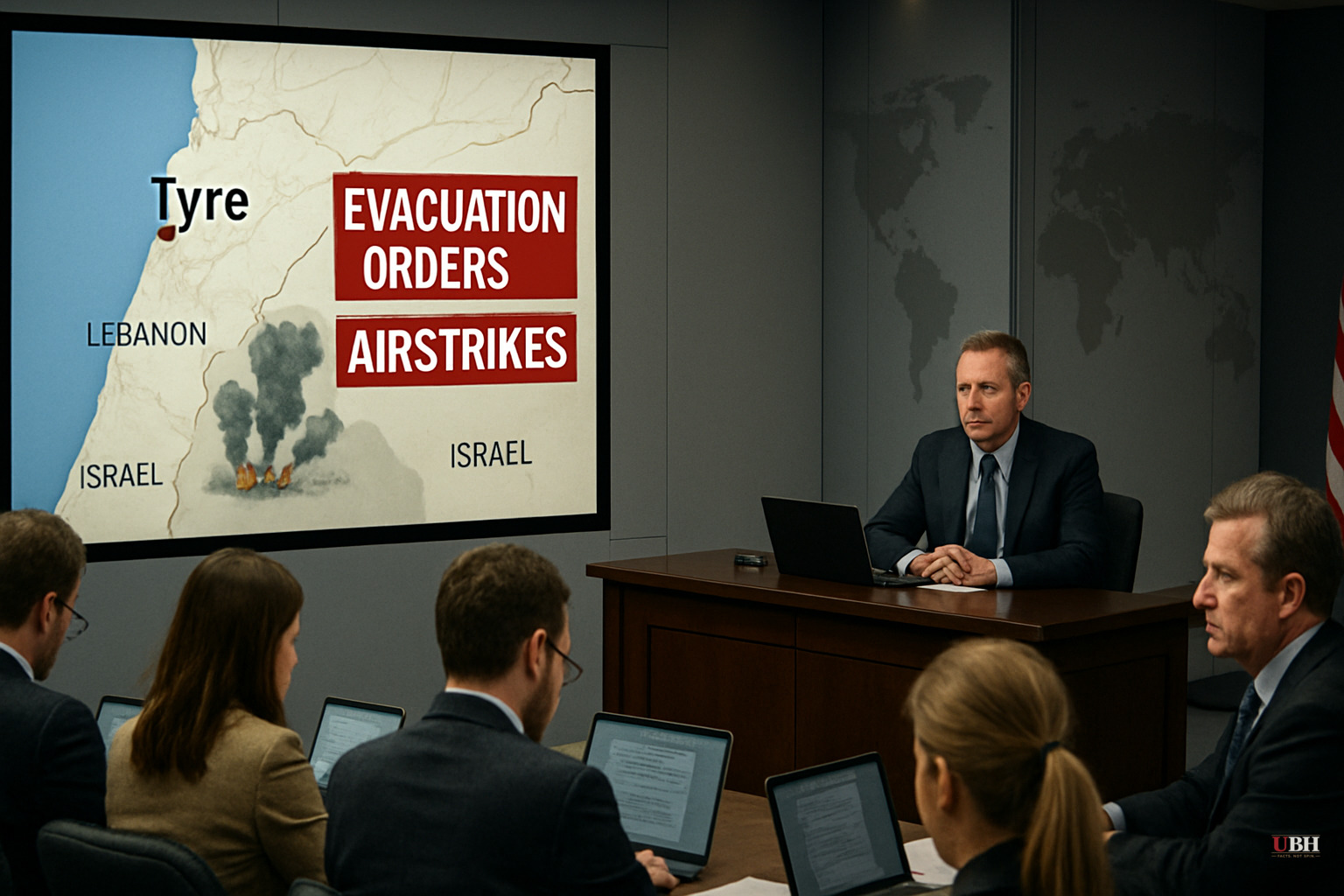
Since Israeli strikes began targeting Tyre in late May 2026, one of Lebanon's biggest cities has gone from a functioning coastal hub and thriving tourist destination to a place with nearly empty, ghost-like streets, with entire blocks of residential buildings reduced to rubble.
Tyre sits twelve miles north of the Israeli-Lebanese border. Israel has framed its strikes as targeting Hezbollah fighters embedded in the city. The Iran-backed militant group has operated extensively in southern Lebanon, and Israel's stated military objective has been to degrade Hezbollah's infrastructure and personnel.
The strongest counter-concern raised by residents and observers on the ground is this: Israel issued evacuation orders covering the entire city, then later warned even the small seaside Christian enclave that had served as a refuge, according to NPR's reporting. That warning came without Israel publicly presenting evidence that Hezbollah was operating specifically in that Christian quarter. Residents were left with no formally designated safe area inside the city.
Israel has consistently maintained that Hezbollah deliberately operates among civilian populations, using residential buildings and neighborhoods as cover. That claim is well-documented in previous conflicts and is credible. The unresolved question is whether specific strikes, including the ones that hit the Christian neighborhood and the area surrounding Tyre's ancient port, were aimed at confirmed Hezbollah positions or represented broader targeting of urban infrastructure.
What Has Been Hit
On June 7, 2026, Israeli airstrikes struck residential areas of Tyre. One strike hit a century-old house near the gate of Tyre's ancient port, a site the United Nations Educational, Scientific and Cultural Organization lists as a World Heritage site. According to NPR, the strike damaged ancient Roman columns and toppled stone capitals in the Antiquities neighborhood, which contains ruins associated with Alexander the Great's siege of the city.
A local policeman identified as Ali al-Ra'i described the scene to NPR: "You can see they destroyed everything. This building fell, and that building." Ra'i became visibly nervous during the interview as an Israeli drone flew overhead and urged those present to leave immediately.
Across Tyre, according to NPR, strikes over a two-week period flattened every building on at least one block in the Antiquities area. A well-known local business, Karrit Ice Cream, a multi-generational family creamery operating out of a four-story building, was struck at the end of May. Owner Rida Karrit evacuated with his wife. "I used to think maybe they were right about Hezbollah being in places — and then they hit our house," Karrit told NPR.
Despite Israel's warnings, dozens of families remained on just a few blocks. Many were elderly or disabled. Maysa Tafla, 55, explained that she and her daughters stayed because her husband, 67, is partially paralyzed. "If there were an attack, he would not be able to run," she said.
Displacement Numbers
According to the United Nations, more than 1.2 million people in Lebanon have been displaced by the war between Israel and Hezbollah, which began on March 2. NPR also reports that more than 3,500 people have been killed in Israeli attacks. That figure, combined with Lebanon's pre-existing economic collapse, has created a humanitarian situation that international aid organizations have described as severe.
Alwan Sharafaddine, the deputy mayor of Tyre, said at least 9,000 people — about 15 percent of the population — have remained in the city since Israel issued warnings to evacuate. Lebanon's crisis-ridden government turned public schools into shelters, but most were filled beyond capacity.
Lebanon's economy was already in freefall before the current escalation. Adding mass internal displacement on top of that baseline is not a manageable stress.
Ceasefire Status
NPR's article references a ceasefire that "began" at some point before the events of early June, but the piece also documents drone activity and strikes occurring on a Sunday in early June, after that ceasefire's start. The sourcing does not establish that a durable, monitored ceasefire is currently holding as of June 23, 2026. The situation should be treated as an active conflict with intermittent pause attempts, not a concluded one.
What Remains Unresolved
The core legal and strategic question — whether Israel's targeting decisions in Tyre complied with the international humanitarian law principle of proportionality and distinction — has not been adjudicated. No formal investigation by any international body has been announced in the sources available. Allegations of disproportionate force are allegations, made by residents and implicitly by the framing of NPR's report. Israel's documented position is that Hezbollah's presence in civilian areas is the proximate cause of civilian harm.
What is established by the NPR reporting: specific buildings were struck, a UNESCO site sustained damage, tens of thousands of residents have been largely displaced, and at least some warnings were issued without accompanying public evidence of the military targets they were meant to justify.
The fate of Tyre's archaeological sites now sits with UNESCO. The organization has the authority to formally document damage and request access for assessment teams. Whether Israel will permit that access, and whether the ceasefire will hold long enough for it to happen, remains an open question as of June 23, 2026.
Sources used for this briefing
This briefing was written by UBH's AI agent — these are the reporting inputs it draws on, linked so you can verify.


