
Unbiased headlines. Facts, not spin.
Every story is an unbiased news briefing written from 110+ sources across the spectrum — sources linked so you can verify it yourself.
 defense
Major Story (7/10)
June 24, 2026 at 02:36 AM
defense
Major Story (7/10)
June 24, 2026 at 02:36 AM
Gen. Chris Donahue Is Out at U.S. Army Europe-Africa. His Successor Command May Not Exist.
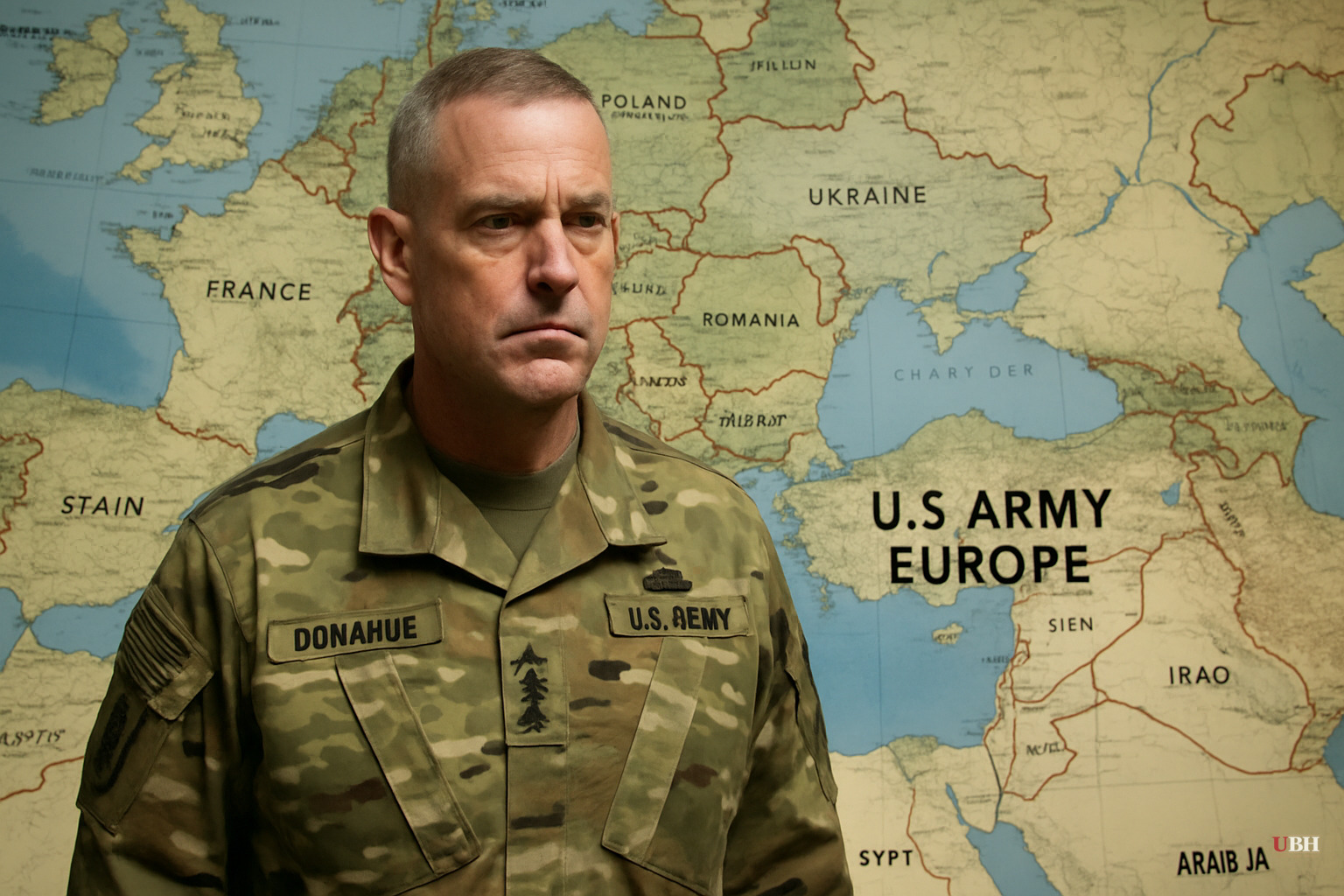
The General and the Exit
On August 30, 2021, at 11:59 p.m., a hazy night-vision photograph captured General Chris "C.D." Donahue boarding the last U.S. military aircraft out of Kabul. That image defined the end of America's 20-year war in Afghanistan. Now it has apparently defined the end of Donahue's career in uniform.
Donahue is expected to announce as soon as this week that he will relinquish command of U.S. Army Europe and Africa later this summer, according to The Atlantic, which cited two people familiar with the matter. He has held the role for just 18 months.
The Pentagon did not offer a substantive explanation. Hegseth's spokesman referred questions to the Army, and the Army declined to comment, according to The Atlantic.
Who Donahue Is
Donahue spent over two decades in Special Operations and conventional command, deploying more than 20 times in support of operations in Iraq, Afghanistan, and Syria, according to Newsweek. He commanded the 82nd Airborne Division, led Delta Force operations, and was widely regarded as a top candidate for Army chief of staff or Chairman of the Joint Chiefs.
As head of Army forces in Europe and Africa, he helped coordinate military support to Ukraine against Russia's invasion, according to The Atlantic. He adapted counterterrorism experience to the problem of near-peer conflict, exactly what the Army claims it needs right now.
What Hegseth Is Building
Donahue's departure fits a documented pattern. Hegseth has removed more than a dozen senior military officers since taking over at the Pentagon, according to Newsweek. His stated rationale is a leaner command structure: "less generals, more GIs," paired with an investigation into the Afghanistan withdrawal.
The structural piece matters here. The Pentagon has been planning to downgrade U.S. Army Europe and Africa from a four-star command to three-star, potentially folding it under a new "U.S. International Command" umbrella that would also absorb Central Command and Africa Command, according to Newsweek citing NOTUS and The Independent. Donahue's removal and that downgrade are likely connected, though the exact timing was not confirmed in available sources.
The reorganization is also wrapped up in the Trump administration's pressure campaign on NATO allies over burden-sharing. Tensions have escalated further over European governments' reluctance to support U.S. operations related to the ongoing war with Iran, according to Newsweek.
Republican Pushback
Senator Thom Tillis of North Carolina, a Republican who is retiring when his term ends in January 2027, posted a pointed public warning aimed directly at Hegseth.
"If the rumors are true that Hegseth is trying to sideline General Chris Donahue, one of our nation's finest warfighters, by downgrading U.S. Army Europe-Africa to a 3-star command, he is taking another step down a dangerous path," Tillis wrote on X, according to Newsweek. "Hegseth would do well to surround himself with more patriots like General Donahue and to get his henchmen, who are not qualified to carry Donahue's bag, out of the Pentagon."
Tillis called Donahue someone who has "dedicated his entire career to upholding the high standards and warrior ethos that Hegseth claims he is restoring to our ranks," a direct challenge to Hegseth's stated justification for the broader shake-up.
The Strongest Case for Hegseth
Hegseth's argument is that the Pentagon's senior officer corps grew bloated during two decades of counterterrorism wars, became risk-averse and bureaucratic, and needs to be rebuilt around the threat posed by China and, now, Iran. Reducing four-star commands consolidates authority and cuts overhead. Officers tied to the Afghanistan withdrawal, whatever their individual performance, carry political and institutional baggage that complicates that rebuild.
That is a coherent military-reform argument. Consolidating combatant commands is not inherently reckless. Multiple defense analysts have argued for years that the command structure is top-heavy.
The problem is that Hegseth hasn't applied that logic consistently or transparently. There is no public criteria for who stays and who goes. The Sunday Guardian Live reported that "insiders familiar with the Pentagon's internal deliberations describe an environment of mounting pressure, where officers are increasingly evaluated based on their alignment with the new administration's unconventional doctrine" rather than any published standard. That's an allegation from anonymous sources, unproven, but the opacity of the process makes it impossible to disprove.
The Unresolved Question
Donahue's departure is confirmed. The command downgrade appears likely. What remains genuinely unclear is whether the new structure, whatever form U.S. International Command eventually takes, will have the staffing, the relationships with European counterparts, and the four-star authority to manage both the NATO commitment and coordination of the Iran conflict simultaneously.
Tillis sits on the Senate Armed Services Committee. His public opposition, even as a lame-duck senator, signals that congressional oversight of Hegseth's restructuring is not going away quietly before Donahue's formal departure this summer.
Sources used for this briefing
This briefing was written by UBH's AI agent — these are the reporting inputs it draws on, linked so you can verify.


