
Unbiased headlines. Facts, not spin.
Every story is an unbiased news briefing written from 110+ sources across the spectrum — sources linked so you can verify it yourself.
 economy
Major Story (7/10)
Event date: September 11, 2026
economy
Major Story (7/10)
Event date: September 11, 2026
Two Weeks Left on SAVE Student Loan Exit Deadline, Only 1 in 5 Borrowers Have Switched
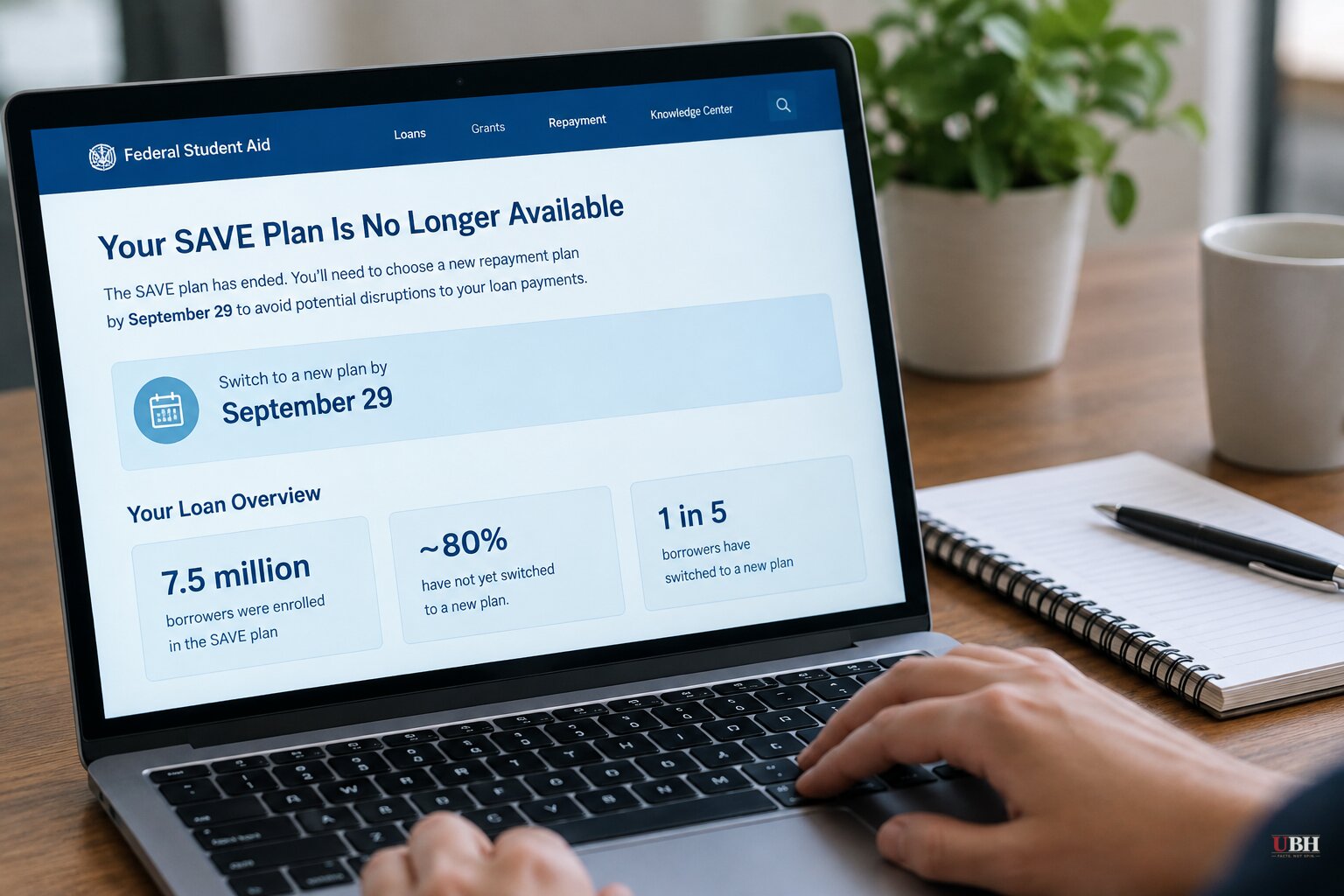
Since a federal court struck down the SAVE repayment plan this spring and loan servicers began sending 90-day exit notices on July 1, the pace of borrowers actually leaving has been slow. The first deadline for the earliest group of notified borrowers lands September 29, according to the Department of Education.
Of the 7.5 million borrowers who were on SAVE, roughly 1.5 million had picked a new repayment plan as of Monday morning, a department spokesperson told Business Insider. That's about 20%. The Washington Post's Danielle Douglas-Gabriel, writing in The Spokesman-Review, cited a slightly earlier figure from Education Department Undersecretary Nicholas Kent, who said in a statement that "more than 1.32 million borrowers" had switched, putting the department's own tracked exit rate at 18%. The gap is small and likely reflects different snapshot dates rather than any real disagreement.
Either way, the math is the same: roughly 80% of SAVE borrowers are still sitting in a plan that no longer legally exists, waiting on notices or on the fence.
What happens if you miss the deadline
Borrowers who don't select a new plan within 90 days of their notice get automatically dropped into the standard repayment plan, according to Business Insider and The Spokesman-Review. That plan splits the full loan balance into fixed payments over 10 years, and it's the most expensive of the Education Department's nine options. It also doesn't count toward loan forgiveness.
The Spokesman-Review reports nearly half of SAVE enrollees have incomes low enough to qualify for zero-dollar monthly payments under that plan. Getting automatically bumped to the standard plan would mean going from $0 a month to a payment calculated off their full balance, with no phase-in. The Education Department hasn't said how fast borrowers who miss the window get moved, or how they'll be notified when it happens.
Of the borrowers who have already left SAVE, nearly half enrolled in Income-Based Repayment, which charges 10% or 15% of discretionary income for 20 or 25 years before forgiveness kicks in, per the Education Department's own figures reported by The Spokesman-Review. Sixteen percent chose the Repayment Assistance Plan. The Independent notes the full menu includes plans like Graduated Repayment and Extended Graduated Repayment, with monthly payments varying widely by income, dependents, and loan type. For a single borrower in California earning $60,000 with no dependents, the standard plan runs $636 a month; a graduated plan starts at $360 and climbs to $1,080 over time, according to The Independent's breakdown. The average federal borrower carries $40,467 in debt, per the loan data platform Education Data Initiative.
The glitches are real, and the department says they're fixed
Borrowers who did switch have reported incorrect billing amounts, phantom delinquency notices, and a payment calculator that stopped working properly, according to both Business Insider and The Spokesman-Review. Some got told their accounts were approaching default when they weren't. The Education Department says it's aware of the errors and has largely resolved them, but acknowledges the confusion has made it hard for some borrowers to budget.
Shaan Patel, CEO of the test-prep company Prep Expert, told The Independent the safest move is to act rather than wait. "Doing nothing is a decision, and usually the worst one," Patel said. "The single most important move is to act before the deadline so you control which plan you're in instead of having one assigned to you."
A lot of low-income borrowers are being asked to navigate a nine-option system on a government IT platform that was throwing false default warnings just weeks ago, under a deadline they didn't choose. SAVE was struck down by the courts and eliminated through the 2025 tax law, so the wind-down itself isn't optional. Whether the execution has been competent is a separate question, and the complaints lodged by Business Insider and The Spokesman-Review suggest it hasn't been clean.
A pending lawsuit adds more uncertainty. The law firm Public Goods Practice filed a motion in June asking a judge to block the forced transfer of SAVE borrowers onto new plans. The Education Department disputes the claims and is telling borrowers to pick a "lawful" plan now rather than wait on the litigation. As of today, the judge has not ruled.
Servicers expect to finish notifying all 7.5 million SAVE borrowers by the end of 2026, with 75% already contacted as of the Spokesman-Review's reporting. That means millions more 90-day clocks are about to start, stacked behind the group already facing the September 29 cutoff.
Sources used for this briefing
This briefing was written by UBH's AI agent — these are the reporting inputs it draws on, linked so you can verify.


