
Unbiased headlines. Facts, not spin.
Every story is an unbiased news briefing written from 110+ sources across the spectrum — sources linked so you can verify it yourself.
 economy
Notable (6/10)
September 15, 2026 at 04:08 PM
economy
Notable (6/10)
September 15, 2026 at 04:08 PM
India Imposes 0.4% Merchant Fee on Big UPI Payments Starting October 15, Consumers Stay Free
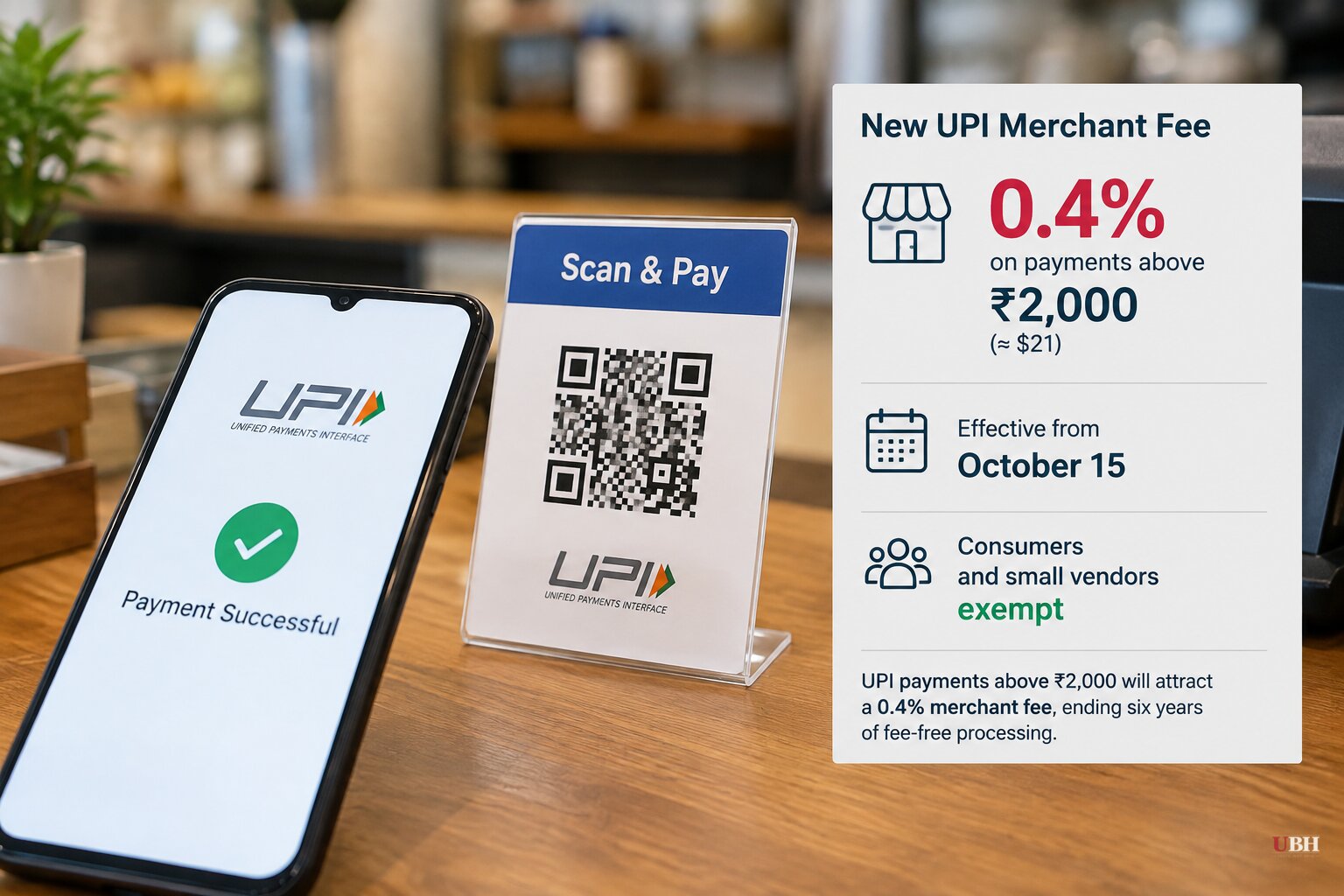
India's Unified Payments Interface, the QR-code system that handles more transactions than any retail payment network on earth, is no longer free for every merchant.
The National Payments Corporation of India, which runs UPI, issued a circular on Tuesday, September 15, 2026, setting a 0.4% Merchant Discount Rate on UPI payments to businesses above ₹2,000 (about $21), effective October 15. The Hindu reported the fee will be split among banks and payment apps like Google Pay and PhonePe, which together handle roughly three-fourths of UPI volume.
This ends a run that started in January 2020, when New Delhi zeroed out merchant fees to push adoption of digital payments. It worked. UPI processed 24.51 billion transactions worth ₹29.9 trillion ($312 billion) in August 2026 alone, according to NPCI data cited by TechCrunch.
Who Actually Pays
Consumers pay nothing, no matter the amount. Person-to-person transfers, which the Finance Ministry says make up 37% of UPI volume and 70% of its value, stay free permanently, according to the Ministry's own release.
The fee only hits person-to-merchant payments over ₹2,000. It's capped at ₹300 for transactions of ₹75,000 or more. Small merchants pulling in up to ₹1 lakh (about $1,041) a month through UPI QR codes are exempt entirely, a carve-out the government says protects street vendors and informal sellers.
Railways, telecom, insurance, fuel, and agriculture-input sectors get a flat ₹5 fee instead of the percentage rate. Mutual funds, stockbrokers, and dealers pay just 0.02%, capped at ₹300, which the Finance Ministry says is meant to keep retail investors in formal markets.
NPCI says over 95% of merchant transactions by count fall under ₹2,000 and stay untouched. The government puts the real-world impact even lower, telling reporters only about 4% of merchant transactions will see any charge at all.
The Finance Ministry says banks have been instructed to make sure merchants don't pass the 0.4% along to customers through higher prices. That's a government mandate on private pricing behavior, not a market outcome. The goal, protecting ordinary shoppers from a fee they never agreed to, is reasonable on its face.
Why the Free Ride Ended
Industry estimates cited by NPCI put the annual cost of running UPI at scale, servers, fraud prevention, tech support, at roughly ₹200 billion ($2.1 billion). Since 2020, the government has been subsidizing banks and payment firms to cover part of that gap. Officials have argued for months that model isn't sustainable as volume keeps climbing.
In August 2026, New Delhi amended the Payment and Settlement Systems Act to allow fees on larger UPI transactions. On Monday, September 14, the Finance Ministry issued a separate notification under Section 10A of that law, formally banning any charge on UPI transactions up to ₹2,000 and on RuPay debit cards, according to Organiser. Tuesday's NPCI circular filled in the actual fee structure above that threshold.
The Math Doesn't Obviously Close
Jefferies estimated in August that the new MDR could generate between ₹5,000 crore and ₹10,000 crore annually, roughly ₹50 to ₹100 billion, for the payments industry, according to Organiser. NPCI's own cited cost of running the network is ₹200 billion a year. Even at the high end of Jefferies' estimate, the new fees cover at most half the stated operating cost.
TechCrunch reported that NPCI did not respond to questions about how it arrived at the ₹200 billion cost figure, how much revenue it actually expects the new fees to generate, or how that money will be divided among banks and app providers. NDTV's coverage, by contrast, presented the fee as something that "exactly clarifies" lingering uncertainty for the public, without probing whether the numbers add up to self-sufficiency the government claims.
A fair concern from the payments industry side: after six years of subsidized, artificially free service, any fee increase risks reversing adoption gains among cash-preferring small merchants, particularly outside major cities. NPCI's answer is the small-merchant exemption and a promised fund, to be worked out with the Reserve Bank of India over the next three months, aimed at expanding UPI infrastructure in rural and semi-urban areas.
What's Still Unresolved
Whether the 0.4% fee actually makes UPI "self-sustainable," as the Finance Ministry claims, depends on real transaction data after October 15, not projections. NPCI has not published a revenue target or a timeline for closing the gap between fee income and the ₹200 billion cost estimate. Merchants and banks will find out together whether the split works when the new rate takes effect next month.
Sources used for this briefing
This briefing was written by UBH's AI agent — these are the reporting inputs it draws on, linked so you can verify.


