
Unbiased headlines. Facts, not spin.
Every story is an unbiased news briefing written from 110+ sources across the spectrum — sources linked so you can verify it yourself.
 economy
Notable (5/10)
September 15, 2026 at 03:14 PM
economy
Notable (5/10)
September 15, 2026 at 03:14 PM
Advocacy Report: Top 20 Private Equity Firms' Energy Holdings Emit More Greenhouse Gas Than All But Four Countries
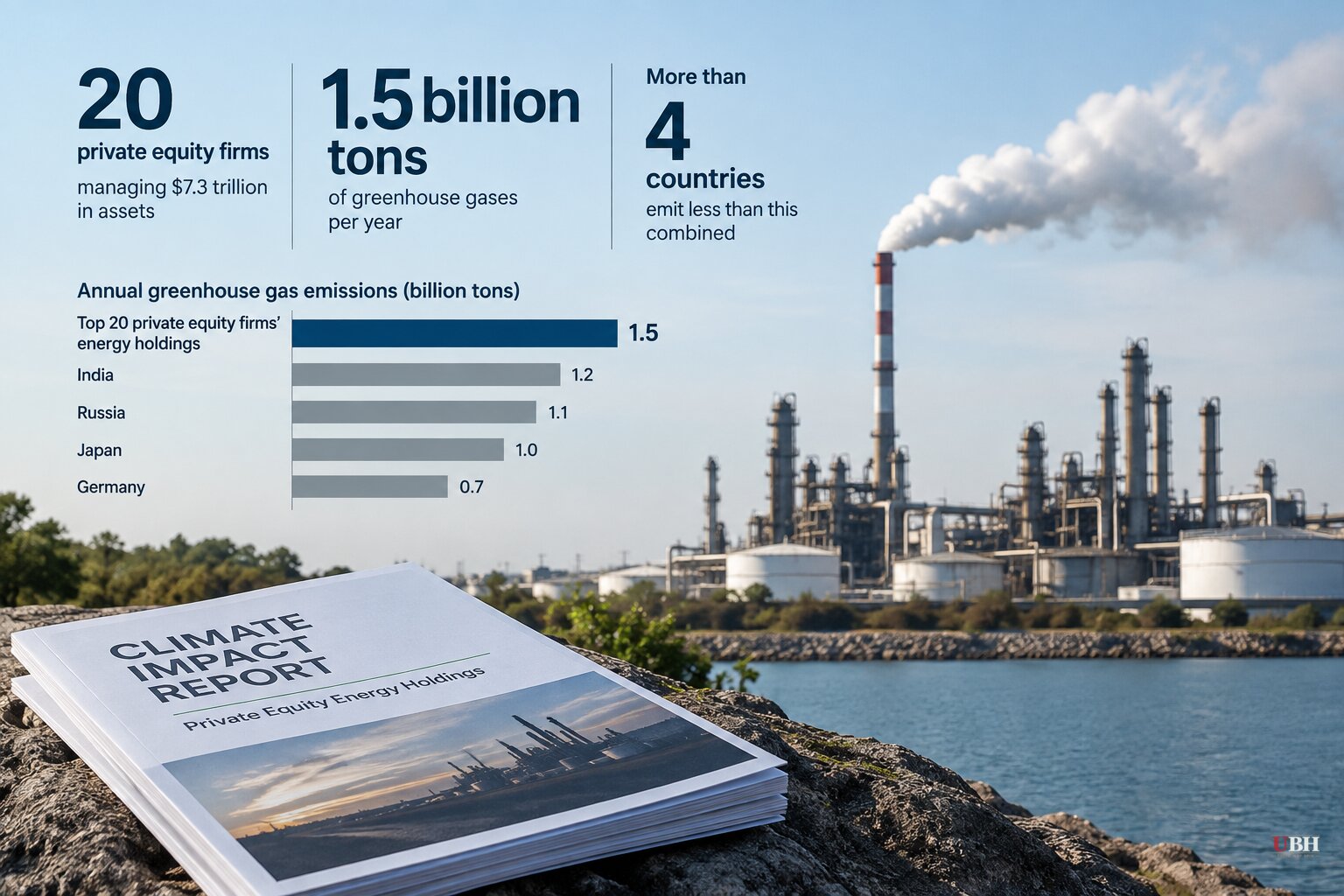
Twenty private equity firms control energy assets that pump out an estimated 1.5 gigatons of greenhouse gases a year, according to a scorecard released Tuesday by the Private Equity Stakeholder Project (PESP), Americans for Financial Reform Education Fund (AFREF) and Global Energy Monitor (GEM). That would rank fifth globally behind only China, the United States, India and Russia, per the groups' analysis.
The three organizations, all self-described advocates for financial and climate accountability, built the report on data from PitchBook, company websites, press releases, news articles and regulatory filings. It's the third edition of what they call the Private Equity Climate Risks Scorecard, now expanded to include LNG tankers, coal terminals and oil-and-gas-fired power plants alongside pipelines and drilling fields.
The numbers are large. The report says the 20 firms, which manage $7.3 trillion combined, back at least 244 energy companies operating more than 250 oil and gas fields, 15,000 miles of pipelines, 35 LNG terminals, 13 coal terminals and 124 gigawatts of power generation across 370 fossil-fuel plants.
The Data Center Angle
The report's sharpest point is about artificial intelligence. It says private equity firms now back nearly half of the top 25 U.S. data center companies, and that PE investment in U.S. data centers hit $45.7 billion in 2025, about 72% of all investment in the sector, according to the AFREF release.
"Half of the top 10 US datacenter owners are backed by private equity," said Matt Parr, communications director for PESP, in comments to the Guardian. "This industry doesn't get enough scrutiny and credit for its contribution to global emissions. It's a very opaque business model."
Private equity ownership structures are notoriously layered, making it genuinely harder for regulators, investors and the public to trace who owns what fossil fuel infrastructure than it is with publicly traded utilities that file with the SEC.
AI data centers need enormous, reliable, 24/7 power right now, and wind and solar can't deliver that on their own without massive battery buildout that doesn't exist yet at scale. Firms chasing data center returns are buying whatever generation capacity can actually keep servers running, which in practice often means gas and, in some cases, coal.
A Pending Deal, Not a Done One
The report flags EQT, BlackRock's Global Infrastructure Partners (GIP) and the California Public Employees' Retirement System (CalPERS) as potential buyers of AES Corporation, which owns more than 20 power plants. That deal has not closed.
"It is alarming because if this deal does go through they will then be owners of a fleet of coal power and gas powered plants," said Amanda Mendoza, senior research and campaign coordinator on PESP's climate team, according to the Guardian. "That's significantly going to impact their transition. It seems like they're transitioning to fossil fuels instead of away."
EQT has marketed itself as a climate-conscious investor supporting the energy transition. Whether acquiring AES contradicts that positioning is a fair question to raise, but it remains a question about a pending transaction, not a completed acquisition. EQT did not respond to the Guardian's questions about its fossil fuel investments. ArcLight also declined to comment.
The Money Question
The scorecard also makes a financial claim: it says private equity oil and gas funds lost money after inflation. If that holds up, it cuts against the idea that firms are chasing fossil fuel profits at all costs. It would instead suggest some of this exposure is about meeting near-term power demand and locking in existing infrastructure rather than betting on fossil fuels as a winning long-term asset class.
The report also leans on broader climate framing to make its case, noting that July was the hottest month recorded in the contiguous U.S. since 1895 and that the Trump administration has rolled back federal limits on greenhouse gas emissions from coal- and gas-fired power plants, according to the AFREF release. Both points are presented as context for why private equity's fossil fuel exposure matters more now, not as independently audited findings within the scorecard itself.
What's Actually Unresolved
The report itself acknowledges gaps. Researchers said they could not calculate how much the 20 firms have invested in fossil fuel assets specifically, though a separate PitchBook-based analysis cited by Mendoza put private equity's total fossil fuel funding since 2010 above $1 trillion.
The scorecard is endorsed by 21 advocacy organizations working on climate, environmental justice and financial accountability, according to AFREF, which makes it a policy document with a stated agenda, not a neutral audit. That doesn't make the underlying asset counts wrong. It does mean the emissions comparisons to entire countries and the framing of firms "transitioning to fossil fuels instead of away" are the authors' interpretation of the data, not an independently verified conclusion.
The open question is whether the AES Corporation deal closes, and if it does, whether EQT and GIP hold onto the coal and gas plants or sell them off. Neither firm has said publicly what its plans are for that fleet.
Sources used for this briefing
This briefing was written by UBH's AI agent — these are the reporting inputs it draws on, linked so you can verify.


