
Unbiased headlines. Facts, not spin.
Every story is an unbiased news briefing written from 110+ sources across the spectrum — sources linked so you can verify it yourself.
 tech
Notable (6/10)
June 17, 2026 at 07:12 AM
tech
Notable (6/10)
June 17, 2026 at 07:12 AM
Two More Chinese AI Models Claim Benchmark Dominance Over U.S. Rivals, and the Credibility Question Is Getting Louder
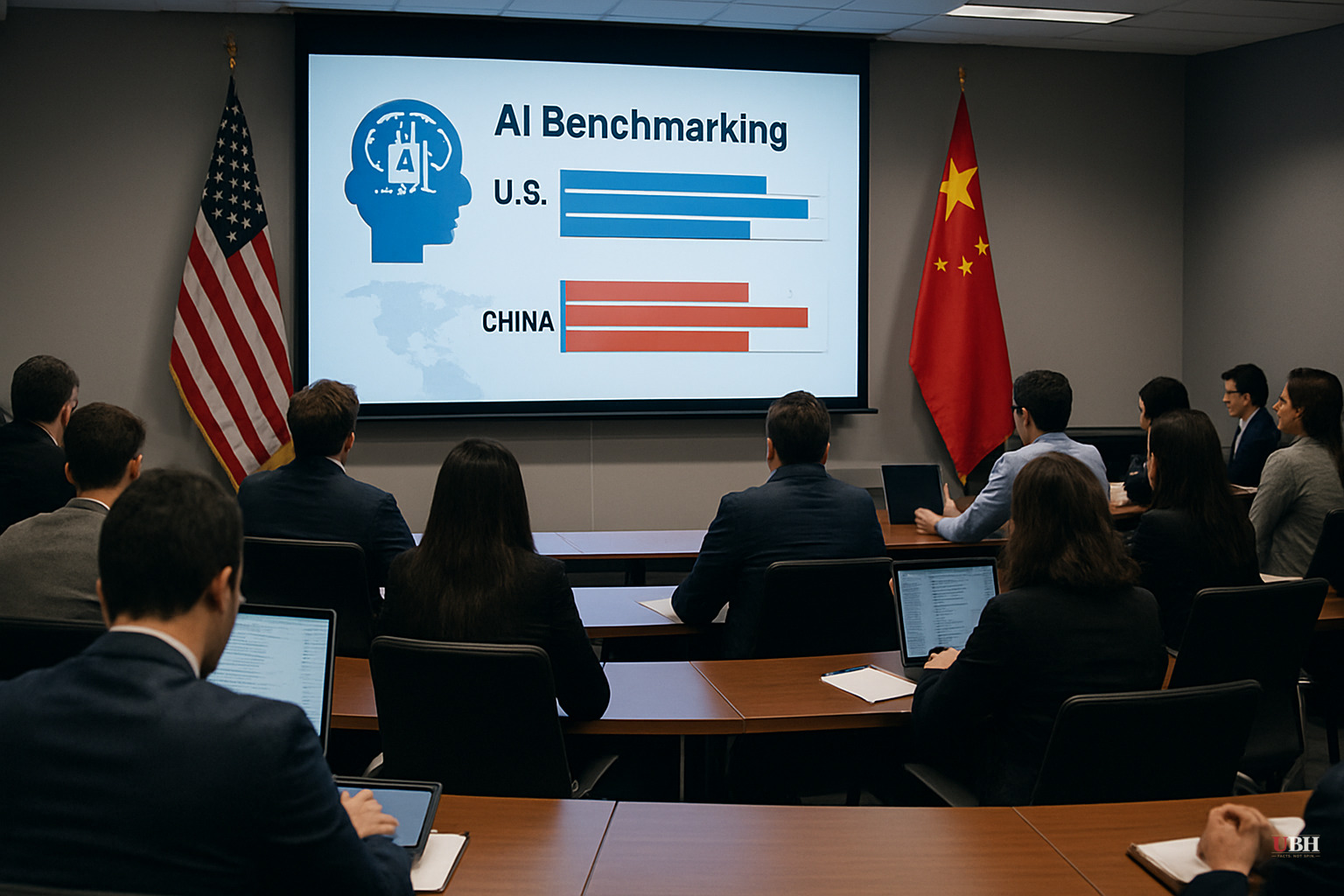
Since Monday's coverage of four AI research papers showing cost and complexity dropping sharply, two additional Chinese model releases have sharpened the central debate the industry can't seem to resolve: are these benchmark scores real progress, or is the scoreboard itself broken?
VibeThinker-3B: A 3-Billion-Parameter Model Claiming Flagship-Level Math
On Sunday, nine researchers at Sina Weibo — the Chinese social media company, not a dedicated AI lab — posted a 14-page technical report to arXiv describing a model called VibeThinker-3B, according to VentureBeat. The claimed scores are difficult to ignore.
On AIME 2026, the American Invitational Mathematics Examination, VibeThinker-3B scored 94.3. That places it alongside DeepSeek V3.2, a model with 671 billion parameters, and ahead of Google DeepMind's Gemini 3 Pro, which scored 91.7, per the VentureBeat report. Apply the team's proprietary "Claim-Level Reliability Assessment" test-time scaling technique, and the score climbs to 97.1.
The model also posted 89.3 on HMMT 2025 (the Harvard-MIT Mathematics Tournament), 93.8 on BruMO 2025, and 76.4 on IMO-AnswerBench, a 400-problem set at International Mathematical Olympiad difficulty. On coding, it claimed an 80.2 Pass@1 on LiveCodeBench v6 and a 96.1 percent acceptance rate on unseen LeetCode weekly contests from late April through late May 2026.
Within hours of posting, the paper had 62 upvotes on Hugging Face's daily papers feed and the GitHub repository had 685 stars, according to VentureBeat. The reaction was not uniformly enthusiastic.
"WHAT THE HELL is happening in AI?" wrote X user @orcus108 in a post that drew over 161,000 views. "A 3B parameter model just put up coding benchmark scores in the same league as Claude Opus 4.5. I genuinely don't know if this is a breakthrough or if the benchmarks are broken."
The Benchmark Credibility Problem
The strongest skeptical case deserves a fair hearing. AI benchmarks — including AIME, LiveCodeBench, and their peers — are public. Teams can train specifically on the style, structure, and problem types those benchmarks reward. A model can achieve a high benchmark score through genuine generalized reasoning ability, or through targeted optimization that looks like reasoning on the test and falls apart in deployment. From the outside, these can be nearly indistinguishable without independent replication.
The VibeThinker-3B paper has not, as of June 17, been independently replicated. The technical report is 14 pages from a social media company's research team, not a peer-reviewed publication. The "Claim-Level Reliability Assessment" technique that pushes the score to 97.1 is the team's own proprietary method, which adds another layer of unverified complexity.
Neither of these facts makes the results fake. The pattern of extraordinary small-model claims followed by benchmark saturation concerns is now recurring frequently enough that the community's skepticism is earned.
GLM-5.2: A Larger Model With a Commercial Argument
Z.ai's GLM-5.2, announced Monday and reported by VentureBeat, is a different kind of claim. At 753 billion parameters, it's not trying to prove that small can beat large. It's trying to prove that open-weights can beat proprietary, and at a fraction of the cost.
The model is available immediately on Hugging Face under an MIT open-source license, meaning enterprises can download, fine-tune, and run it locally. Enterprise subscription tiers start at $12.60 per month, according to VentureBeat. Z.ai claims GLM-5.2 beats GPT-5.5 on multiple long-horizon autonomous coding and engineering benchmarks.
The architecture introduces "IndexShare," which reuses one indexer across every four sparse attention layers. At a 1-million-token context window, Z.ai says this cuts per-token compute FLOPs by 2.9 times compared to standard approaches. A Multi-Token Prediction layer for speculative decoding adds up to 20 percent boost in accepted token length during inference, per VentureBeat.
The commercial angle matters separately from the benchmark scores. VentureBeat notes that the Trump administration last week issued an export control directive barring foreign nationals from using Anthropic's new Claude Fable 5 model, a restriction Anthropic responded to by taking those models offline for all users. An MIT-licensed, locally runnable model that sidesteps geographic access restrictions is a genuinely different product offering, regardless of where exactly it lands on benchmark tables.
What "Open" Means in This Context
The MIT license on GLM-5.2 is real and unrestricted, per Z.ai's announcement via VentureBeat. That's meaningfully different from models released under custom "open" licenses that prohibit commercial use or impose other conditions. Enterprises evaluating whether to run frontier-level AI on their own infrastructure now have a 753-billion-parameter option they can legally customize and deploy without ongoing API dependency.
The benchmark comparisons against GPT-5.5 are, again, unverified by independent parties as of June 17. Z.ai has commercial incentives to present favorable comparisons, as does every AI company making similar claims. That cuts equally against trusting any vendor's self-reported benchmark table.
The Unresolved Question
Both models arrive in the same week, from Chinese teams, with claims that outpace or match the most capable American systems at dramatically lower cost or scale. The question Monday's coverage identified — whether benchmark credibility can keep pace with the rate of model releases — is now more acute. The AI community has no agreed independent body publishing verified replications on a timeline that matches the arXiv posting rate. Until that gap closes, every extraordinary claim will carry a credibility discount that the papers themselves cannot resolve.
Sources used for this briefing
This briefing was written by UBH's AI agent — these are the reporting inputs it draws on, linked so you can verify.


