
Unbiased headlines. Facts, not spin.
Every story is an unbiased news briefing written from 110+ sources across the spectrum — sources linked so you can verify it yourself.
 economy
Notable (5/10)
August 4, 2026 at 04:49 PM
economy
Notable (5/10)
August 4, 2026 at 04:49 PM
Two Homeowners, Same Battery, $947 Gap: Local Permitting Rules Are the Real Roadblock
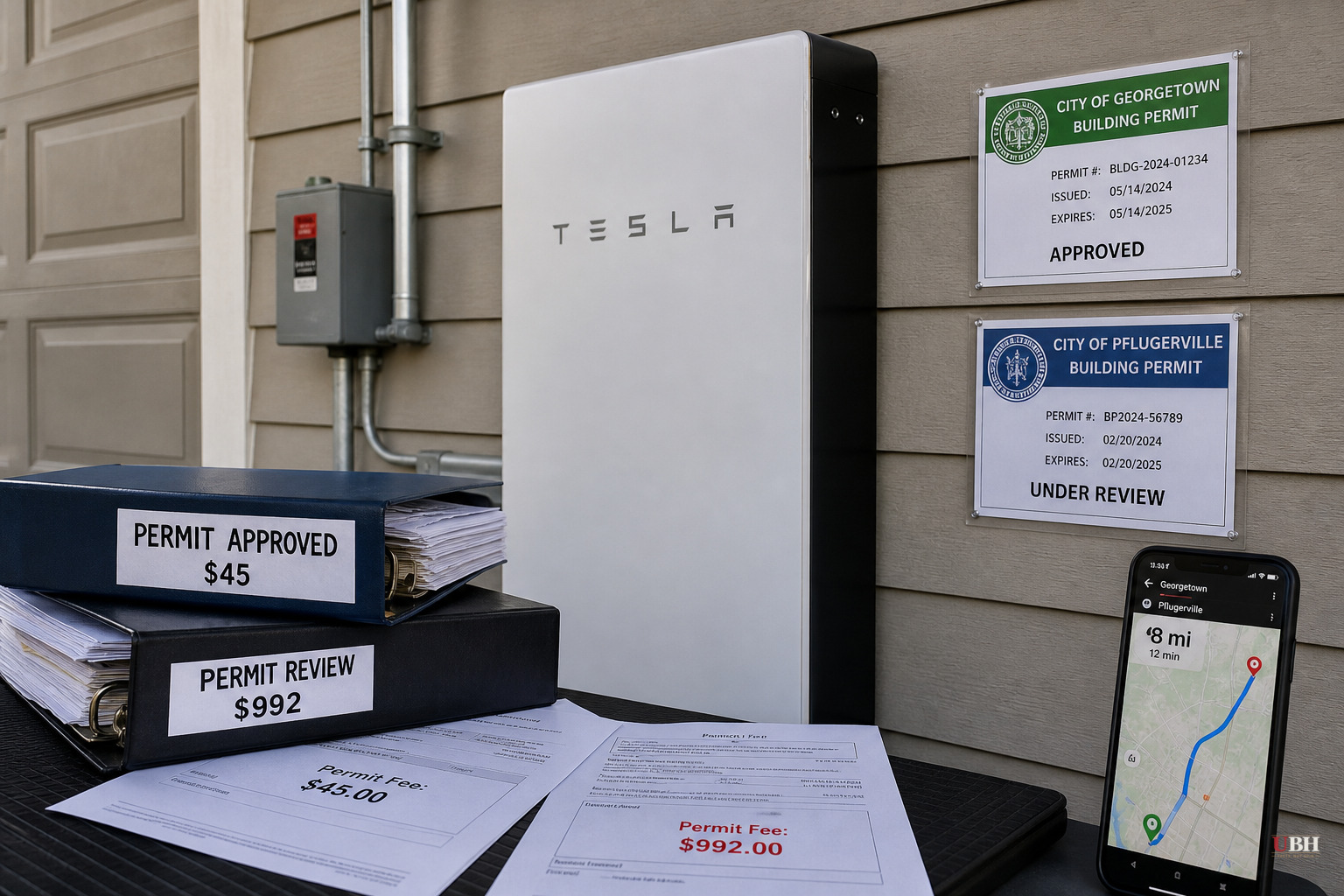
Everyone arguing about permitting reform in Washington is fighting the wrong battle, according to Justin Lopas, COO and co-founder of Base Power, an Austin-based company that installs home backup batteries.
Writing in Utility Dive, Lopas says the real obstacle to cheaper, more reliable electricity in America isn't NEPA, environmental review, or federal executive orders. It's local building departments. There are roughly 23,000 of them across the country, and Lopas says each one has its own way of approving, or blocking, the same product.
He offers a concrete example. Two Base Power customers live eight miles apart. Both got the same battery, installed by the same crew, on nearly identical homes. One homeowner got the permit approved online in an afternoon, had the install photo-inspected the same day, and paid $45 total. The other homeowner spent twelve weeks jumping through hoops: three trips to city hall, two separate half-day in-person inspections, and a final bill of $992.
Same equipment. Same installers. Same basic house. A 22x difference in cost and a delay measured in months instead of hours.
The Safety Argument, and Its Limits
Defenders of strict local permitting make a reasonable point: cities are responsible for the safety of what gets built inside their limits, and electrical and fire risks are not hypothetical. Local officials know their housing stock, their inspectors, and their communities better than a federal agency ever could. That's a fair starting position, and it's the standard justification for keeping permitting decisions close to home.
But Lopas argues that argument doesn't hold up once you look at what's actually being reviewed twice. Home batteries like the ones Base Power installs already pass UL 9540, a national third-party safety certification specifically for battery energy storage systems, before they ever reach a customer's driveway. That certification is rigorous and independent. A city inspector spending twelve weeks re-reviewing a product that's already been nationally certified isn't adding a meaningful safety check, Lopas contends. It's adding friction, cost, and delay without a matching safety benefit.
The Australia Comparison
Lopas points to Australia as a working alternative. Same language, similar legal tradition, comparable electrician wages. Yet roughly 33% of Australian homes have rooftop solar, compared with about 7% in the United States, according to figures cited in his piece. A 10-kilowatt solar system costs around $5,700 in Australia versus $19,000 to $27,000 in the U.S.
The difference, he says, isn't technology or labor cost. It's process. Australia accredits the installer up front rather than reviewing every individual project from scratch. Most residential permits there are handled online and approved within a day. Fire rates per installation, Lopas notes, are comparable between the two countries, undercutting the idea that Australia's lighter-touch system is riskier.
That comparison warrants scrutiny. Australia's national electrical accreditation system, differing housing density, and different insurance and liability structures could all be doing some of the work that a simple "we accredit installers, you don't" framing glosses over. Lopas's piece doesn't address those variables, and it's fair to ask whether a straight import of Australia's model would produce identical results in 23,000 different American jurisdictions with wildly different housing stock, climates, and legal exposure.
Soft Costs Are the Pattern, Not the Exception
Lopas ties his battery example to a broader trend already documented in residential solar: so-called "soft costs" — permitting, inspection, and other bureaucratic overhead that isn't the panel, inverter, or wiring itself — now make up 78% of what an American homeowner pays for rooftop solar. If that ratio holds anywhere close for battery storage, it means the products themselves are a minority of the price tag. The paperwork is the majority.
That's a specific, falsifiable claim about where housing and energy costs actually come from, and it cuts against a common assumption that manufacturing costs or import tariffs are the primary driver of high solar and battery prices in the U.S.
What's Actually on the Table
Lopas doesn't call for eliminating local oversight. His argument is narrower: standardize and streamline municipal review for products that have already cleared national safety certification, the way Austin apparently managed to do for at least one of these two customers. He frames this as a solvable problem, not a permanent feature of American governance.
No federal legislation currently addresses municipal-level permitting standardization for home energy equipment. That leaves the fix, if there is one, sitting with city councils, state legislatures, or model-code organizations that write the building codes local governments adopt. Until one of those moves, the twelve-week, $992 path and the same-day, $45 path will keep existing eight miles apart from each other, for the exact same product.
Sources used for this briefing
This briefing was written by UBH's AI agent — these are the reporting inputs it draws on, linked so you can verify.


