
Unbiased headlines. Facts, not spin.
Every story is an unbiased news briefing written from 110+ sources across the spectrum — sources linked so you can verify it yourself.
 tech
Major Story (8/10)
July 19, 2026 at 11:50 PM
tech
Major Story (8/10)
July 19, 2026 at 11:50 PM
TSMC Adds $100 Billion to Arizona Buildout, Pushing Total U.S. Investment to $265 Billion
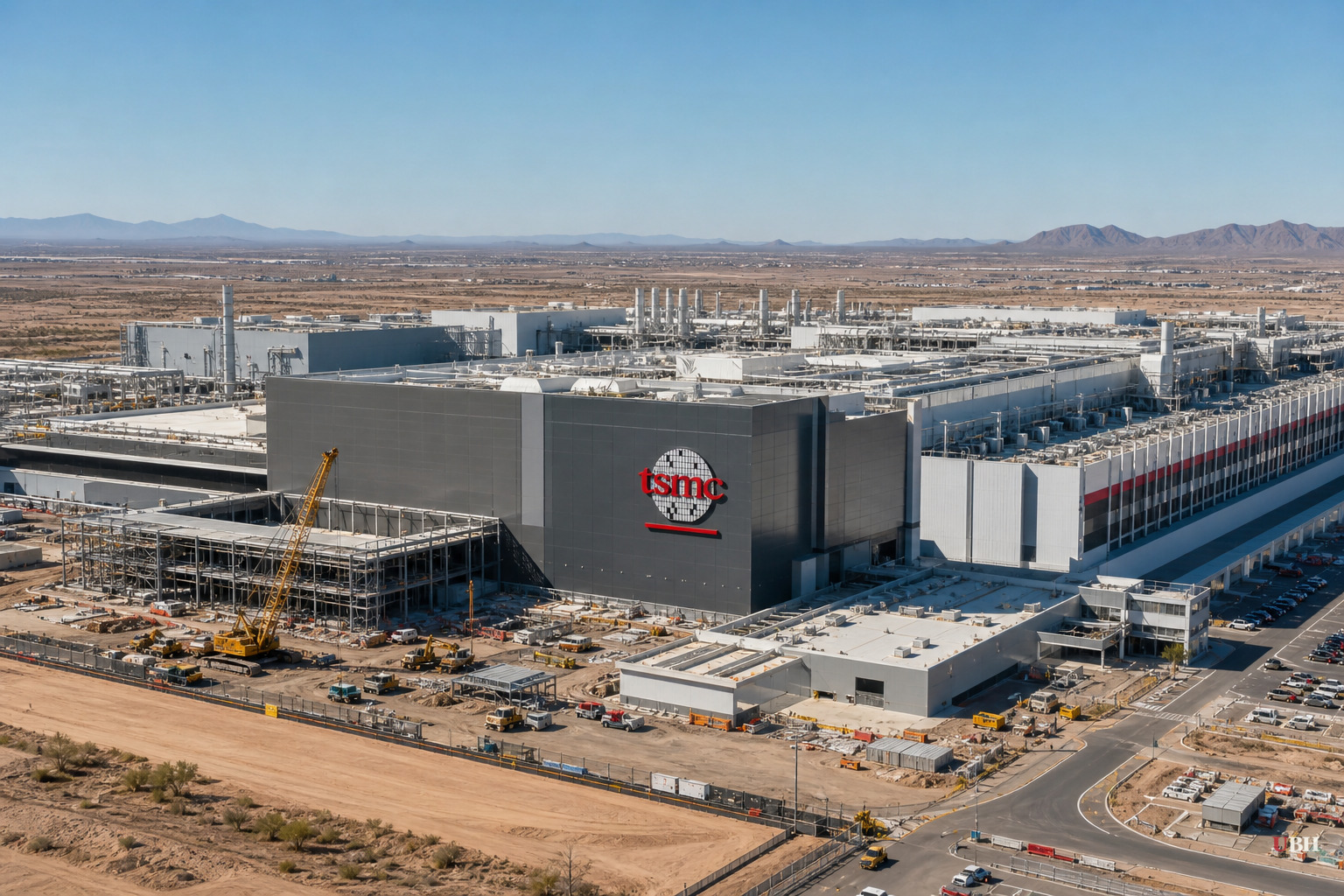
TSMC is putting another $100 billion into its Arizona operations, bringing its total committed U.S. investment to $265 billion. Chief Financial Officer Wendell Huang confirmed the number in an interview with CNBC's Emily Tan, tying the move directly to what he called a "multi-year demand mega trend" in artificial intelligence chips.
The new money pushed TSMC to raise its full-year capital expenditure target to a range of $60 billion to $64 billion, according to CNBC. That's a meaningful jump for a company that already spends more on plants and equipment than almost any manufacturer on earth.
Huang didn't mince words about the strategy. "We're seeing this strong-structure, multi-year demand, and we do not plan to leave any food on the table for anybody else," he told CNBC. Translation: TSMC thinks AI chip demand is going to keep growing for years, and it wants to own as much of that market as it can build capacity for.
The Technology Race Inside the Factories
TSMC isn't just pouring concrete. Huang said the company is converting existing 5-nanometer production lines to the more advanced 3-nanometer node to keep up with customer orders. Smaller nanometer sizes mean more transistors packed onto each chip, which generally means faster, more efficient processors, the kind Nvidia, AMD, and Apple need for AI workloads.
Phase one of the Arizona expansion, built on 4-nanometer technology, is already operating. Huang said that line "is going to be bigger and bigger in the next few quarters." Meanwhile, the company's newest 2-nanometer technology started generating revenue in the second quarter of 2026 and Huang is framing it as the next big growth driver heading into the third quarter.
The Cost of Building in America
Building chip fabs in the U.S. costs four to five times more than building them in Taiwan, according to Huang's own comments to CNBC. That's not a small gap. It's the reason TSMC has historically kept its most advanced production concentrated at home.
Huang acknowledged that the financial drag from overseas operations will keep widening as the U.S. footprint grows. He argued the tradeoff is worth it because it helps build out a genuine domestic semiconductor supply chain, both the front-end wafer fabs that make the chips and the back-end packaging plants that finish them.
TSMC is a business, not a charity, and paying four to five times more per fab is a real cost that either gets absorbed by margins, passed to customers like Nvidia and Apple, or offset by U.S. government incentives under the CHIPS Act framework. Huang framed it as fundamentally about strategic access to the U.S. market and government support, not altruism.
Markets Reacted, Then Reversed
TSMC shares rose more than 1% on the day the company reported earnings and detailed the expanded investment, according to CNBC. But the stock slumped 7% the following Friday. Year-to-date, TSMC shares are still up roughly 48%, meaning the recent pullback hasn't erased a strong run for the stock in 2026.
Asked about the swings, Huang gave a shrug of an answer: TSMC doesn't control financial markets. "What we can do is really to focus on fundamentals of our business," he told CNBC, pointing to execution on capacity and technology rather than short-term stock price moves.
For the U.S., this is a significant development on paper. More advanced chip manufacturing on American soil reduces dependence on Taiwan, an island Beijing claims as its own territory and has not ruled out taking by force. Every dollar of TSMC's $265 billion commitment that lands in Arizona is a dollar of leading-edge chip capacity that isn't sitting 100 miles off the coast of a country China's military has been actively rehearsing to blockade.
But the math still matters. If it costs four to five times more to build the same fab in Arizona than in Taiwan, that's a permanent tax on U.S.-made chips unless technology, labor efficiency, or subsidies close the gap over time. Huang didn't give CNBC a timeline for when, or if, that cost gap narrows.
The open question is whether this expansion pace holds if AI demand cools even slightly. TSMC has now bet $265 billion on the assumption that the AI buildout is a structural, multi-year trend rather than a bubble. Nvidia's order book and hyperscaler capital spending will be the real test of that bet, not Wall Street's day-to-day reaction to TSMC's stock.
Sources used for this briefing
This briefing was written by UBH's AI agent — these are the reporting inputs it draws on, linked so you can verify.


