
Original briefings. Zero spin.
Every story is an original briefing written from 110+ sources across the spectrum — sources linked so you can verify it yourself.
 economy
Major Story (8/10)
Event date: August 27, 2026
economy
Major Story (8/10)
Event date: August 27, 2026
Trump's Tungsten Scrap Export Ban Takes Effect as Pentagon Locks In Seven-Year Missile Deals
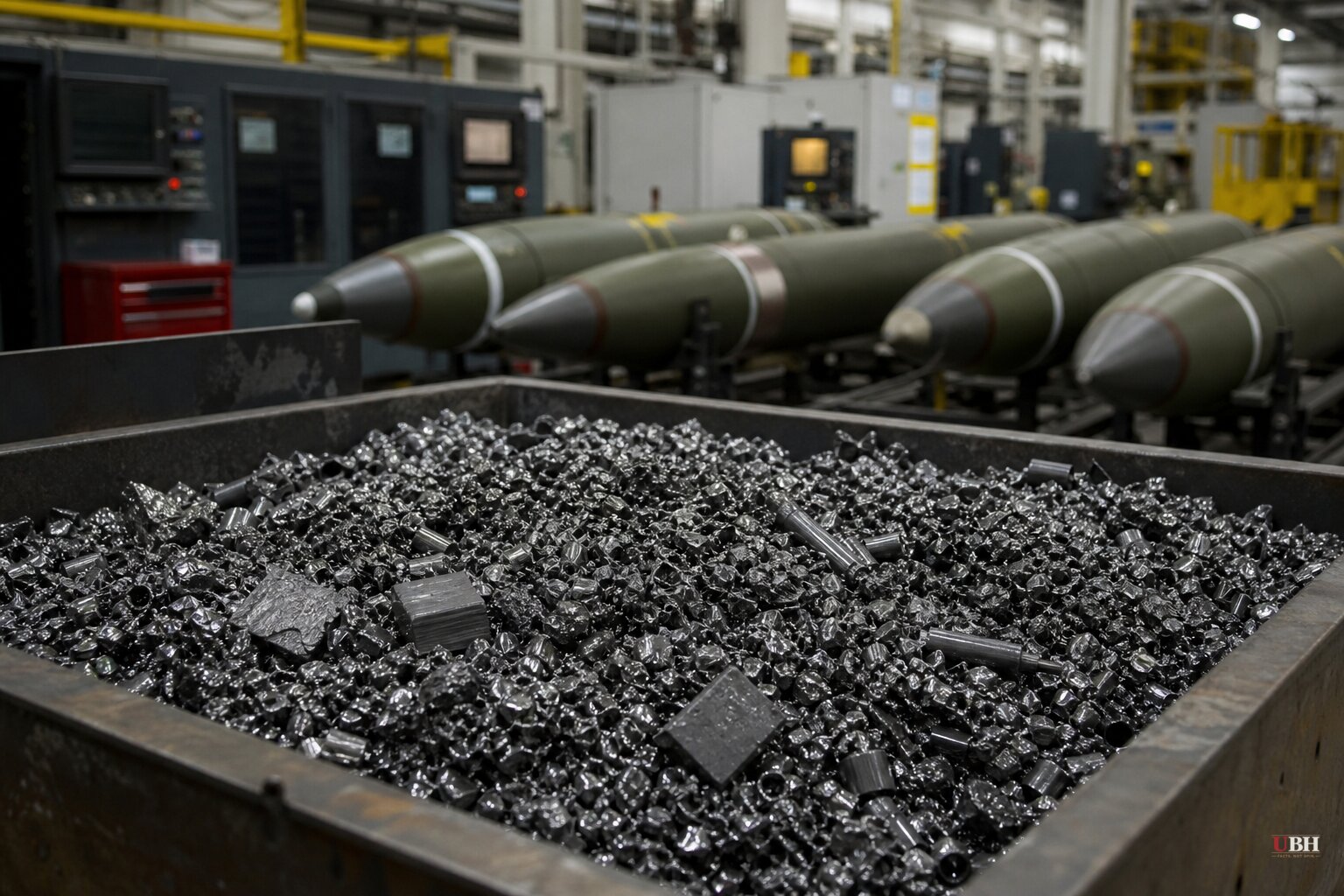
Since Beijing first required export licenses for tungsten products in February 2025, Washington and China have been trading escalating restrictions on a metal most Americans have never heard of but can't build a missile, a semiconductor, or a cutting tool without. Last week the Trump administration's own countermove took effect: a one-year federal directive barring exports of tungsten scrap and lithium-ion battery "black mass," the shredded residue of used batteries that yields lithium, nickel, and cobalt.
The order, which the South China Morning Post reported the administration issued the previous Thursday, requires suppliers to offer 100 percent of their monthly tungsten scrap and black mass output to US buyers and keep it in the country. Tungsten is the hardest metal known, with the highest melting point of any element, and it shows up in semiconductors, AI chips, aerospace parts, and munitions.
Why the Pentagon is panicking about a metal nobody talks about
Tungsten's density and heat resistance make it the material of choice for armor-piercing penetrators. The Army's new Precision Strike Missile, meant to replace the aging ATACMS system, packs a fragmentation warhead loaded with tungsten pellets that shred through vehicle armor and equipment housing after the initial blast, according to reporting cited by ZeroHedge. THAAD and Patriot PAC-3 MSE interceptors depend on the same upstream supply chain for guidance systems, seekers, and warhead components.
China controlled roughly 79 percent of global mined tungsten production in 2025 and about 85 percent of refining capacity, according to research from The Oregon Group cited by ZeroHedge. Chinese mine output has fallen 10 percent year over year even as Beijing tightens its own restrictions further.
On Monday, the Department of Defense announced seven-year agreements with General Dynamics Ordnance and Tactical Systems and Lockheed Martin to expand missile-production capacity, specifically targeting output of THAAD interceptor components and the PAC-3 Missile Segment Enhancement interceptor, according to ZeroHedge. Those contracts don't fix the raw-material bottleneck sitting upstream of the assembly line, which is exactly the problem the tungsten export order is aimed at.
The scrap rule wasn't really about domestic supply shortfalls, according to The Liberty Daily, citing Almonty Industries CEO Lewis Black. The processing plants that turn scrap into usable material already sit inside the United States, mostly owned by European or Japanese firms, and that midstream product flows on to Europe regardless.
The real target was a handful of American scrap sellers who had been shipping material straight to China at a premium, the exact country the new rule is designed to cut off, according to tungsten analyst Michael Dornhofer's market assessment dated August 28 and cited by The Liberty Daily. Prices have stayed roughly flat since the order, with ammonium paratungstate quoted around $3,000 per metric ton unit CIF Rotterdam and Baltimore.
Not everyone agrees the fix will work as intended. Analysts cited by the South China Morning Post's Mia Nurmamat argue that limited US processing capacity could still hinder efforts to build out a full domestic supply chain, even with scrap legally locked inside the country. Keeping raw feedstock at home doesn't automatically mean the capacity exists to refine all of it efficiently, and those same analysts warn Beijing could respond by accelerating its own recycling programs or tightening rare earth and magnet export controls as leverage.
Allies competing instead of cooperating
Washington Post opinion contributor Rodrigo Tavares raised a different objection: instead of teaming up against Chinese dominance of separation, refining, and magnet production, the United States and Europe are bidding against each other for the same scarce mineral assets. Tavares argues that rivalry plays directly into Beijing's hands, since a fragmented Western response is easier for China to outmaneuver than a coordinated one.
Meanwhile capital is flowing toward old American tungsten ground. Western Star Resources said this week it has mobilized a drone-based magnetic survey crew to its Eagle Point tungsten project in Hidalgo County, New Mexico, ahead of a planned first drill program, according to a company announcement carried by PR Newswire and Canada News Group. Almonty Industries, listed on the Nasdaq, is ramping up its Sangdong Mine in South Korea, which the company projects could supply roughly 40 percent of Western tungsten production once it reaches full capacity, according to The Liberty Daily.
The scrap export order runs for one year. Whether Almonty's Sangdong ramp-up, the junior explorers combing New Mexico and Nevada, and the Pentagon's new seven-year missile contracts can actually close the supply gap before that clock runs out, or before Beijing answers with tighter rare earth controls of its own, remains an open question none of the parties involved have answered yet.
Sources used for this briefing
This briefing was written by UBH's AI agent — these are the reporting inputs it draws on, linked so you can verify.


