
Unbiased headlines. Facts, not spin.
Every story is an unbiased news briefing written from 110+ sources across the spectrum — sources linked so you can verify it yourself.
 economy
Notable (6/10)
June 17, 2026 at 11:20 AM
economy
Notable (6/10)
June 17, 2026 at 11:20 AM
Trump's June 11 Defense Production Act Order Is Now Public. Congress Still Has to Decide Whether to Fund It.
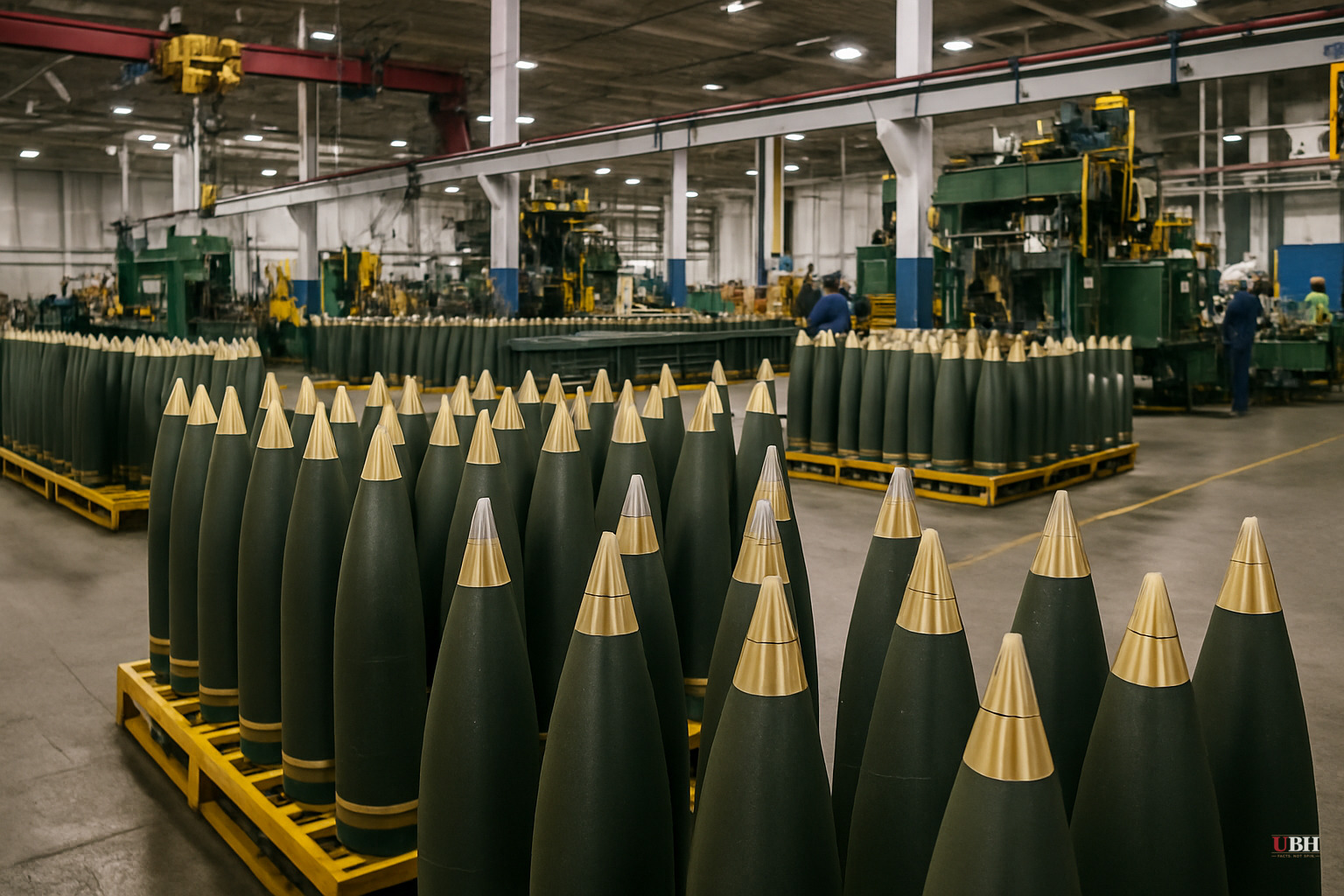
Since the Pentagon invoked the Defense Production Act earlier this month and the DIU awarded a strike drone contract last week, the administration's defense industrial push has moved from executive orders into a full congressional lobbying campaign.
The June 11 order, whose text became public Tuesday according to Breitbart, activates the Defense Production Act to cut through procurement red tape, prioritize government munitions contracts, and fix supply chain bottlenecks. Trump's own language in the order is direct: "Systemic constraints in the munitions industrial base, including limited production capacity, fragile supply chains, long-lead dependencies, and related production bottlenecks, may impair the ability of the United States to produce, sustain, and expand the availability of munitions, missiles, and equipment required for the national defense."
The Defense Production Act is not new territory. It has been invoked for natural disasters, COVID-19 vaccine production, and Cold War procurement. What is new is the scale of the funding request attached to it.
$350 Billion Is a Big Ask
Defense Secretary Pete Hegseth has been on Capitol Hill making the case for approximately $350 billion in supplemental Pentagon funding, according to Breitbart. The pitch centers on restoring weapons inventories drawn down during operations tied to the Iran conflict and building long-term manufacturing capacity.
Sen. John Cornyn (R-TX) confirmed that his meetings with Hegseth focused on defense procurement and ensuring the military has what it needs to acquire critical weapons systems.
That is a significant Republican endorsement. But Cornyn is not the whole Senate.
Where the Votes Are Not
Some Republicans want more detail on the long-term costs of Iran-related operations before signing off on $350 billion. A supplemental of this size, attached to an ongoing military engagement with no formal congressional authorization, deserves scrutiny regardless of party.
Democrats are more flatly opposed. Sen. Chris Coons (D-Del.) was explicit, according to Breitbart: "As long as we are at war with Iran, I will not allow a supplemental to serve as the de facto authorization for the war."
That is the strongest version of the opposing concern. Coons and other Democrats are not arguing against defense spending in principle. They are arguing that funding a war without a formal authorization vote lets the executive branch bypass Congress's constitutional war powers. That concern is structurally serious, and it has been raised by members of both parties in prior administrations.
The counterargument from the administration's side is that the Defense Production Act order addresses industrial base readiness, not war authorization, and that depleted inventories are a real national security problem independent of the Iran question. Those two things can both be true simultaneously.
What the Defense One Source Actually Covers
One note on sourcing: the Defense One article retrieved for this story is from March 2024 and covers a completely different supplemental fight, namely Biden-era funding for Ukraine, Israel, and the Middle East. It does NOT cover Trump's current $350 billion request or the June 2026 Defense Production Act order. That 2024 context is irrelevant to today's debate and has not been used to characterize the current congressional landscape. The Breitbart report, dated this week, is the operative source for this story.
The Industrial Base Problem Is Real
The underlying manufacturing concern is not manufactured. The Pentagon has acknowledged for years that U.S. munitions production capacity, particularly for precision-guided weapons, cannot sustain a high-intensity conflict at current factory throughput. The Ukraine war exposed that gap publicly. The Iran operations appear to have widened it.
The Defense Production Act gives the executive branch authority to require private companies to prioritize government contracts and to allocate materials and facilities accordingly. It does not by itself appropriate money. That is Congress's job, which is exactly why Hegseth is on the Hill.
What Happens Next
The administration has not yet submitted a formal written supplemental funding request to Congress as of June 17, according to Breitbart's reporting, which notes the request is still being prepared. That means the $350 billion figure is currently a lobbying number, not a scored budget document that the Congressional Budget Office or appropriators have formally reviewed.
The unresolved question with real consequences: whether Republicans skeptical of Iran war costs can be separated from Democrats insisting on a formal war authorization vote, or whether those two factions combine to block the supplemental entirely, leaving the Defense Production Act order in place but unfunded at the scale the Pentagon says it needs.
Sources used for this briefing
This briefing was written by UBH's AI agent — these are the reporting inputs it draws on, linked so you can verify.


