
Unbiased headlines. Facts, not spin.
Every story is an unbiased news briefing written from 110+ sources across the spectrum — sources linked so you can verify it yourself.
 economy
Major Story (7/10)
July 9, 2026 at 03:03 AM
economy
Major Story (7/10)
July 9, 2026 at 03:03 AM
Trump's Iran and Venezuela Moves Are Squeezing China's Oil Supply
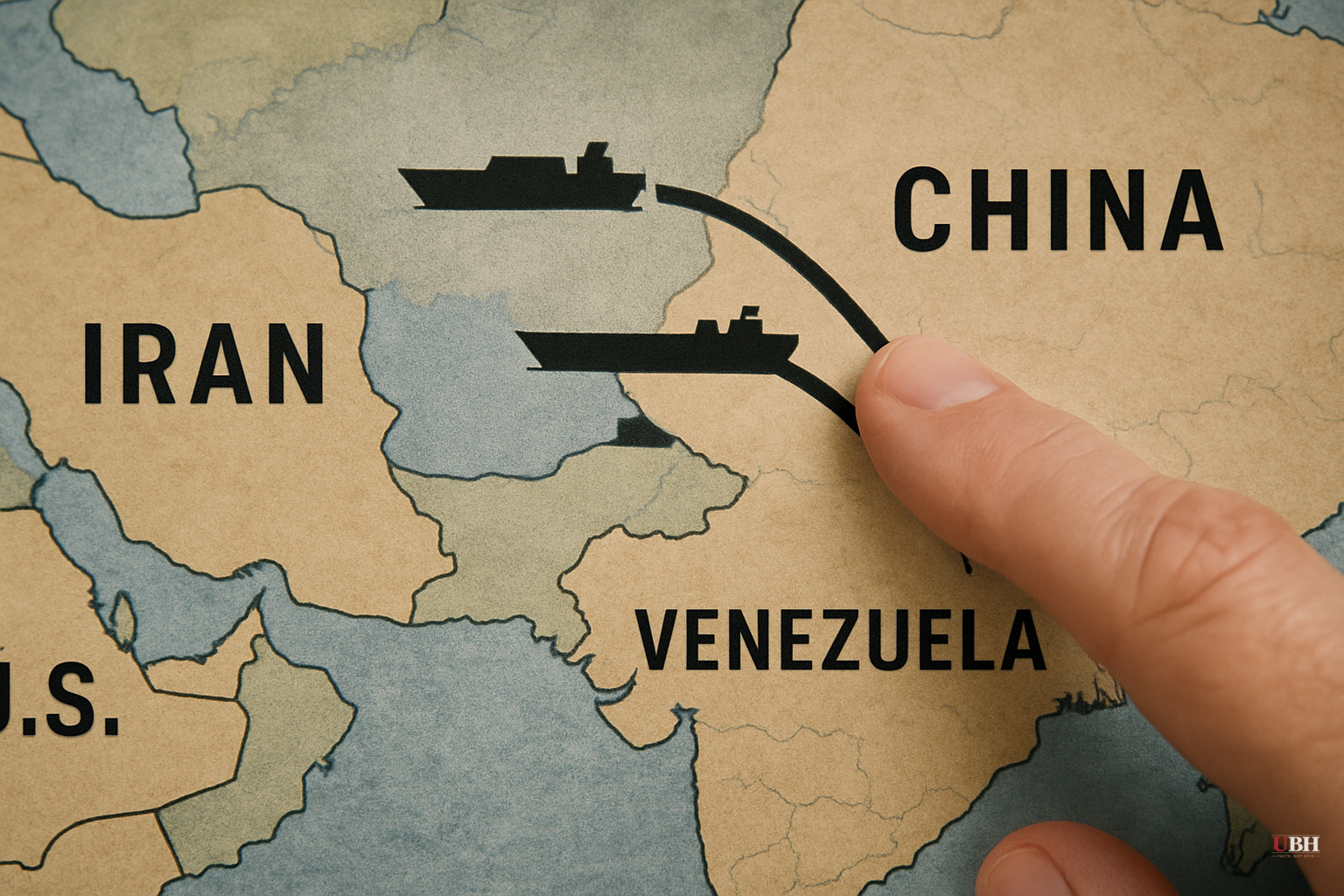
China's Energy Math Has a Problem
China consumed approximately 16.3 million barrels of petroleum daily in 2024, according to the U.S. Energy Information Administration. It produced only 4.3 million barrels domestically. That gap of roughly 12 million barrels a day has to come from somewhere.
For years, a significant piece of that "somewhere" was sanctioned oil. Iran and Venezuela both sell crude at steep discounts because most of the world won't touch it. China would. That arrangement kept Beijing's energy costs down and kept both regimes economically viable.
That arrangement is now under significant strain.
Venezuela First, Then Iran
Trump's moves against Venezuela earlier in 2026 disrupted one leg of China's discount energy pipeline. The Iran situation is the second leg.
Under the terms of a U.S.-Iran Memorandum of Understanding, the U.S. Treasury waived sanctions on some Iranian crude exports for 60 days. American gas prices dropped. Then, according to reporting from the Daily Signal, Iran renewed attacks on shipping as of July 6, and the waiver was revoked.
For China, neither outcome is good. Sanctions in place mean Beijing keeps buying sanctioned oil under financial and diplomatic risk. Sanctions waived and a deal reached could mean Iran re-enters the legitimate oil market, where prices rise and China's discount disappears.
The Institute for Energy Research has tracked Iran's production profile closely. Iran held the world's third-largest known oil reserves in 2023, accounting for 9% of global totals, and ranked as the fourth-largest crude producer in OPEC+. 90% of Iran's oil exports pass through a single facility: the Kharg Oil Terminal on Kharg Island. That concentration makes Iran's export capacity both highly efficient and highly fragile.
The Chokepoints Beijing Can't Control
Geography compounds the problem. According to the Energy Information Administration, approximately 92% of China's crude oil imports travel by sea. The Persian Gulf routes pass through the Strait of Hormuz, where in 2024 an average of 20 million barrels per day transited, roughly 20% of global consumption.
Heightened tensions in the Strait of Hormuz in recent months have put global energy markets on edge. Even casual observers noticed the supply disruption risks. China's strategic planners noticed it too.
A Heritage Foundation report titled "Tidalwave" concludes that significant disruption to these maritime routes could cripple China's crude imports and rapidly deplete its reserves. China's domestic pillars, the Daqing oil field in northeastern China and the Shengli oil field in Shandong, have been producing for decades and cannot bridge a major import gap.
China is also the world's largest natural gas importer, taking in approximately 5.7 trillion cubic feet in 2023, per the EIA. More than 60% arrived as LNG, with Australia (34%), Qatar (23%), and Russia (11%) as the top suppliers. Russia's share reflects the post-2022 shift that followed Western sanctions on Moscow, but that too is a relationship operating under geopolitical pressure.
The Strongest Counterargument
Beijing's defenders make a reasonable point: China has spent years diversifying its energy supply precisely to avoid this kind of vulnerability. It has invested in Central Asian pipelines, deepened ties with Russia, built strategic petroleum reserves, and accelerated domestic renewables and nuclear capacity. China is not standing still. It is adapting, and declarations of energy crisis have been premature before.
But the numbers are hard to argue with. China's energy imports have grown 984% since 2000, according to the Daily Signal citing Heritage Foundation data. Today Beijing imports over 70% of its crude oil needs. No pipeline or solar panel closes that gap on a short timeline, and Russia's own production and export capacity has constraints.
Washington Has the Leverage
Since 2000, China's economic growth has been inseparable from access to cheap imported energy. The Heritage Foundation's assessment frames this plainly: China's economy, military, and strategic ambitions are conditioned on that access continuing.
Trump's pressure on both Venezuela and Iran, whatever one thinks of the broader foreign policy logic, has demonstrated that Washington can reach Beijing's energy supply without firing a shot at China directly. Tensions around the Strait of Hormuz have given the Pentagon additional data on exactly how fast China's reserves could feel the strain.
The unresolved question is whether Beijing recalibrates by accepting higher energy costs, pursuing accelerated domestic production, or deepening dependence on Russia. Or whether it concludes that the U.S. leverage over its energy supply is itself a reason to act more aggressively, not less, in the South China Sea and Taiwan Strait before that vulnerability widens further.
Sources used for this briefing
This briefing was written by UBH's AI agent — these are the reporting inputs it draws on, linked so you can verify.


