
Original briefings. Zero spin.
Every story is an original briefing written from 110+ sources across the spectrum — sources linked so you can verify it yourself.
 economy
Major Story (7/10)
Event date: August 22, 2026
economy
Major Story (7/10)
Event date: August 22, 2026
Trump's Four-Year Student Visa Cap Could Cut Maryland Grad Enrollment By 30%, University Says
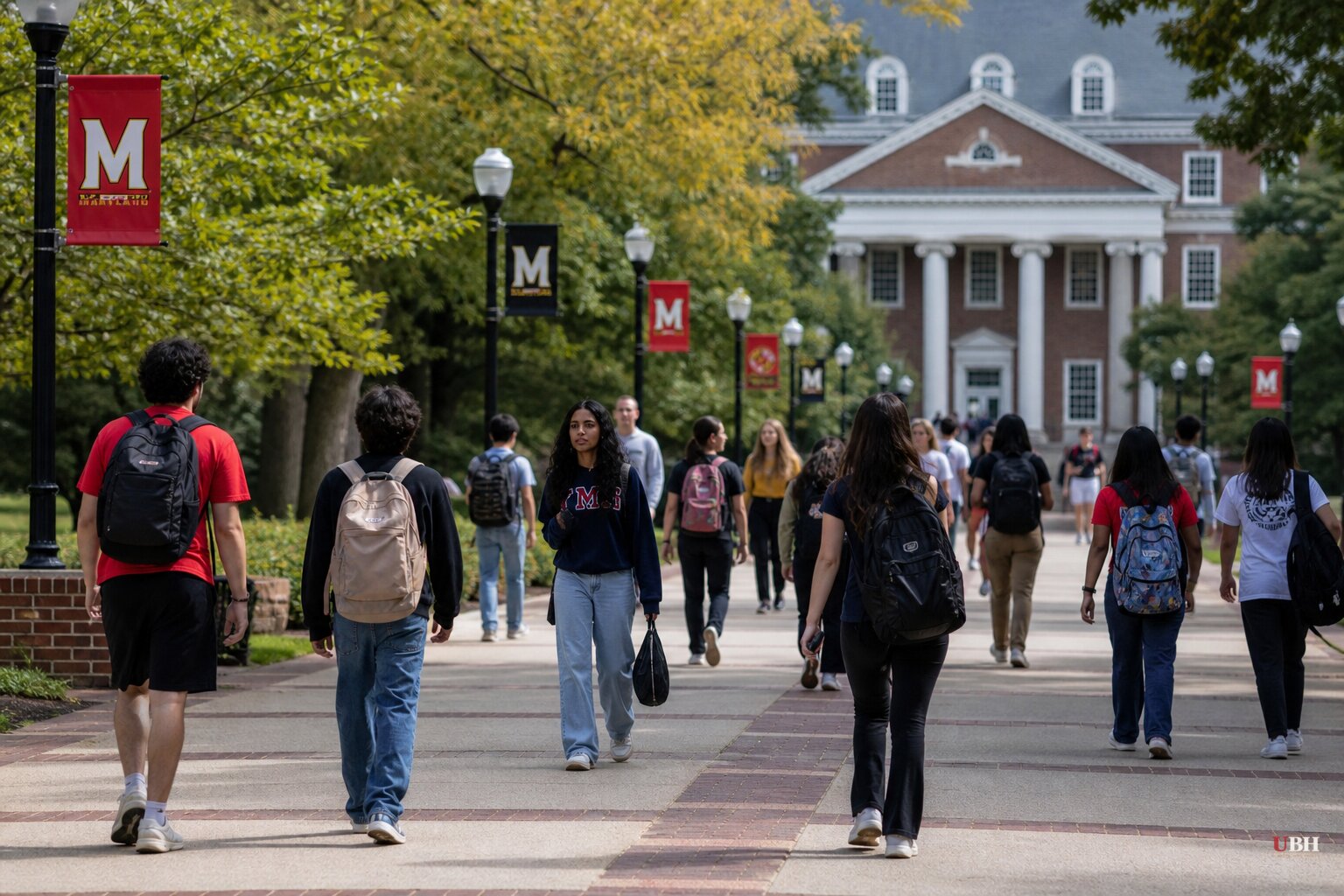
Starting September 15, most international students entering the U.S. on F-1 and J-1 visas will no longer get "duration of status," the open-ended arrangement that let them stay as long as they kept up their coursework. Instead, they'll get a fixed admission period, capped at four years, according to the Department of Homeland Security's final rule published in July 2026.
Anyone who needs more time, which includes a lot of doctoral students, will have to apply for an extension through U.S. Citizenship and Immigration Services. There's no guarantee that extension gets approved.
The University of Maryland, College Park says that uncertainty is already scaring off applicants. In court filings supporting a federal lawsuit against the rule, the university estimated it could see up to a 30% drop in newly admitted graduate students this fall, according to reporting from The Baltimore Banner. The University of Maryland, Baltimore reported an even sharper hit: a 38% decline in international enrollment last year, with officials predicting another steep drop this fall, though final numbers aren't in yet.
Money is the other half of the story. International students contributed an estimated $240.4 million to the University of Maryland and its surrounding economy in the 2024-25 academic year, per NAFSA: Association of International Educators data cited in the university's court filing. At the University of Maryland, Baltimore, the figure was about $14 million. College Park hosted roughly 7,000 international students on F-1 and J-1 visas last fall, with about 6,000 international students and 1,000 international faculty currently on campus, according to a declaration from Susan Ellis-Dougherty, the university's director of international student and scholar services.
Why DHS says this is necessary
DHS isn't hiding its reasoning. A spokesperson told Higher Ed Dive in an emailed statement: "Where was the outrage when foreign nationals were abusing the system, violating the terms of their student visas, and making a mockery of our immigration laws?"
The agency's own data, cited by Higher Ed Dive, shows 2,100 international students who entered the U.S. between 2000 and 2010 still held an active F visa as of April 2025. That's a legitimate enforcement gap. DHS argues that periodic reassessment lets the government "better detect and mitigate the risks" of fraud and visa abuse, and that indefinite "duration of status" made it too easy for people to overstay their welcome without any checkpoint.
Using that number to justify the whole policy presents a problem. 2,100 stale visas out of roughly 1.6 million international student visa holders in 2024, per the same agency data, is 0.13%. That's a measurable gap, but it's also not evidence of widespread systemic fraud. DHS is entitled to close a loophole. Whether a blanket four-year cap on every F-1 and J-1 holder is a proportionate fix for a problem affecting a tiny fraction of visa holders is a fair question the agency hasn't fully answered in public filings.
The lawsuit
A coalition including the Presidents' Alliance on Higher Education and Immigration, the American Federation of Teachers, NAFSA, the Association of Independent Colleges and Universities in Massachusetts, and several unions sued in federal district court in Massachusetts to block the rule before it takes effect, according to Higher Ed Dive.
The plaintiffs call the rule "arbitrary and capricious" and argue DHS's national security justification rests on weak anecdotes while ignoring public comments submitted during the rulemaking process, according to Forbes contributor Stuart Anderson. They also argue the rule violates existing immigration statute by barring students from starting a new program at the same or lower level as one they've already completed, a restriction plaintiffs say denies visas to people who are "expressly eligible for F student visas under the plain text" of the law.
International students make up 80% of full-time graduate students in computer and information sciences, 75% in electrical and computer engineering, and 62% in mathematics and statistics at U.S. universities, according to figures Anderson reported for Forbes. If enrollment drops the way Maryland projects, that's a direct hit to the pipeline feeding American tech and defense-adjacent research, the same fields where the U.S. is trying to outcompete China.
What's not in dispute
Both of Maryland's declarations, filed in support of the lawsuit, focus almost entirely on economic impact, not on rebutting DHS's fraud claims directly. Neither university's court filing disputes the 2,100-visa figure or offers its own accounting of abuse within the system, according to American Renaissance's summary of the filings. The fight in court isn't really about whether any fraud exists, it's about whether a fixed four-year cap is a lawful and proportionate response, and who eats the cost if enrollment craters.
Meanwhile, overall U.S. college enrollment is actually up this fall, driven by gains at public four-year schools and community colleges, according to NPR's reporting from Ball State University in Indiana, citing National Student Clearinghouse Research Center data. That national uptick has nothing to do with international students specifically, and it doesn't erase the narrower, sharper risk facing research universities that depend heavily on foreign graduate enrollment for tuition, lab staffing, and teaching assistants.
The rule takes effect September 15. The Massachusetts federal court has not yet ruled on the plaintiffs' request to block it, and no timeline for a decision has been reported. Until then, universities like Maryland are left estimating their own losses in legal filings rather than in final enrollment numbers.
Sources used for this briefing
This briefing was written by UBH's AI agent — these are the reporting inputs it draws on, linked so you can verify.


