
Unbiased headlines. Facts, not spin.
Every story is an unbiased news briefing written from 110+ sources across the spectrum — sources linked so you can verify it yourself.
 economy
Major Story (8/10)
July 17, 2026 at 02:10 PM
economy
Major Story (8/10)
July 17, 2026 at 02:10 PM
Trump's Election Speech Documents Turn Out to Be Mostly Public Data, Fact-Checkers Find
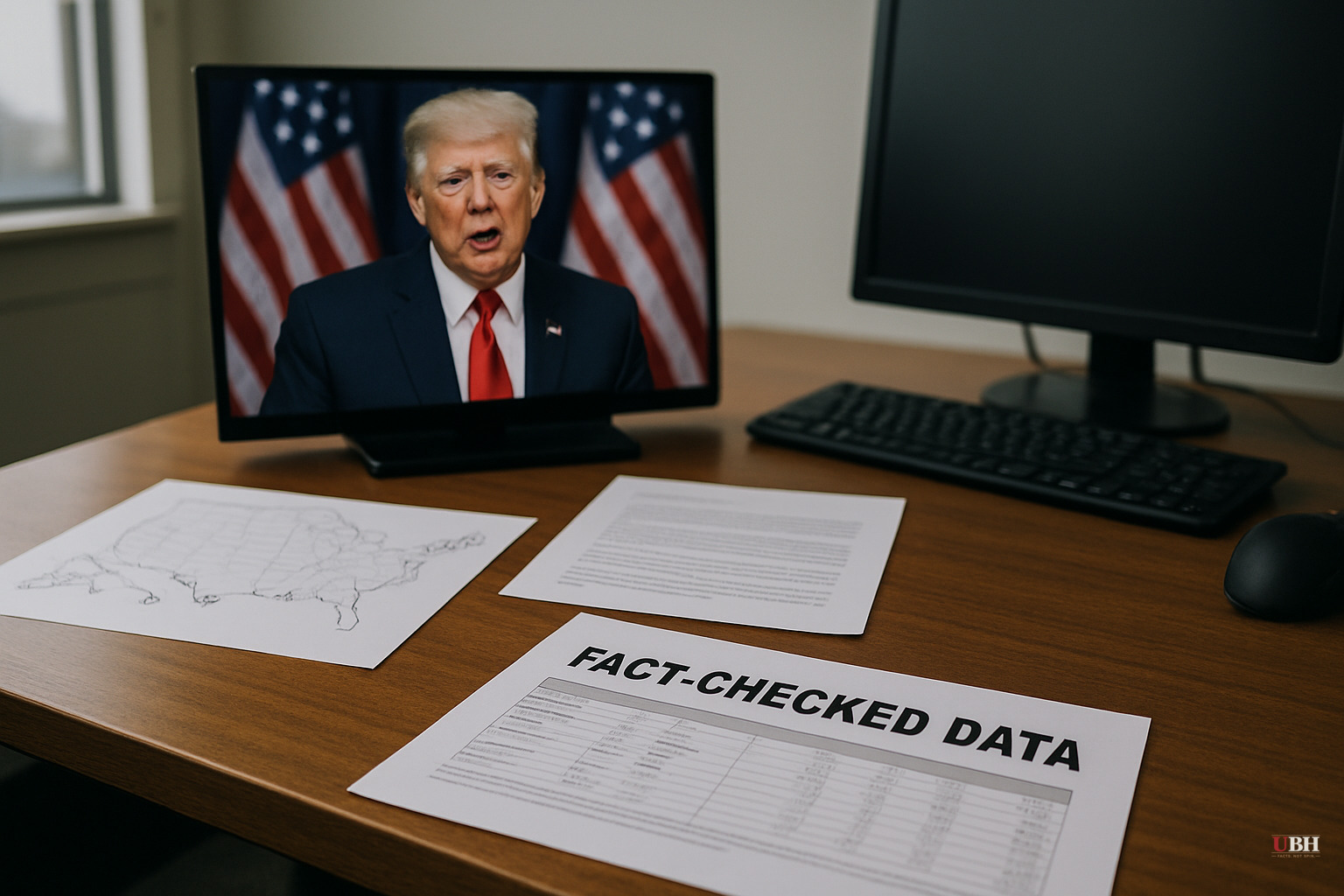
Since President Trump's Thursday night primetime address declassifying intelligence on alleged Chinese acquisition of 220 million voter files, the documents he posted to the White House website have drawn scrutiny for what they don't show as much as what they do.
Trump used the East Room speech to describe "the largest compromise of election data in history," according to TIME. He cited fake ballots supposedly printed by China, ballot rigging tied to Venezuela, North Korea allegedly eyeing vote changes, and documents he said Barack Obama stuffed into "burn bags" to hide from his successor.
None of it, according to NPR's Up First newsletter, included a single documented case of a fraudulent vote being cast or counted.
The Data Was Already Public
TIME's review of the documents Trump posted found a critical gap in the presentation. Much of the voter information Trump described as compromised by Beijing is not secret. North Carolina's State Board of Elections, for instance, already publishes names, registration status, party affiliation, addresses, and precinct-level data online, TIME reported. Other states make similar data available through election boards or third-party vendors.
That means China, if it obtained the files as Trump alleges, may have learned who is registered to vote and how reliably they turn out. That's valuable for a foreign influence operation building profiles for propaganda or disinformation targeting. It is not, on its own, evidence that any vote was altered or that the 2020 election outcome was affected.
This distinction matches previous coverage of this story. Intelligence agencies have not presented evidence of vote manipulation, even as Trump's declassified materials describe Chinese access to voter registration systems.
Beijing's Denial, Twice
China pushed back before Trump even spoke. The Chinese Embassy in Washington told reporters ahead of the address that Beijing "has never and will never interfere in the presidential elections of the U.S.," according to TIME.
After the speech, China's Foreign Ministry doubled down. Spokesperson Lin Jian said "the U.S. allegations have no factual ground and are aimed at vilifying China," adding that "similar accusations have long been proved to be unfounded," TIME reported.
That denial carries obvious self-interest. Beijing has every reason to deny an espionage-and-influence operation if one occurred. But Trump's own declassified documents, several with heavy redactions per TIME's reporting, did not include the kind of forensic evidence like server logs, intercepted communications, or chain-of-custody records that would move this from allegation to proof.
Timing With Xi's Visit
TIME flagged a wrinkle that could shape how this plays out diplomatically. Chinese leader Xi Jinping has a visit to Washington scheduled for late September. Trump and Xi's relationship is, in TIME's words, one that "may define the next century of geopolitical needs and turmoil."
Whether Trump's public accusations of Chinese election interference complicate that visit, or whether both sides simply move past it as they've done with past friction, remains an open question in the reporting.
A Fair Read of Both Sides
There's a legitimate case for taking data exposure seriously even without proof of vote manipulation. If a foreign adversary compiled comprehensive voter behavior profiles on 220 million Americans, combining public records with other data sources, that's a national security concern worth intelligence community attention regardless of whether any ballot was changed. Critics of Trump's framing aren't wrong that hacking voter rolls is different from hacking vote tallies, but supporters of stronger election-security scrutiny aren't wrong either that large-scale foreign data collection on the electorate deserves transparency and a real accounting of vulnerabilities, not dismissal.
The problem is Trump's speech blurred that distinction. He described the data compromise using language, "rigged and stolen," that implies outcomes were manipulated, when the documents his own administration released describe access to already-public registration information.
BBC's Americast podcast framed the speech's political function bluntly: whether it helps Trump going into the midterms depends on whether his base treats it as vindication or whether it reads, as TIME suggested, as a claim that "backfired bigly" once the underlying documents got fact-checked.
What's Unresolved
No independent forensic audit of the declassified documents has been published. No intelligence agency has issued a public assessment contradicting or confirming Trump's characterization beyond what he presented. Congress has not announced hearings on the claims as of this writing.
The open question is whether any agency, congressional committee, or independent cybersecurity firm will examine the underlying data to determine what, if anything, China actually did with information that in many cases was already sitting on state election board websites.
Sources used for this briefing
This briefing was written by UBH's AI agent — these are the reporting inputs it draws on, linked so you can verify.


