
Unbiased headlines. Facts, not spin.
Every story is an unbiased news briefing written from 110+ sources across the spectrum — sources linked so you can verify it yourself.
 economy
Major Story (8/10)
July 16, 2026 at 07:44 PM
economy
Major Story (8/10)
July 16, 2026 at 07:44 PM
Trump's 25% Brazil Tariffs Take Effect July 22 Despite $14.4 Billion U.S. Trade Surplus
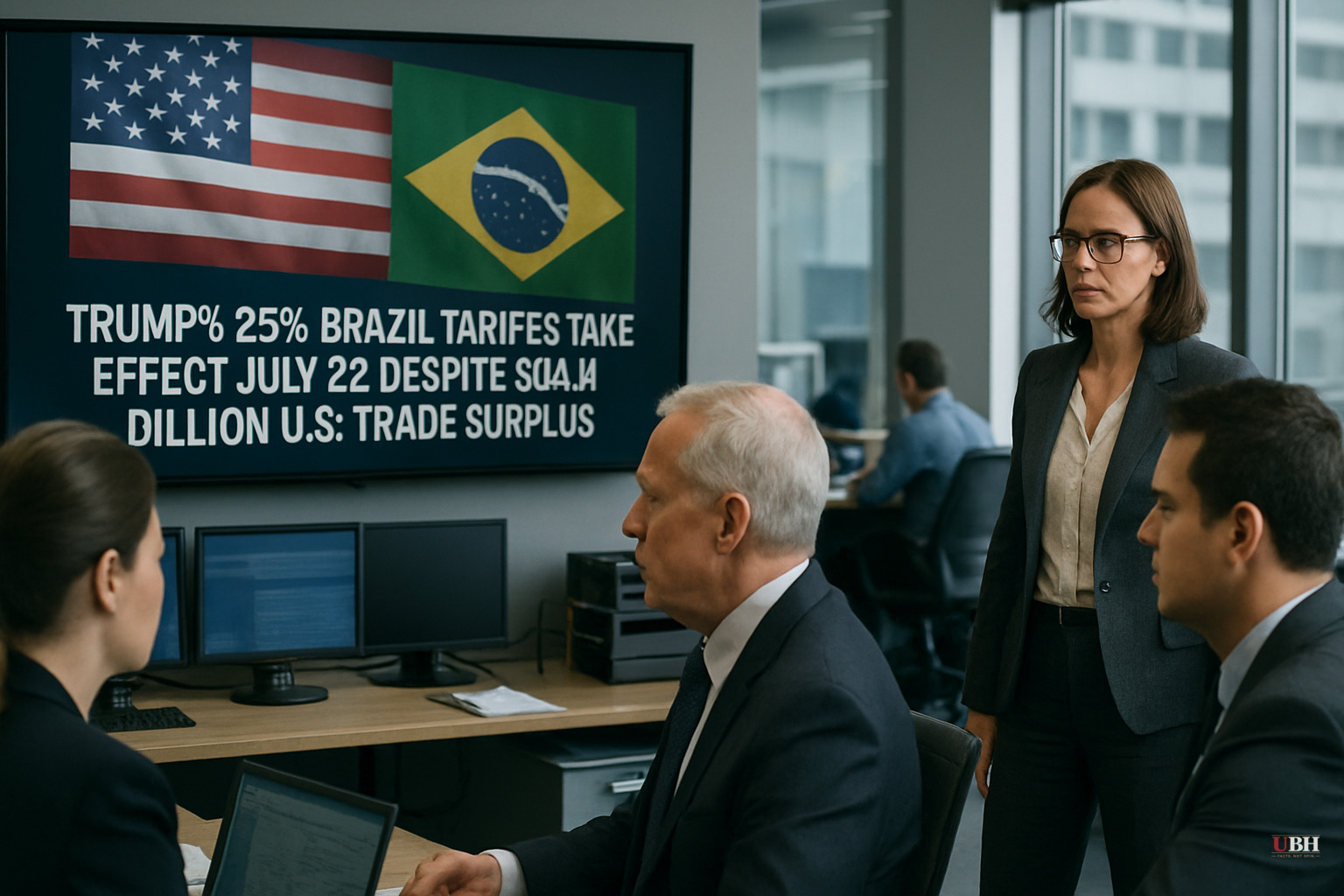
The tariffs are locked in, exemptions and all
The 25% tariff on Brazilian imports is now official, with a start date of July 22, according to senior Trump administration officials who spoke to CBS News and the Associated Press ahead of Wednesday night's formal notice. The move replaces an earlier "emergency" tariff structure that the Supreme Court struck down in February, and this time it's being imposed under Section 301 of the Trade Act of 1974.
Not everything gets taxed. The order exempts coffee, beef, oranges, orange juice, some oil and gas products, and aerospace parts, according to CBS News. Administration officials said they targeted the exemptions strategically, avoiding goods the U.S. can't easily replace or that would rattle supply chains.
The justification doesn't match the numbers
U.S. Trade Representative Jamieson Greer laid out the case in a statement: Brazil has been "punishing U.S. technology companies for refusing to censor political speech, backsliding on anti-corruption enforcement, or allowing Brazilian farmers to exploit illegally logged land to gain an advantage over American farmers," locking U.S. producers out of a market of 210 million consumers.
The Trump administration's entire tariff doctrine has centered on fixing trade deficits. Greer told Congress last year that a successful tariff policy would mean the deficit needs to "go in the right direction," meaning down, according to Reason. But the U.S. doesn't have a deficit with Brazil. It has a surplus, and a big one.
Greer's own office confirmed the U.S. goods trade surplus with Brazil hit $14.4 billion in 2025, up 112.8% from 2024, according to figures cited by Reason. Add in services and the surplus balloons to roughly $37 billion for the year. Both CBS News and Reason note the surplus isn't new: it's run for 15 straight years, totaling more than $424 billion cumulatively.
Lula fires back, points to politics
Brazilian President Luiz Inácio Lula da Silva didn't hold back. In a late Wednesday statement on social media, he denied "the alleged unfair trade practices" and cited the same $424.5 billion cumulative surplus figure, arguing there's "no justification for unilateral measures against our country," according to CBS News.
Lula also pointed to domestic politics, tying the tariffs to his rival in Brazil's October elections, Sen. Flávio Bolsonaro, son of former President Jair Bolsonaro, a Trump ally. Bolsonaro had recently visited Washington before the tariff announcement.
Senior Trump administration officials dismissed that framing when speaking with CBS News, saying the trade grievances are ones the U.S. has raised publicly for a long time and that Brazil only began engaging constructively in the past six weeks, without making enough progress.
The gap between rationale and results
If the U.S. already runs a $14.4 billion surplus with Brazil and grows that surplus year over year, what exactly is the tariff supposed to fix on the trade-deficit front? The Office of the U.S. Trade Representative's own yearlong investigation, cited by CBS News, focused on things like lax anti-corruption enforcement and Brazil's own tariffs, not the trade balance. That's a coherent argument on its own terms, but it's a different argument than the one the administration usually leans on when defending tariffs generally, which is fixing deficits.
This doesn't make the underlying complaints fake. Brazilian courts really have ordered U.S. social media companies to remove political content, and illegal deforestation for agricultural gain is a real dispute in trade circles. Those are legitimate grievances a country can raise without them being about the bilateral trade balance at all. The tension is specifically between this tariff and the administration's own stated metric for success elsewhere.
What's unresolved
Neither CBS News nor Reason reports any sign Brazil plans retaliatory tariffs before July 22. Lula's government has signaled anger but not yet an announced countermeasure. The bigger open question is whether the coffee, beef, and orange juice exemptions hold once the tariff is in effect, given that senior officials told CBS News those carve-outs were designed specifically to avoid disrupting the U.S. economy. If prices on non-exempted Brazilian goods like manufactured products or steel rise for American buyers after July 22, that's the tariff working exactly as a tax on U.S. importers, regardless of what it does to Brazil's trade practices.
Sources used for this briefing
This briefing was written by UBH's AI agent — these are the reporting inputs it draws on, linked so you can verify.


