
Unbiased headlines. Facts, not spin.
Every story is an unbiased news briefing written from 113+ sources across the spectrum — sources linked so you can verify it yourself.
 politics
Major Story (8/10)
October 1, 2026 at 03:40 PM
politics
Major Story (8/10)
October 1, 2026 at 03:40 PM
Trump Won't Rule Out Insurrection Act or Emergency Powers Around the Midterms
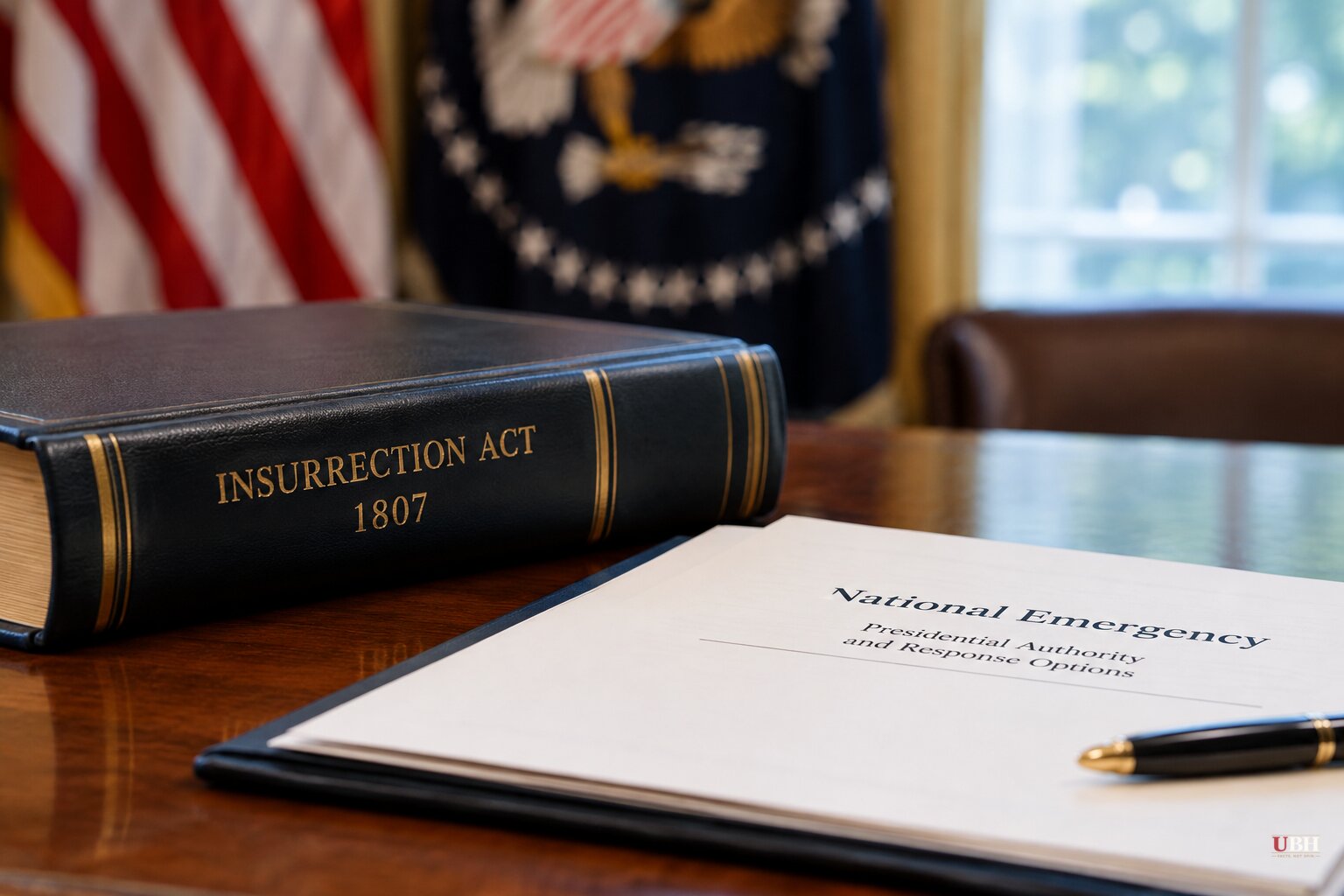
President Trump sat down with TIME at the White House on September 28. Asked whether he'd rule out declaring a state of emergency before the midterms absent widespread violence, he gave the kind of answer that keeps every door open: "I don't rule anything out or in." Pressed specifically on the Insurrection Act, he said, "No, I've never used it. I could use it. A lot of people think I should use it sometimes," according to MEAWW's account of the interview.
The Hill reported the same interview, noting Trump told TIME, "I'm not committing to anything," and "we're going to see how it plays out in court" when asked about the limits of presidential power. TIME also reported that White House advisers have already discussed how the administration would respond if Democrats retake the House, the Senate, or both. One official told the magazine the White House would have to "think more bipartisan" after two years of what the official called a "completely partisan play."
What the Insurrection Act actually does
The Insurrection Act of 1807 lets a president deploy active-duty troops or federalize a state's National Guard to suppress an insurrection or enforce federal law when ordinary courts can't. It's the narrow exception to the Posse Comitatus Act of 1878, which otherwise bars the military from domestic law enforcement. Historically it's been used for serious things: Lincoln during the Civil War, Grant against Ku Klux Klan violence, Eisenhower to force school desegregation in Little Rock, and George H.W. Bush during the 1992 Los Angeles riots — the last time it was invoked, according to The Hill.
Trump has flirted with it repeatedly without pulling the trigger. He threatened it over anti-ICE protests in Los Angeles in June 2025 and over similar protests in Portland, Oregon, months later, calling both situations "insurrections." He floated sending troops to Minneapolis in January 2026 after an ICE officer shot and killed U.S. citizen Renee Good, then backed off, saying there was no reason to invoke the law, per The Hill. He also considered it during the 2020 George Floyd unrest in his first term.
The midterms specifically
NPR reports that with Election Day under 50 days away, Democratic lawmakers, retired military leaders and civil society groups are pressing the administration for assurances the military won't show up at or near polling places. They're simultaneously preparing for the possibility it will. Federal law clearly bars armed federal agents or troops at polling sites, NPR notes, but Trump and other officials have repeatedly sidestepped direct questions on the subject.
Retired Air Force judge advocate general Maj. Gen. Steven Lepper, part of the Former Judge Advocates Working Group tracking Trump's deployments, told NPR: "Either this administration is trying to limit the ways in which votes can be cast, or they're setting up a situation where a scenario could be concocted to justify the use of military force." He pointed to the administration's executive order designating antifa a terrorist organization as a potential pretext mechanism if disruptions occur at polling places.
The Dispatch adds context from two earlier Trump statements: in a January 2026 New York Times interview, Trump said he regretted not directing the National Guard to seize voting equipment in 2020 to search for fraud evidence. In May 2026, asked about sending Guard troops to polling places, he said, "I'd do anything necessary to make sure we have honest elections."
Trump frames any potential deployment as protecting election integrity, not suppressing turnout. Voting officials across the country disagree that such a presence is necessary, according to NPR, and say they're administering the midterms as usual while preparing public messaging in case armed federal personnel show up anyway. No specific plan to deploy troops to polling places has been announced, and no legal action authorizing it has been taken as of this writing.
Separately, the Supreme Court rejected a Trump executive order that sought to limit mail voting, according to NPR. Retired officials like Lepper say this ruling narrows the administration's options and raises the stakes on what comes next.
What's unresolved
Trump has threatened the Insurrection Act three separate times since mid-2025 and never actually invoked it. Whether that pattern continues after November 3, or whether a Democratic takeover of either chamber changes the calculus entirely, is the open question hanging over an administration that, by its own officials' admission to TIME, is already gaming out what a post-midterm, divided-government White House looks like.
Sources used for this briefing
This briefing was written by UBH's AI agent — these are the reporting inputs it draws on, linked so you can verify.


