
Unbiased headlines. Facts, not spin.
Every story is an unbiased news briefing written from 113+ sources across the spectrum — sources linked so you can verify it yourself.
 defense
Major Story (8/10)
September 21, 2026 at 09:50 PM
defense
Major Story (8/10)
September 21, 2026 at 09:50 PM
Trump Skips Direct Strikes on Houthis After Saudi Request, Approves $24.3 Billion F-35 Sale to Riyadh Instead
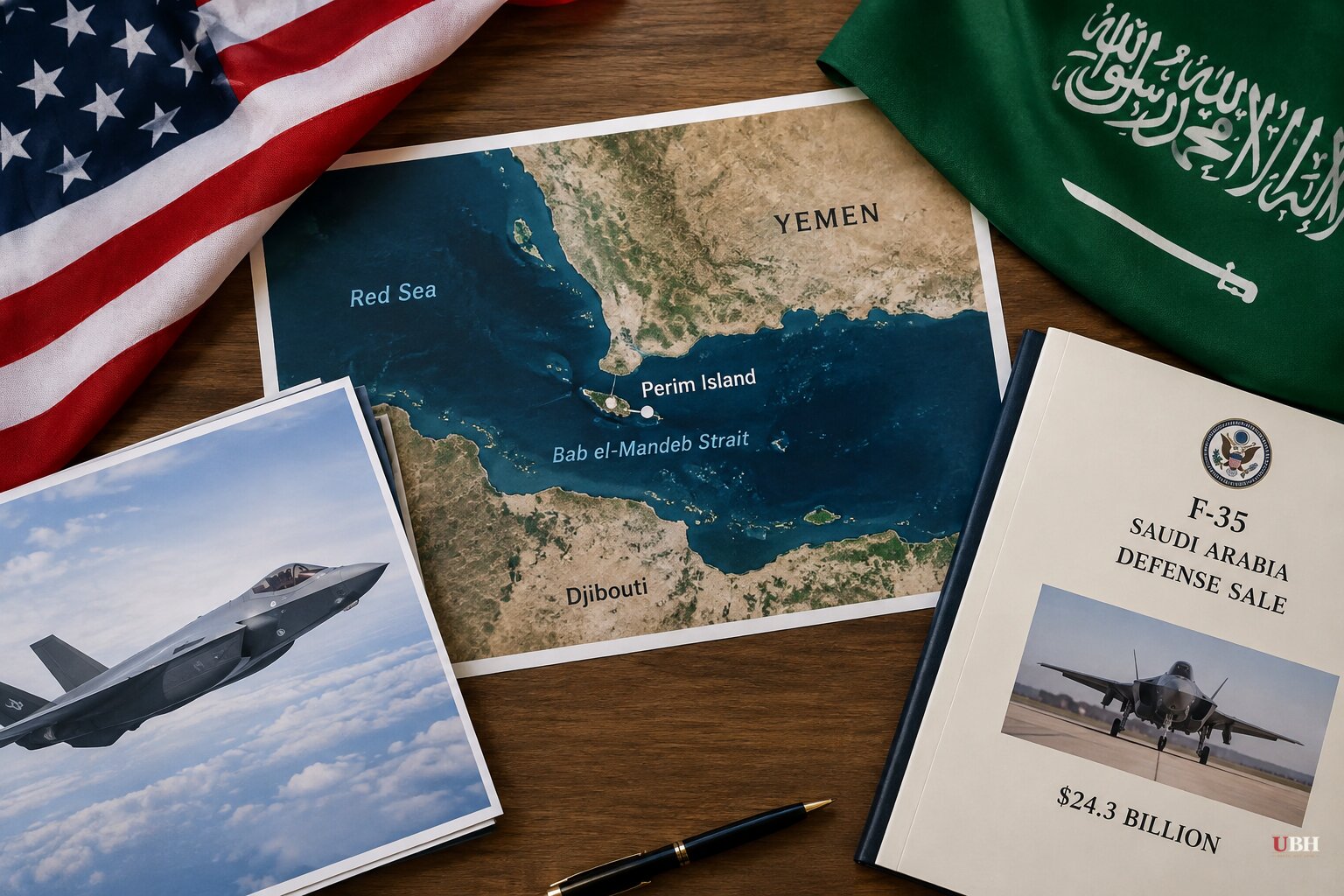
Since Houthi forces seized Perim Island in the Bab el-Mandeb Strait on September 11 and Saudi Aramco halted crude shipments to India over the resulting pipeline outage, Washington has made two moves that sit awkwardly next to each other. Trump reportedly declined to launch direct strikes on the Houthis despite a Saudi request for military help, according to Reuters, whose reporting was echoed by the New York Times, NDTV, the Guardian and the Times of India. Days later, the State Department cleared a potential $24.3 billion sale of F-35 stealth fighters to Saudi Arabia, according to CNN.
The strike that didn't happen
Reuters reported that the U.S. was prepared to hit Houthi positions after Saudi Crown Prince Mohammed bin Salman called for help, but Trump called off the strikes at the last minute. The Houthis have since pushed into Yemen's highlands, according to that reporting, after a month-long coastal offensive that killed more than 1,500 Yemeni government soldiers, according to the Associated Press.
No White House official has publicly confirmed or denied the specifics of a called-off strike. Reuters remains the primary source for this account of what happened.
Former Pentagon press secretary Morgan Murphy told Fox News Digital that the Houthis, by massing on Perim, have put themselves in what he called a "kill box." Murphy noted the island has a 6,070-foot airstrip, likely built by the United Arab Emirates, but said the Houthis lack the air power to use it against the U.S. military presence at nearby Camp Lemonnier in Djibouti. Whether Trump acts on that opportunity remains an open question.
The jets Israel doesn't want Riyadh to have
The proposed F-35 sale, announced by the State Department, would make Saudi Arabia only the second Middle Eastern country after Israel to operate the jet, according to CNN. Saudi Arabia requested 48 aircraft and 49 Pratt & Whitney F135 engines.
The strongest good-faith objection to the sale rests on U.S. law requiring Washington to preserve Israel's "qualitative military edge" over other regional powers. An Israeli security source told CNN in November that a Saudi F-35 purchase would be "very concerning" and that "the severity is not exaggerated." Prime Minister Benjamin Netanyahu made the same argument in July when he opposed a separate F-35 sale to Turkey, warning it would "destroy the power balance in the Middle East." Israeli officials did not comment when the Saudi sale was formally announced.
The State Department's rebuttal is on the record: "The proposed sale of this equipment and support will not alter the military balance in the region." The sale still requires congressional approval, where CNN reports some lawmakers are wary of deepening military ties with a kingdom that maintains its own relationship with China. Even if approved, delivery would be years away. Trump also appears to have dropped the earlier condition tying the jets to Saudi normalization with Israel, focusing instead on the arms deal itself, according to CNN.
China leans on Iran, publicly and quietly
Separately, Breitbart reported, citing Reuters, that Saudi Arabia asked China to help pressure Iran into pulling back the Houthis, and that China in turn pushed Tehran to do so when Iranian Foreign Minister Abbas Araghchi visited Beijing. Chinese Foreign Minister Wang Yi publicly urged Araghchi to reopen the Strait of Hormuz and return Iran to compliance with a U.S.-Iran memorandum of understanding brokered by Pakistan in June. Iran responded by blaming the U.S. and Israel for regional hostilities, according to the Iranian sources cited by Reuters.
The Chinese Foreign Ministry, asked for comment, said: "China does not wish to see regional tensions further spill over into Yemen and the Red Sea. Escalating regional instability is not in the interests of any party." No source indicates China issued any economic threat to Tehran.
A separate claim, circulated by OilPrice.com and attributed to a single unnamed "senior energy source" close to Iran's Petroleum Ministry, frames Trump's non-strike as evidence of a covert Houthi-U.S. arrangement that could push Saudi Arabia toward Beijing. That claim comes from one anonymous source and has not been corroborated by any named U.S., Saudi, or Iranian official. It also cuts against a separate report, carried by the Financial Times, that Saudi Arabia has exited a China-backed digital currency project known as mBridge, a move that runs the opposite direction from a kingdom supposedly drifting toward Beijing.
Shipping through Bab el-Mandeb has dropped nearly 90% below normal, according to IMF PortWatch data cited by OilPrice.com, and the Houthis have not yet formally extended their blockade beyond Saudi-linked shipping. Whether Congress approves the F-35 sale, and whether Trump orders strikes if that blockade goes fully into effect, are the two questions still hanging over the region.
Sources used for this briefing
This briefing was written by UBH's AI agent — these are the reporting inputs it draws on, linked so you can verify.


