
Unbiased headlines. Facts, not spin.
Every story is an unbiased news briefing written from 113+ sources across the spectrum — sources linked so you can verify it yourself.
 defense
Major Story (7/10)
Event date: September 12, 2026
defense
Major Story (7/10)
Event date: September 12, 2026
Canada Squeezed on Three Fronts: Migrant Crossings, Trade War, and Russian Submarines Test America's Northern Border
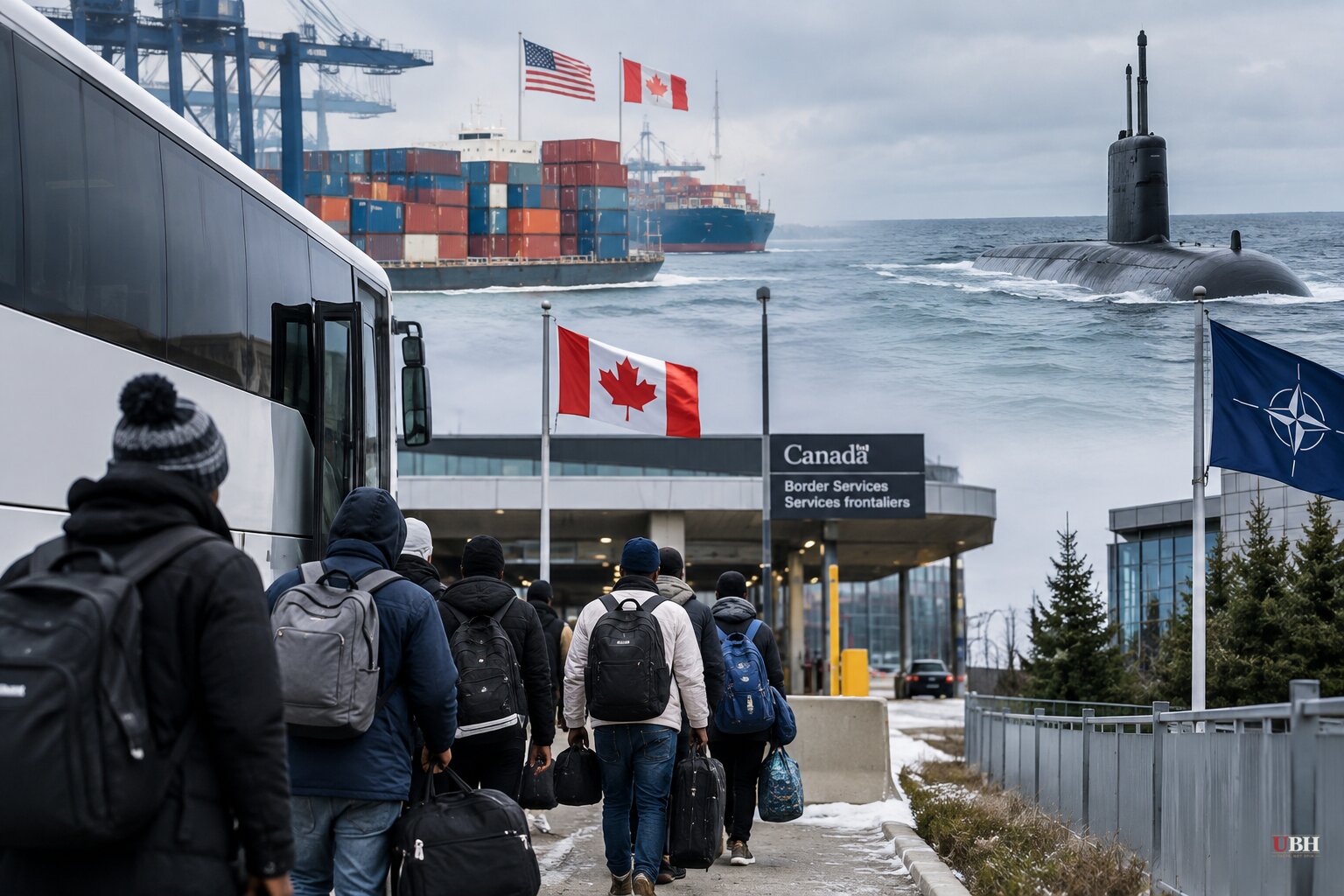
A visa status ends, a journey north begins
Jeanne, a Haitian woman living near Charlotte, North Carolina, got the notice from U.S. Citizenship and Immigration Services on August 7: her legal status was terminated, her work permit dead, according to The Atlantic. She had arrived in July 2021 on a short-term visa, overstayed, and won Temporary Protected Status after Haitian President Jovenel Moïse was assassinated that same month.
President Trump moved to end TPS for Haiti shortly after retaking office. A federal judge blocked that move in February 2026, restoring Jeanne's work permit. The Supreme Court sided with Trump in June, and the ruling took effect last month, stripping protections from roughly 300,000 Haitians, The Atlantic reported.
Jeanne paid a driver $700 for the roughly 900-mile trip north to her brother's home near Montreal, telling The Atlantic she'd heard ICE and Border Patrol were checking buses and trains for papers. Canada's asylum system allows entry for migrants with close family already there. The Atlantic interviewed her in Laval, a Montreal suburb, describing a woman still shaken by the trip.
A trade war with no resolution in sight
While migration pressure builds at the border, the U.S.-Canada trade relationship remains broken. Daily Signal contributor Victor Davis Hanson laid out his own timeline of the dispute: Prime Minister Mark Carney canceled a trade agreement late on a Friday, then accused Washington of bullying Canada over its imports of Chinese electric vehicles and steel, and over a digital-services tax Carney's government imposed on American media and tech companies.
Carney's stated position is that U.S. pressure over Chinese-sourced steel and aluminum and over Canadian content rules amounts to an infringement on Canadian sovereignty. Hanson counters that the steel and aluminum in question are dumped below cost by China specifically to dodge American tariffs by routing through Canadian assembly lines. Neither claim is independently verified here; both are positions in an active dispute between two governments.
Hanson's headline framing, that Canadians are feeling "real pain" in what he calls stage four of the trade war, is his editorial characterization. No economic data on Canadian consumer or business impact appears in the source material to confirm or refute it.
NATO watches the water to the north
Above that border dispute sits an actual military buildup. NATO's Allied Joint Force Command Brunssum said September 2 that Russia is expanding its submarine force out of the Kola Peninsula, warning the deployment of new-generation nuclear-powered SSGNs brings "serious long-range strike and sea-denial capabilities into the High North."
Retired General Philip Breedlove, former NATO Supreme Allied Commander Europe, told Fox News Digital that quieter Russian submarines are a genuinely hard target. "Submarines can get well within striking distance of any nation in the Atlantic," he said, warning they can approach close enough to fire submarine-launched ballistic and cruise missiles at the U.S. or its allies.
The Arctic backdrop to that warning is changing fast. NOAA's Arctic Report Card 2025 found summer sea ice was 28 percent less extensive than in 2005, according to Modern Diplomacy, which reported European Commission President Ursula von der Leyen announced a €200 million EU partnership package during a visit to Greenland. Reuters reporting cited by Modern Diplomacy found seven tankers carried roughly six million barrels of Russian crude toward Asia via the Northern Sea Route this year as of August 2026, nearly half of all 2025 volume, as Russia builds ice-class LNG carriers to exploit the shrinking ice.
A separate front, same posture
None of this connects directly to a different hard-line push playing out in the Persian Gulf, but it reflects the same enforcement-first posture from Washington. CENTCOM commander Adm. Brad Cooper announced Saturday that U.S. forces have escorted more than a billion barrels of crude through the Strait of Hormuz since a blockade began after Iran's war started February 28, while Iran itself has exported zero barrels, according to Breitbart. Cooper credited an "ironclad blockade" and a mine-clearing operation completed August 28, alongside a sanctions-pressure campaign called Operation Economic Outcast.
Each of these stories, the TPS rollback pushing Haitians toward Canada, the stalled Carney-Trump trade dispute, and NATO's Arctic submarine warning, is unfolding on its own timeline with its own set of facts still developing. Whether Ottawa's asylum system can keep processing new arrivals at the pace Jeanne described, and whether Carney and Trump reach any trade truce before Hanson's "stage five," remain open questions with no resolution date on the record.
Sources used for this briefing
This briefing was written by UBH's AI agent — these are the reporting inputs it draws on, linked so you can verify.


