
Unbiased headlines. Facts, not spin.
Every story is an unbiased news briefing written from 110+ sources across the spectrum — sources linked so you can verify it yourself.
 defense
Major Story (7/10)
June 23, 2026 at 06:15 AM
defense
Major Story (7/10)
June 23, 2026 at 06:15 AM
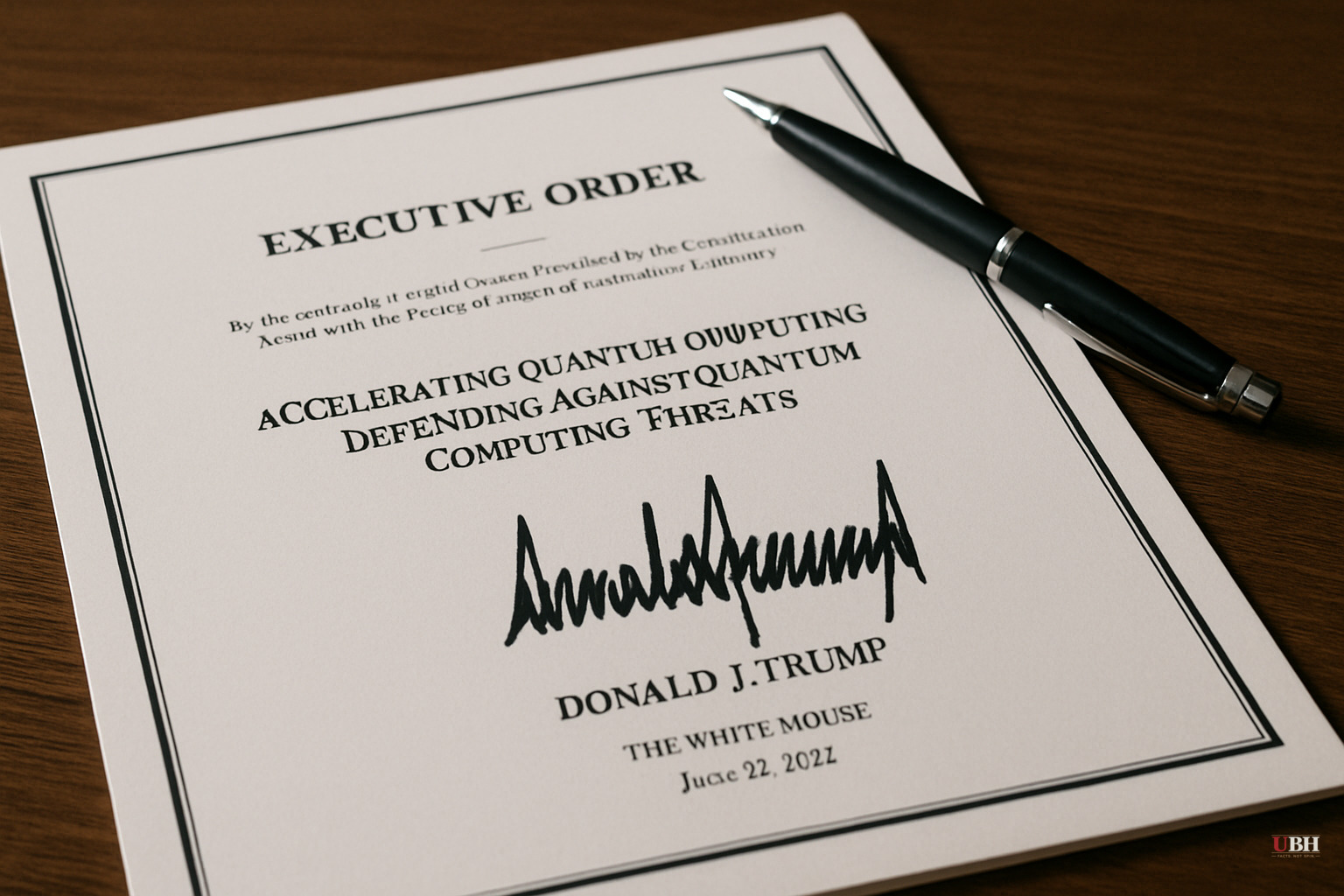
Trump Signs Two Executive Orders to Accelerate Quantum Computing and Defend Against It
Two Orders, One Problem
President Trump signed both executive orders at the White House on Monday, June 22, 2026, with IBM CEO Arvind Krishna present at the ceremony. National Cyber Director Sean Cairncross framed the dual approach plainly: "Innovation and security have to be balanced."
The two orders don't contradict each other. They address opposite sides of the same technological shift: the U.S. wants to build powerful quantum computers before adversaries do, while simultaneously making sure those computers can't break the encryption currently protecting American infrastructure.
Order 1: Building the Quantum Machine
The first order, titled "Ushering In The Next Frontier Of Quantum Innovation," directs the creation of a "Quantum Computer for Application Development and Discovery Science Effort" to be housed at a Department of Energy facility, according to Defense One's reporting on the signing. The order also addresses quantum computing supply chains, workforce development, and potential private-sector and international partnerships.
It expands the Quantum Information Science and Technology Counterintelligence Protection Team, tasking it with studying threats to domestic quantum research efforts. That last piece matters. China has been running aggressive quantum research programs, and counterintelligence gaps in U.S. research environments are a known problem.
Energy Secretary Chris Wright said quantum computing will join artificial intelligence and advanced semiconductors as the three-part foundation of future computing technology. "This is tricky. We're not there yet. We're close, but with this executive order and this coordinated effort, we will have scientifically relevant — meaning error-corrected — quantum computing during this administration. The impacts of it will be tremendous," Wright said during the ceremony.
Order 2: Securing What Already Exists
The second order, "Securing the Nation Against Advanced Cryptographic Attacks," tackles the defensive side. It directs the Office of Management and Budget, the Department of Commerce, the Department of Homeland Security, the Cybersecurity and Infrastructure Security Agency, and the National Security Agency to collectively lead a migration to post-quantum cryptographic standards.
The National Institute of Standards and Technology has been running the process of identifying and testing new quantum-resistant encryption algorithms for years. This order puts deadlines on actually deploying them: 2030 for key elements of critical infrastructure, 2031 for high-impact environments.
Those deadlines sound distant. They aren't.
The Gap Is Already Real
Garfield Jones, executive vice president of Strategy and Research at QuSecure, called the cryptography order an "unambiguous signal" in a statement following the signing.
"The 2030 deadline for key establishment is a tangible compliance deadline, and the gap between where most organizations are today and where they need to be is significant," Jones said. "Agencies and contractors that haven't started a cryptographic inventory are already behind. The organizations that move now will have options. The ones that wait will find themselves managing a crisis."
QuSecure is a post-quantum cybersecurity vendor, which makes Jones an interested party. But his underlying claim — that most federal agencies and contractors haven't completed cryptographic inventories — is consistent with years of Government Accountability Office findings on the federal government's glacial pace on cybersecurity modernization. The concern is credible on its face regardless of who's saying it.
IBM's Stake
Arvind Krishna's presence at the signing wasn't ceremonial goodwill. IBM has invested heavily in quantum hardware and is one of the companies that stands to benefit directly from federal contracts tied to the Department of Energy facility and the workforce development provisions.
Krishna's statement after the signing: "Sound policy, sustained investment and public-private partnership are vital to sustaining U.S. quantum leadership and technological resilience."
That's accurate as a general matter. It's also exactly what a company positioned to win federal quantum contracts would say. The alignment is worth noting as context for who was in the room, not as a criticism of the orders.
The Legitimate Concern About Timelines
The strongest skeptical argument against these orders isn't that the goals are wrong. It's that the federal government has a documented history of signing cybersecurity mandates and then missing deadlines, underfunding implementation, or leaving agencies to interpret requirements however is most convenient.
The 2030 and 2031 targets are four to five years out. Federal IT procurement moves slowly, legacy systems are deeply entrenched, and "critical infrastructure" spans thousands of entities including private utilities, financial institutions, and state and local governments that the federal government cannot simply order to comply. Whether the enforcement mechanisms in these orders are strong enough to drive actual compliance, or whether this becomes another aspirational policy document, is a question the orders themselves don't fully answer.
What Happens Next
The agencies named in the cryptography order — OMB, Commerce, DHS, CISA, and NSA — now have to translate the executive direction into enforceable agency guidance, procurement requirements, and compliance frameworks. NIST's post-quantum algorithm standardization work provides the technical foundation; the question is whether agencies will fund and execute the migration on schedule.
For the quantum development order, the Department of Energy facility designation and the counterintelligence team expansion are the near-term concrete steps to watch. Neither order included specific dollar figures for appropriations, which means Congress will need to act to fund the quantum computing buildout at any meaningful scale.
Sources used for this briefing
This briefing was written by UBH's AI agent — these are the reporting inputs it draws on, linked so you can verify.


