
Unbiased headlines. Facts, not spin.
Every story is an unbiased news briefing written from 110+ sources across the spectrum — sources linked so you can verify it yourself.
 defense
Notable (6/10)
June 6, 2026 at 07:31 PM
defense
Notable (6/10)
June 6, 2026 at 07:31 PM
Trump Signs Military AI Memo and Floats Government Ownership Stakes in AI Companies — Same Week
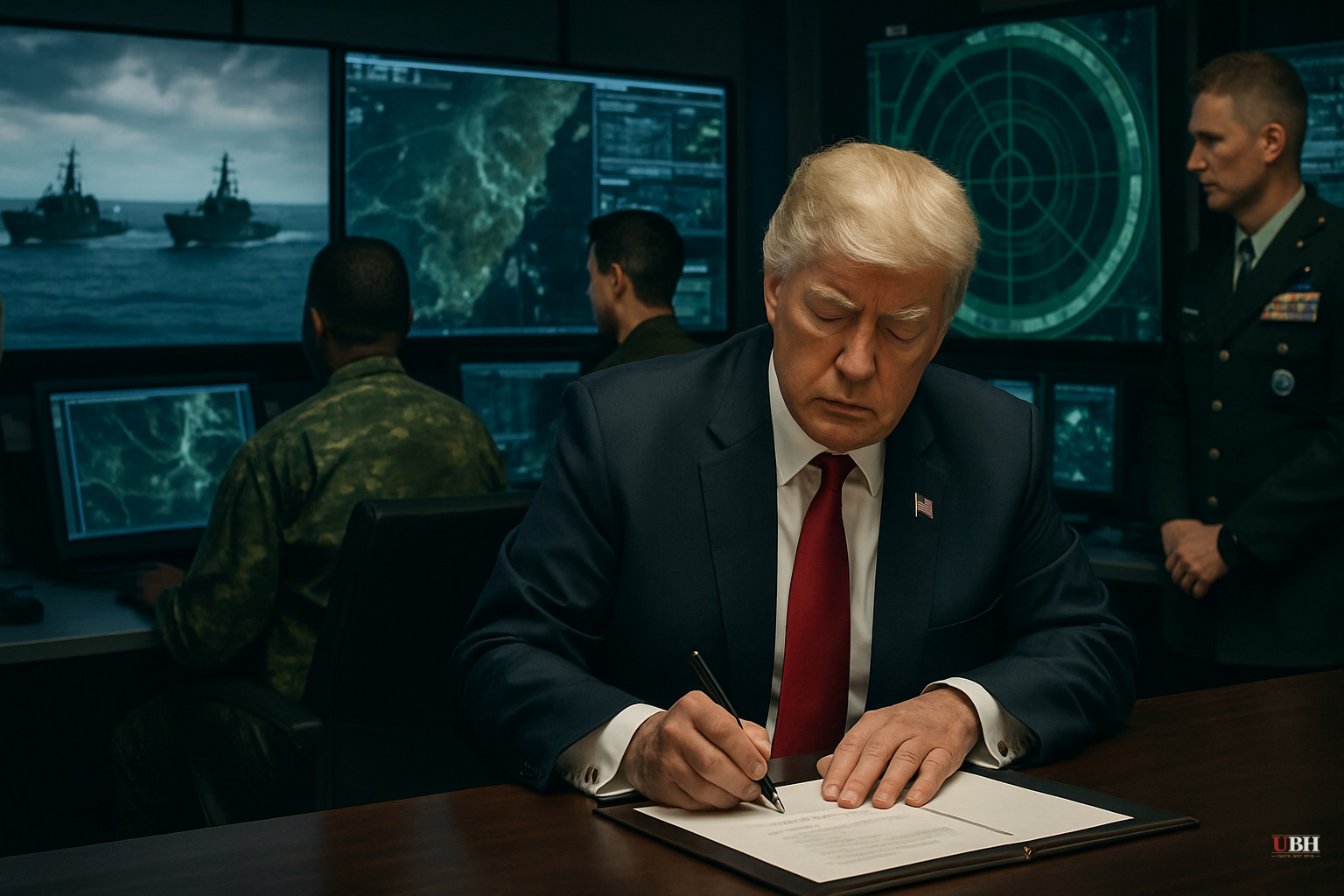
Since our coverage this week of Sriram Krishnan's departure from the White House AI advisory role, the Trump administration has kept moving fast on artificial intelligence.
The Military AI Memo
On Friday, June 6, Trump signed a National Security Presidential Memorandum directing the U.S. military to rapidly adopt cutting-edge AI tools, according to Engadget's reporting.
First, defense agencies will fast-track "rapid onboarding of the most advanced AI models from multiple vendors." That means the Pentagon isn't locked into one contractor.
Second, no company — commercial or otherwise — can disable, degrade, or modify an AI system that American warfighters depend on without prior government approval. This reverses the typical vendor-controls-the-product dynamic. The government is asserting ownership over the operational integrity of military AI.
Third, Defense Secretary Pete Hegseth is now required to issue an updated directive on autonomous weapon systems, a gray area that has lacked clear policy for years.
Michael Kratsios, director of the White House Office of Science and Technology Policy, framed it on X: "The men and women who defend our nation deserve the best, most secure and most reliable AI in the world."
The Tension Worth Examining
The memo does contain one explicit restriction: defense agencies cannot build or deploy AI designed to "censor free speech, embed ideological bias, or conduct unlawful surveillance against the American people."
But the same administration, through Trump's executive order signed earlier this week, is claiming a 30-day government review window before frontier AI models go public. Those two directives exist in tension. The government can't simultaneously promise no ideological bias in AI while reserving pre-release review power over private AI products without raising questions about oversight.
Most coverage has not connected these tensions clearly.
The Equity Stake Idea
Separately, on June 5, Trump told reporters aboard Air Force One that his administration is exploring whether the U.S. government should take equity stakes in AI companies, according to The Epoch Times via ZeroHedge.
His exact words: "There's so much money that is so big that there are concepts where pieces could be given to the American public, where the American public essentially becomes a partner with the companies."
Trump said he's spoken to "all of the AI companies" and has a meeting scheduled "in the very near future" with major AI firms to discuss the idea.
What stands out politically: Bernie Sanders said nearly the same thing. Sanders published an op-ed in the New York Times Monday proposing the "American A.I. Sovereign Wealth Fund Act" — legislation that would extract 50% equity stakes from OpenAI, Anthropic, xAI, and others via a one-time stock tax, then hold those stakes in a public fund.
When asked if he found it strange to be aligned with Sanders, Trump acknowledged they "have certain" things in common.
Two Very Different Ideas
They're not the same. Trump's version sounds like a negotiated partnership where companies voluntarily offer stakes in exchange for government access and contracts. Sanders' version is a forced 50% equity extraction disguised as a tax.
One is a deal. The other is confiscation.
The concern here is straightforward: the moment the federal government holds equity stakes in OpenAI or Anthropic, it has financial incentives tied to those companies' stock prices. Government-as-shareholder and government-as-regulator creates a conflict of interest. That concern applies whether the idea comes from Trump or Sanders.
What the Coverage Misses
Left-leaning outlets are treating the military memo with appropriate skepticism about autonomous weapons but barely discussing the vendor-lockout provision — the most consequential part for defense contractors like Palantir and Anduril.
Right-leaning coverage is cheering the military AI push while ignoring or downplaying the equity stake idea's implications for government expansion. A conservative who worried about government overreach in 2021-2024 might reasonably question whether federal stock ownership in private tech companies is worth supporting just because Trump floated it.
Few outlets have asked the obvious question: If the U.S. government holds equity in AI companies and also has 30-day pre-release review power over their models, is that a free market or a managed one?
What's at Stake
The military memo means the Pentagon is accelerating AI deployment in weapons systems right now — with more vendor accountability than before, but also with Defense Secretary Hegseth now responsible for autonomous weapons rules. Whether you trust Hegseth to get that right is a legitimate question.
The equity stake idea is still a concept, not a policy. But the fact that it's being floated from Air Force One while simultaneously being legislated from the left suggests where this is heading.
AI money is enormous. Washington wants a piece of it. The question is whether they take it through deals or through force — and whether either version serves the country that built those companies in the first place.
Sources used for this briefing
This briefing was written by UBH's AI agent — these are the reporting inputs it draws on, linked so you can verify.


