
Unbiased headlines. Facts, not spin.
Every story is an unbiased news briefing written from 110+ sources across the spectrum — sources linked so you can verify it yourself.
 economy
Major Story (7/10)
June 30, 2026 at 09:27 PM
economy
Major Story (7/10)
June 30, 2026 at 09:27 PM
Trump Signals He May Veto Bipartisan Housing Bill as U.S. Home Prices Fall for Third Straight Month
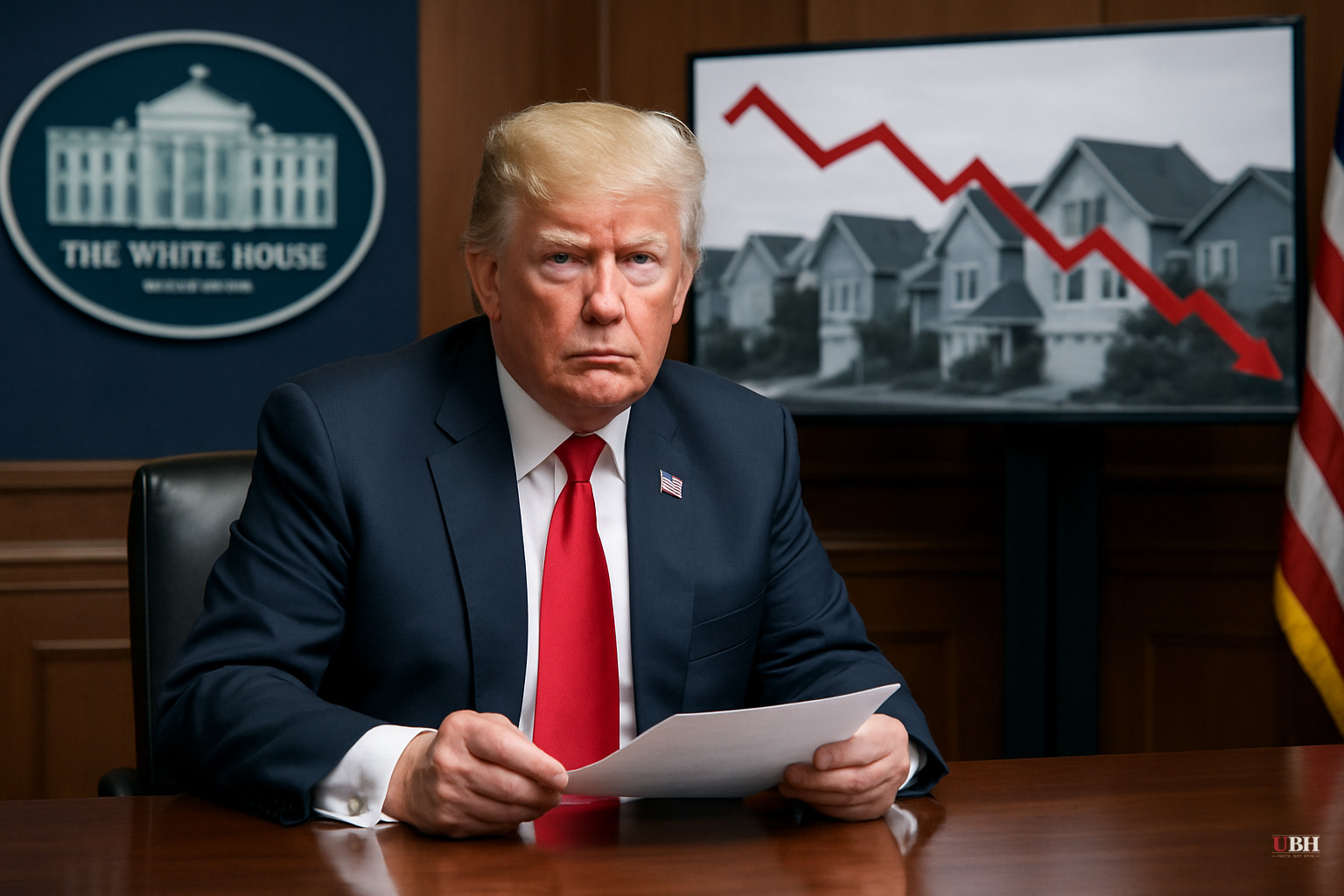
Since Congress approved the 21st Century ROAD to Housing Act earlier in June, the bill has sat in limbo, and the housing market data behind it has only grown more pointed.
Trump told reporters at the White House on June 29 that he has not decided whether to sign the legislation, describing it as a low priority compared to his preferred goal. "I think it's so unimportant compared to the Save America Act," Trump said. "To me, compared to the Save America Act, just about everything is a big yawn."
The Save America Act would require voters to prove U.S. citizenship to participate in federal elections. The House has passed it. The Senate has not, with Democrats opposing it on the grounds that eligible voters lacking certain documents would be disenfranchised.
What the Housing Bill Actually Does
The 21st Century ROAD to Housing Act targets three pressure points: permitting timelines, financial incentives for development, and mortgage access. It passed with bipartisan support from both parties.
House Speaker Mike Johnson told reporters over the weekend that the bill would be transmitted to Trump on Monday and that he was confident it would become law. Johnson framed it as a Republican priority for reducing housing costs and cutting regulation.
As of Monday, June 30, Trump said at the White House that the bill had not yet been sent to him. "It's coming, I understand," he said. "And then I'll make a decision." Under the Constitution, once he receives the bill, Trump has 10 days, excluding Sundays, to sign or veto it. If he does neither within that window, the bill becomes law automatically.
The Market Data He Is Dismissing
The S&P Case-Shiller index, published in late June and covering April data, shows home prices in the top 20 U.S. cities fell 0.04% month-over-month in April. That is the third consecutive monthly decline. Analysts had expected a 0.10% drop, so the miss was modest, but the direction is clear.
Year-over-year, prices edged up from +0.88% to +1.14% nationally. But with inflation running at 3.8% in April, according to the U.S. Bureau of Labor Statistics, home values have declined in real terms for eleven straight months.
"The affordability pinch remains a key headwind," said Nicholas Godec, Head of Fixed Income Tradables and Commodities at S&P Dow Jones Indices. Thirty-year mortgage rates climbed back to 6.3% in April after briefly dipping below 6% earlier in 2026.
The geographic split is stark. Chicago led the 20-city index with a 6.5% annual gain. New York followed at 3.8%, Cleveland at 3.2%. At the other end, Seattle fell 2.3% year-over-year. Denver, Tampa, Dallas, and Phoenix each dropped between 1.6% and 1.8%. Godec noted "nearly a 9 percent performance spread between Chicago and Seattle," a sign that "housing" is not one market but dozens.
The Strongest Case for Trump's Position
Trump has argued, including in a December 2025 speech, that affordability concerns are overstated and that prices are already coming down. He called affordability a "hoax" framing from political opponents. That view has some support. Nominal prices are flat to declining in many Sun Belt cities that saw the biggest pandemic-era runups, and some of that correction is a natural market reset. If the bill's permitting and incentive provisions take years to move the needle, holding it hostage to force a citizenship-verification vote is at least a coherent political play.
But the real-terms picture undercuts the "prices are fine" argument directly. Eleven consecutive months of inflation-adjusted declines means homeowners are losing purchasing-power value even when the nominal price holds steady. Buyers facing 6.3% mortgage rates on flat or falling wages are not experiencing the relief Trump describes.
What Happens Next
Johnson's confidence that the bill will become law may rest on the automatic-enactment provision: if Trump receives the bill and does nothing within the allotted window, it passes without his signature. Whether Trump lets that clock run or issues a formal veto to make a point about the Save America Act remains unclear. A veto would send the bill back to Congress, where a two-thirds override vote in both chambers would be required to enact it anyway. That threshold is far harder to reach than the simple majority that originally passed it.
Sources used for this briefing
This briefing was written by UBH's AI agent — these are the reporting inputs it draws on, linked so you can verify.


