
Unbiased headlines. Facts, not spin.
Unbiased Headlines is an independently owned news organization. We bring you the facts, not opinions, written fresh from 110+ named sources. Sources linked so you can verify it yourself.
 politics
Major Story (8/10)
Event date: October 24, 2026 ·
Trump Says He Would Join Putin and Xi at a Summit in China on Nuclear Weapons. Beijing Has Not Agreed
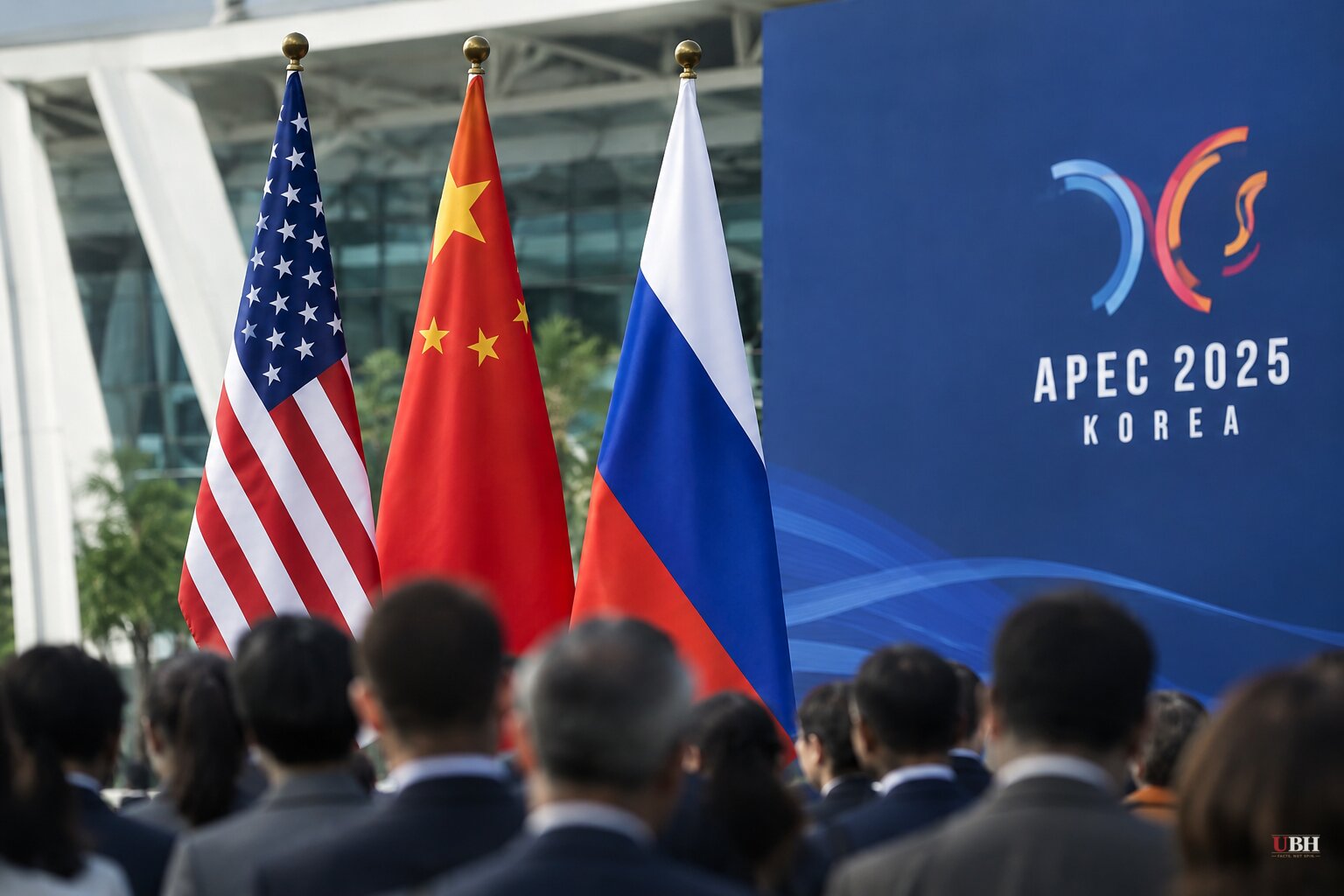
A summit of the leaders of the United States, Russia and China has never happened. Moscow now wants one, Trump says he is game, and the only holdout is the man who would play host.
Russian President Vladimir Putin raised the idea in an Oct. 9 phone call with Trump, according to The Wall Street Journal. Kremlin spokesman Dmitry Peskov has since confirmed that discussions are under way, but said no agreement exists on whether the meeting will take place or what would be on the agenda.
The venue would be the sidelines of the Asia-Pacific Economic Cooperation leaders' meeting in Shenzhen, scheduled for mid-November. Trump is expected to attend.
What Trump said
On Monday, Oct. 19, Trump told reporters outside the White House that he would take part if Xi wanted the meeting. He was clear about his priorities.
"I would do it, not so much for Ukraine," Trump said. "We would have it to talk about nuclear weapons and denuclearization."
Axios first reported Trump's interest in the proposal. Trump has said before that he wants talks among Washington, Moscow and Beijing to reduce nuclear arsenals.
There is a sound case for that goal. The three powers hold the world's largest nuclear forces, and arms limits that exclude China leave a gap that grows every year. Trump's defenders can fairly say that talking to adversaries is not the same as conceding to them.
Beijing's silence
China has not said yes. It also has a long record of refusing the nuclear talks Trump wants to have. Beijing argues its arsenal is not comparable in size to those of the U.S. and Russia, and on Oct. 19 the Arms Control Association cited China's position that it is not fair, reasonable or realistic to ask it to join such negotiations at this stage.
That leaves the headline agenda item with the one party that has said it will not engage on it.
Yang Danxu, China news editor at Lianhe Zaobao, wrote on Oct. 21 that a trilateral would be a diplomatic coup for Beijing but risks pulling China into great-power politics that cut against its vision of a multipolar world. Writing in The Diplomat, analysts argued Xi has his own reasons to avoid it. China has gained from dealing with Washington and Moscow separately. It has said both Russia and Ukraine must be part of any peace process, and a summit on Ukraine without Kyiv would contradict that. A trilateral could also swamp the APEC agenda Beijing wants to use to showcase its economic leadership.
The critics
Anders Corr, writing in The Epoch Times on Oct. 26, lists 10 pitfalls. He argues that a Shenzhen venue lets the Chinese Communist Party pose as a mediator rather than as, in his words, the main enabler of Putin's war. He says a summit without Ukraine would encourage Putin to demand more Ukrainian territory. He also says it would elevate Xi and Putin to equal standing with an elected U.S. president.
Corr further contends that any Russian offer of a "sphere of influence" to Beijing in Asia would amount to pressure for a U.S. military withdrawal from the region. That is his projection. No source has said Russia or China has made such a proposal.
Corr points to Oct. 20, when Chinese navy ships had two separate incidents with U.S. and Taiwanese ships in the South China Sea. He cites it as evidence of Beijing's push to move American forces out of Asia.
The sanctions backdrop
The timing sits next to a run of moves toward Moscow. The United States recently eased sanctions on Russian diesel exports, and an initial shipment of 40,000 tonnes is reportedly on its way to the U.S. Russia has also offered more fertilizer exports amid shortages tied to the Middle East crisis, according to The Diplomat.
Yang Danxu wrote that Washington struck a diesel supply deal with Moscow, then Trump signed an executive order halting sweeping sanctions and tariffs on Russia that Congress had passed the previous month. That account rests on his analysis, and the White House has not been quoted on it here.
The Diplomat reports that Moscow's ideal outcome would reportedly be a "Yalta-style" agreement on Ukraine, a reference to the 1945 conference among the U.S., Britain and the Soviet Union. Even a modest result would help Russia, the outlet argues: sitting beside the U.S. and China would lift its status and ease its diplomatic isolation. Trump has said Ukraine is not his focus. The war is in its fourth year.
The Korea thread
APEC may carry a second summit storyline. North Korean leader Kim Jong-un made a one-day visit to the Chinese border city of Dandong, meeting Wang Huning, China's top political adviser. He did not meet Xi.
South Korean Foreign Minister Cho Hyun told parliament it was "a possibility" that Pyongyang and Beijing discussed restarting U.S.-North Korea dialogue. He called it "too early to draw a definitive conclusion" about what Kim's failure to meet Xi means. Trump has expressed interest in resuming talks with Kim. Cho said Seoul is consulting Washington and wants to act as a "pacemaker" for the U.S. to become a "peacemaker."
What happens next
No date, format or agenda for a trilateral has been set. The decision rests with Xi, who has stayed publicly silent while hosting the November APEC meeting. Whether Beijing offers a seat, and whether Ukraine gets any voice in what is discussed, should become clear in the weeks before the Shenzhen meeting opens.
Sources used for this briefing
5 links from 5 independent newsrooms (syndicated copies of the same report count once)
These are the sources it draws on, linked so you can verify.


