
Unbiased headlines. Facts, not spin.
Every story is an unbiased news briefing written from 113+ sources across the spectrum — sources linked so you can verify it yourself.
 politics
Major Story (8/10)
Event date: September 15, 2026
politics
Major Story (8/10)
Event date: September 15, 2026
Trump Now Calls a DC Arch, the White House Ballroom, an AI Force, and a Union Ban All 'National Security'
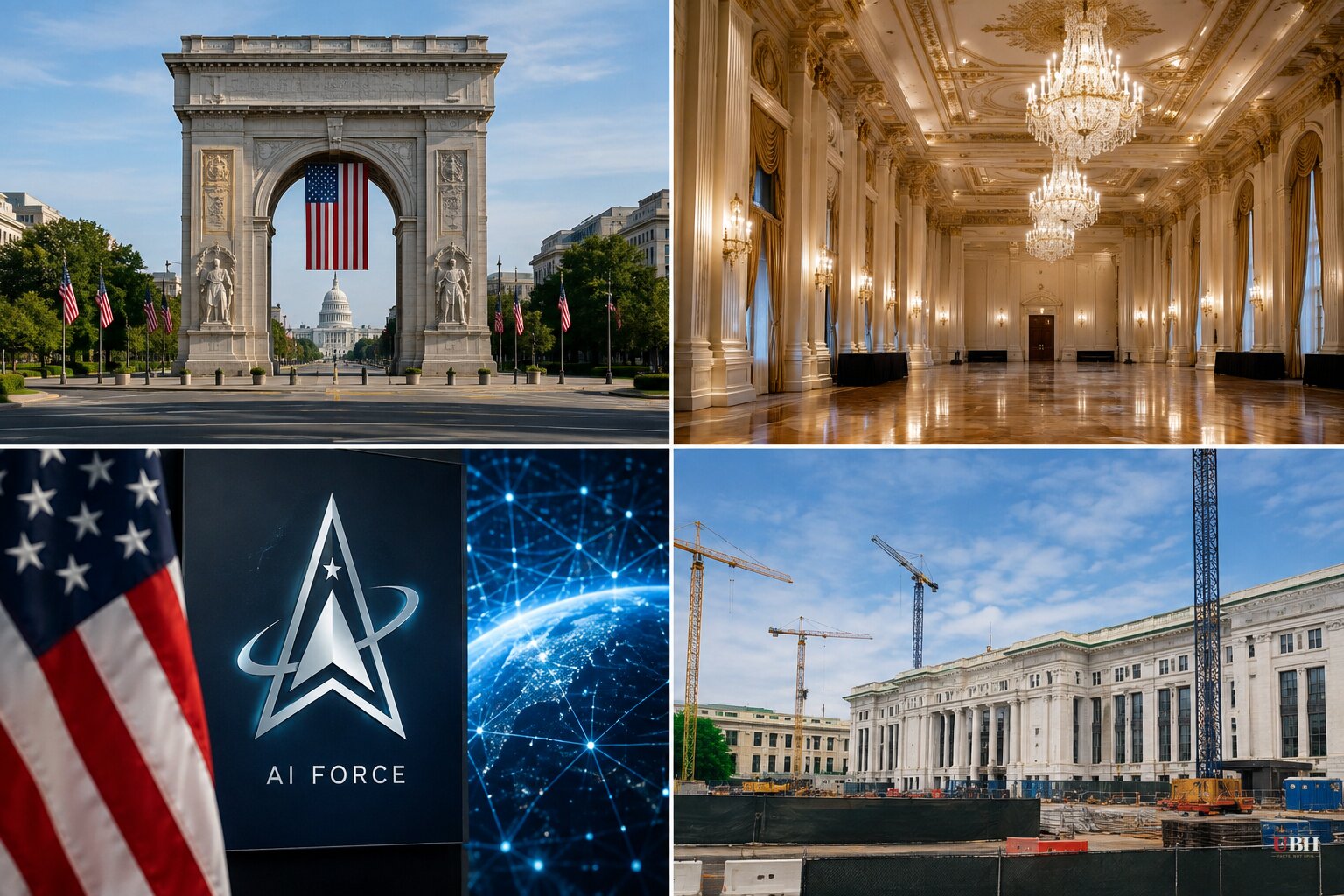
President Trump announced Sunday on Truth Social that his planned 250-foot "triumphal arch" near the Virginia end of Arlington Memorial Bridge won't just be a monument. It will house drone storage, ammunition, and snipers "on both the roof and plaza areas," according to TIME. Trump said the changes came "at the strong request of the United States Military" and were made "for National Security purposes." He gave no revised mockup, no specifics on troop numbers, and no explanation of what threat the arch is meant to defend against. The White House has not responded to TIME's request for comment.
The arch was originally unveiled in the Oval Office on October 15, 2025, as a commemoration of America's 250th anniversary. It's now the second Trump construction project reclassified as a military asset mid-build.
The White House ballroom, a $400 million project Trump initially described as a venue for state dinners, ran into a court order in March that halted construction absent congressional authorization, with an exception carved out for work necessary to White House safety and security, TIME reported. The administration's response was to argue the ballroom and an underground facility beneath it form one "massive" integrated military complex, and that the security exception therefore covers the whole project. A judge's carve-out for security work became, in the administration's filings, a rationale for continuing everything.
The Pattern Widens
On September 21, Trump announced plans for an AI Force, modeled on the Space Force he created in his first term, along with an AI czar to be named later, according to Broadband Breakfast. No organizational chart, budget, or legal authority has been released. The move follows a June executive order pushing federal agencies toward AI-enabled cybersecurity tools and a national security memorandum directing agencies to build high-security computing facilities for advanced AI systems.
The same legal reasoning has already reshaped federal labor law. Executive Order 14251, signed March 27, 2025, declared that a long list of agencies and subdivisions perform intelligence, counterintelligence, investigative, or national security work, and therefore fall outside federal collective-bargaining law. AFSCME says the order stripped bargaining rights from roughly 950,000 workers across six unions, including staff at the Department of Veterans Affairs, the EPA, the Food Safety and Inspection Service, and most of the Treasury Department, according to DM News. The order reclassified agencies, not individual jobs, meaning employees doing ordinary civilian work lost bargaining protections without their actual duties changing.
Medical research funding is the newest front. Following a contentious meeting last Friday, the White House began drafting an executive order to create an external committee overseeing NIH grants and blocking funding to universities the administration says aren't complying with its agenda, The New York Times reported, as covered by The New Republic. OMB Director Russell Vought reportedly clashed with NIH Director Jay Bhattacharya, accusing him of funding projects that conflict with the administration's push to eliminate DEI programs. Courts have already pushed back twice: a federal judge ruled in June 2025 that the administration's $1.81 billion cut to DEI-related grants was illegal racial discrimination, and another judge later blocked a $2 billion funding freeze targeting Harvard.
Other invocations, cataloged by Mother Jones reporter Sophie Hurwitz, include renewed pressure to annex Greenland at July's NATO summit, framed as vital to the "Golden Dome" missile defense system; a September 2025 designation of Antifa as a domestic terrorist organization followed three days later by a memorandum directing Joint Terrorism Task Forces to investigate political violence; and Interior Secretary Doug Burgum's claim, based on a classified Pentagon report he has not detailed, that offshore wind turbines threaten national security.
What's Actually Defensible Here
Some of this is not new or uniquely partisan. Presidents of both parties have stretched national security rationales for trade and labor decisions for decades, and courts have historically given the executive branch wide latitude on genuine military and intelligence matters. An underground security facility beneath the White House, or drone and sniper positions tied to protective operations, are the kind of thing the Secret Service and military legitimately plan for regardless of who's president. Treating AI infrastructure as a national security priority also tracks with a real, bipartisan concern about competing with China on computing power.
The harder cases are the ones where the security rationale isn't explained at all. Burgum has cited a classified report on offshore wind without describing its contents. Trump's arch post asserts a military request without naming which branch made it or what mission it serves. Sipher, a former CIA officer who spent nearly three decades tracking Russia, told NPR that the intelligence community adapted successfully after 9/11 by building new capabilities rather than dismantling oversight. Author Tim Weiner, writing about the CIA's post-9/11 evolution, told NPR the current shake-up amounts to tearing down that architecture without a clear replacement.
None of the four pending pieces are finished. The AI czar hasn't been named. The NIH executive order hasn't been signed. No revised arch design has been made public. And the ballroom litigation, last addressed by a court in March, remains an open legal question about how far a security exception can stretch before it swallows the rule it was carved out of.
Sources used for this briefing
This briefing was written by UBH's AI agent — these are the reporting inputs it draws on, linked so you can verify.


